
Published 11.06.22
Mastering Sustainability with AI: From Data to Product Impact
On March 31st, 2026, Makersite and Siemens co-hosted a GreenBuzz Masterclass at Siemens’ Zurich headquarters, The Dome, bringing together over 40 sustainability, engineering, procurement, and digitalization professionals to work through one of the most pressing questions in industrial sustainability right now: how do you move from portfolio-level ambition to product-level action at scale, and what does AI actually contribute to that?
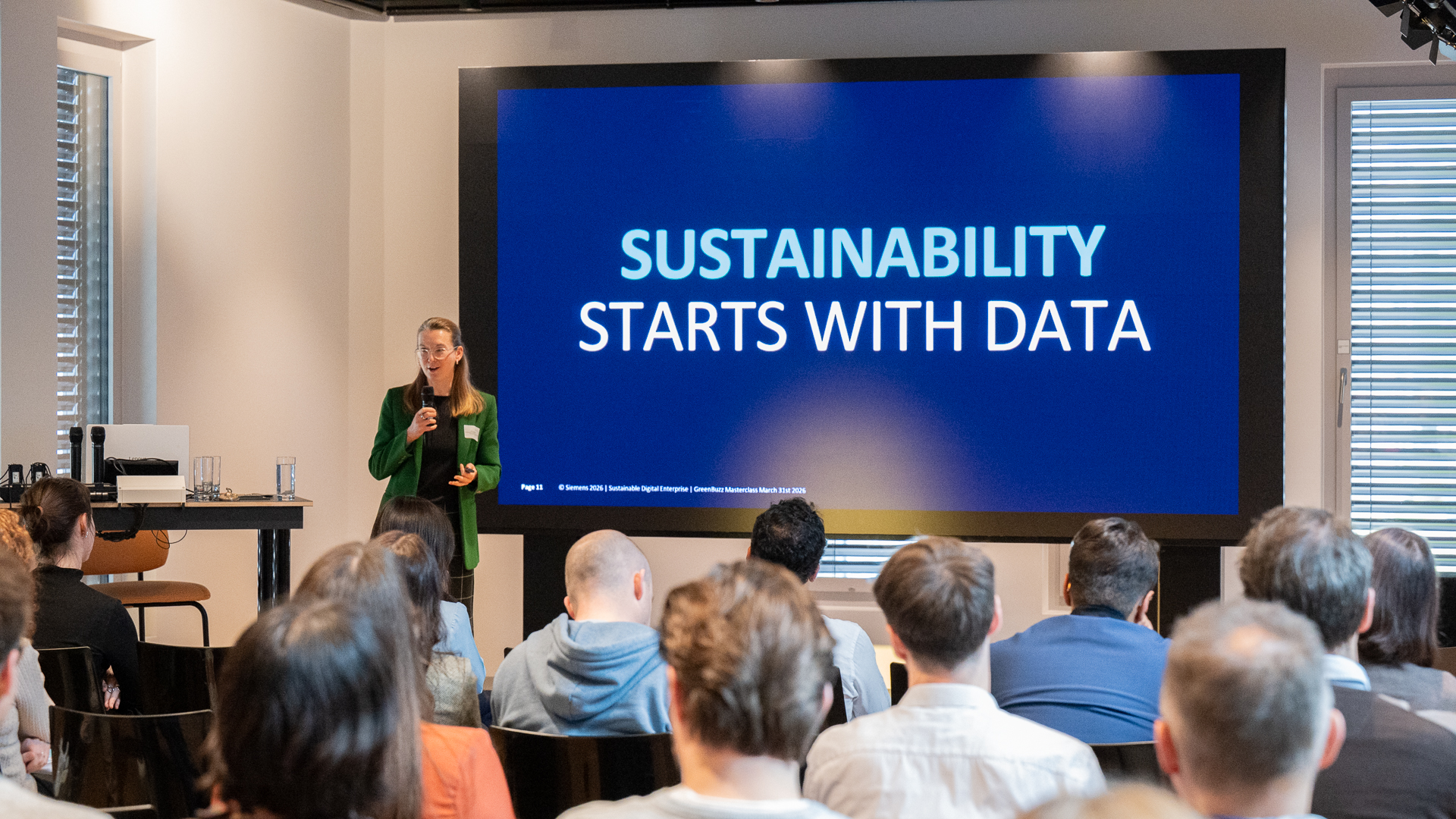
The session was led by Pina Schlombs, Sustainability Lead and Senior Thought Leader on Industrial AI at Siemens Digital Industries Software, and Maryam Bahrami, Global Partnerships & Alliances Director at Makersite. Pina brought a practitioner’s perspective from inside one of the world’s most complex manufacturing organizations. Maryam brought the product intelligence view from Makersite’s work, helping industrial companies close the gap between sustainability strategy and what engineers actually decide at their desks.
The audience was a mix of ESG, sustainability, procurement, and consulting professionals from organizations including Deloitte, EY, PwC, ABB, Sulzer, Google Switzerland, ETH Zurich, WBCSD, Siemens, and Makersite.
The Structural Problem: Strategy and Engineering Still Operate in Isolation
Most organizations have sustainability goals set at the portfolio level by leadership, while the hundreds of material and supplier decisions that actually determine environmental outcomes are made at the component level by engineers, and there is no live mechanism connecting the two. This is not a communication failure. It is a data architecture failure.
Portfolio-level targets for carbon footprint, regulatory compliance, and ecodesign are established at the board level. Meanwhile, engineers making daily decisions about materials, suppliers, and component specifications have limited to no visibility into how those decisions aggregate against those targets. Reporting outputs are disconnected from engineering workflows. Misalignment only surfaces when products are near launch, when change is expensive, and design leverage is at its lowest.
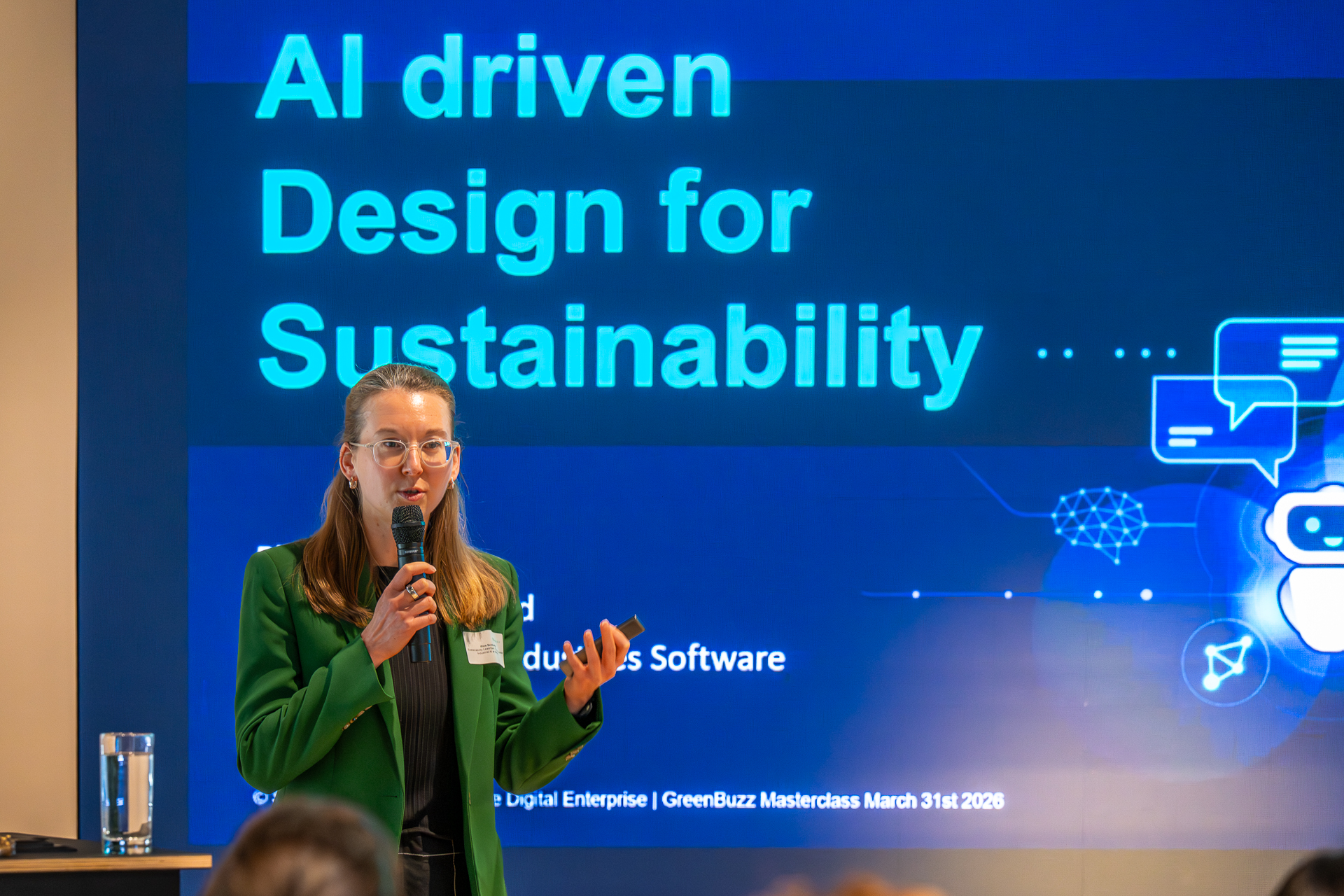
Pina’s slide put it plainly: “Individually sound decisions. Collectively misaligned outcomes.” Ecodesign cannot scale as an isolated sustainability function. It has to be embedded in the engineering workflow itself, with sustainability, cost, compliance, and supply chain risk visible at the point of design, not reported after the fact.
Why 80% of Sustainability Impact Is Determined Before Manufacturing Starts
The European Commission’s proposal for ecodesign requirements for energy-using products makes a well-established claim that is still underestimated in practice: 80% of a product’s environmental impact is determined during its design phase.
The practical implication is that sustainability teams focused on manufacturing efficiency, logistics, or end-of-life optimization are optimizing the wrong part of the problem. The decisive interventions are upstream, in material selection, component architecture, supplier choice, and design configuration, all of which happen in engineering systems before a product ever reaches a factory floor.
That is the core argument for why AI-driven ecodesign is not an extension of sustainability reporting. It is a prerequisite for actually moving the needle on Scope 3, LCA, and EPD at scale. And it requires sustainability intelligence to be embedded in the tools engineers already use, PLM, CAD, ERP, not maintained in parallel systems that no one consults during design.
The Three Structural Barriers to Scaling Ecodesign
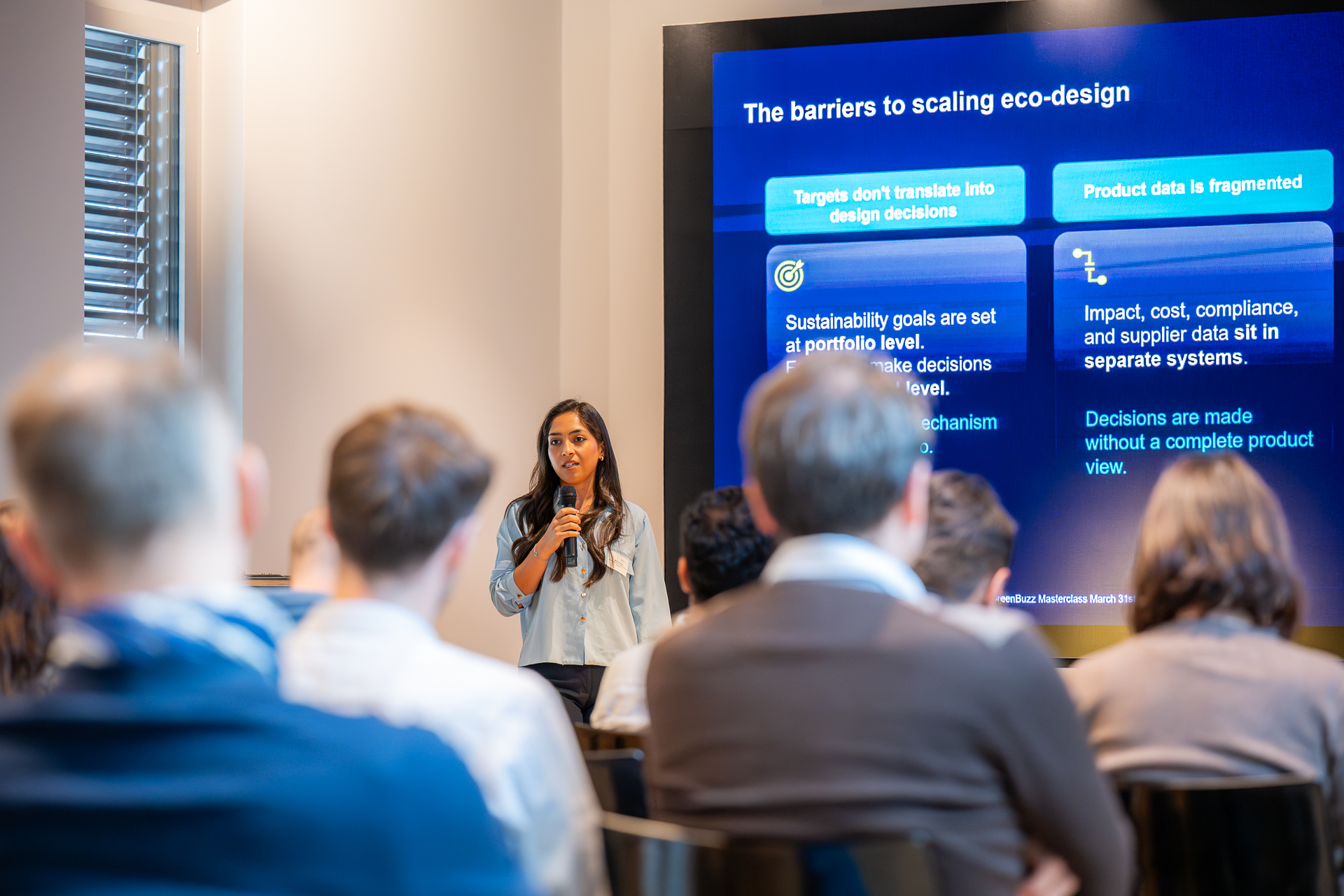
As the barriers to ecodesign at scale were mapped with a precision, the practitioners in the room recognized all the bottlenecks right away. They fall into three interconnected categories.
- Targets don’t translate into design decisions. Sustainability goals are set at portfolio level. Engineers make decisions at component level. There is no live mechanism connecting the two. A sustainability manager publishing a carbon reduction target has no direct line to the engineer selecting a PCB substrate or a housing material three levels down the BOM.
- Product data is fragmented. Impact, cost, compliance, and supplier data sit in separate systems. Decisions are made without a complete product view. LCA data lives in one tool. Compliance watchlist data lives in another. Supplier declarations sit in spreadsheets. When these inputs are never unified at the product model level, the analysis simply never runs.
- Feedback cycles are too long and misdirected. Insights arrive too late in the design cycle. Teams optimize the wrong levers, or discover problems when change is expensive. A sustainability review at the pre-launch stage does not prevent impact. It just documents it.
Each of these barriers is a data and systems problem, not a knowledge or motivation problem. The people in the room understand the stakes. What they lack is infrastructure that connects sustainability intelligence to design decisions in real time.
What the Makersite x Siemens Integration Actually Solves
Makersite’s platform works as a shared product intelligence layer between engineering systems and sustainability analysis. BOM data flows from Siemens’ engineering environment, PLM, CAD, Teamcenter, into Makersite, where it is enriched with material intelligence, sustainability impact data, compliance status, and supply chain risk signals drawn from 150+ supply chain databases. The enriched product model flows back into engineering decisions.
The result is that every material and supplier decision can be evaluated against portfolio sustainability targets in real time, during design, not after it. Cost, performance, and sustainability trade-offs become visible when engineers are actually making choices, not weeks later when a sustainability team runs a retrospective analysis.
For leadership and sustainability teams, this means live progress against portfolio and science-based targets, visibility into which product families and components drive the greatest impact, and the ability to translate strategic goals into measurable design constraints within the product model itself. For engineering and procurement teams, portfolio impact updates automatically as designs change. Trade-offs get resolved early in the development cycle. Supplier decisions can be weighed against sustainability impact rationale, not just cost.
Maryam described this transition as moving from “manual sustainability,” where analysis is handled offline, fragmented, and reported retrospectively, through “connected intelligence,” where BOM data begins to flow between engineering and analysis systems, to “automated ecodesign,” where sustainability is optimized during design, continuously, as an integrated design parameter rather than a downstream check.
That final state is achievable.
The organizations making real progress have structured their engineering and sustainability systems around a unified product data layer. Those that have not are still generating retrospective LCAs and struggling to demonstrate product-level emissions performance to customers and regulators.
AI’s Role: Enabler, Not Oracle
One of the most important takeaways: AI is not the solution. It is the enabler of scale. The real value of AI in this context comes down to three things.
- Bridging data gaps at the design stage. In early-phase product development, actual material and supplier data is not yet available. A well-trained AI and ML models, based on previous generations of a product or similar products, can generate data for missing inputs, substance properties, process emissions, supply chain characteristics, so that sustainability analysis can run before the design is finalized, so even every product designer can access and leverage relevant historic data at very early design phases. As the design matures, AI-generated estimates improve in accuracy by actual product specifications. The critical technical requirement here is that AI-generated data must be highly granular and accurate, so that early decisions reliably translate into real-world outcomes. Aggregate estimates or generic proxies do not meet that bar.
- Automating calculations that are too complex for manual approaches. A single complex product can involve hundreds of materials, thousands of substance-level interactions, and supply chain relationships spanning dozens of tiers. Running a full LCA or PCF at the configuration level, across a product portfolio, on a continuous basis as designs evolve is not a human-scale task. AI makes it tractable.
- Translating data into actionable decisions. The output that matters is not a report. It is a design recommendation: this material substitution reduces the product carbon footprint by X%, brings the assembly into REACH compliance, and costs Y more per unit. That decision-level output requires AI to synthesize cost, sustainability, compliance, and supply chain data simultaneously, which cannot be done from disconnected systems.
What AI cannot do is substitute for the underlying data quality. This point was central to the masterclass, and it is consistent with what Makersite sees across enterprise customers. More data is not automatically better data. Quality, structure, and accessibility are the actual constraints. An AI model running on fragmented, unstructured, or unvalidated product data will generate confident sounding but unreliable outputs.
The foundation must be right first.
The Business Case: How to Frame It Across Stakeholders
The business case for ecodesign doesn’t stall because it lacks merit. It stalls because it’s presented as a single narrative to stakeholders who evaluate it through entirely different lenses.
-
- For the C-suite, the relevant frame is cost, risk, and growth: protecting revenue through market access and regulatory compliance, reducing COGS through material cost reduction and dematerialization, and accelerating growth through faster time to market and stronger product differentiation. The regulatory and commercial cost of inaction is rarely quantified, and that absence of hard numbers is itself a barrier to urgency.
-
- For engineering and procurement leaders, the frame is decision quality and workflow efficiency: clear design priorities backed by live impact data, fewer late-stage surprises, faster iterations. The value is in reducing rework and compressing the concept-to-execution cycle.
-
- For sustainability teams, the shift is from retrospective reporting to proactive input at the design stage. Sustainability insights that are there when they can still influence decisions, not bolted on at launch.
-
- For marketing and communications, the value is defensible claims. Sustainability narratives aligned to real, auditable environmental performance data that hold up to scrutiny in enterprise tenders, regulatory filings, and public reporting.
The resistance map laid out was really useful. On the business side, change management overhead, tool overload, supply chain complexity introduced by new data requirements, and the underestimated cost of inaction. On the technical side, a workflow disruption to established engineering cycles, low confidence in data that feels abstract, and the frustration of having portfolio visibility without clear design-level agency.
Knowing where resistance will come from, and having specific, evidenced answers for each objection, is what separates ecodesign programs that gain organizational traction from those that stay confined to the sustainability team.
Key Takeaways
-
- From ambition to product-level decisions. AI enables teams to move from high-level sustainability goals to concrete product-level decisions, LCA, carbon footprint, compliance status, at the component and configuration level. The portfolio-to-product translation is the central technical challenge, and it requires unified product data infrastructure.
-
- AI as an enabler, not the solution. The real value of AI is in simplifying complexity, automating calculations, and translating data into actionable design insights, freeing engineering and sustainability capacity for judgment calls that machines cannot make. AI is not a replacement for methodological expertise or domain knowledge.
-
- Data is the bottleneck. More data is not better data. Quality, structure, and accessibility are the real constraints and directly determine what AI can produce. Organizations that invest in data quality before deploying AI generate defensible outputs. Organizations that skip this step generate faster noise.
-
- Progress over perfection. Waiting for complete, perfect data before beginning ecodesign analysis delays real impact. Informed decisions made with structured but incomplete data already create value, particularly in early-stage LCA and design exploration, where directional guidance is more useful than post-hoc precision.
-
- Ecodesign needs integration, not isolation. Scaling ecodesign requires embedding it across engineering, procurement, sustainability, and finance functions, with top-down alignment from leadership and bottom-up empowerment of engineers. A sustainability team running ecodesign in a silo cannot move at the speed or scale the problem requires.
- Sustainability is a competitive parameter, not just a constraint. Organizations that treat sustainability as a design input alongside cost, performance, and quality open up product innovation, differentiation, and market access that compliance-driven approaches miss entirely. The companies building this capability now will have a structural advantage in regulated markets and enterprise procurement within the next three to five years.
The Digitalization-Sustainability Loop
Why this is not just a sustainability technology story? Digitalization empowers sustainability, and sustainability drives digitalization. They are not sequential. They are mutually reinforcing.
The organizations that will meet their science-based targets and remain competitive in increasingly regulated industrial markets are the ones building the product intelligence infrastructure now. Not because regulators require it yet in every jurisdiction, but because the alternative, continued misalignment between strategic sustainability commitments and the engineering decisions that actually determine product impact, is not a viable operating model for the next decade.
What Organizations Can Do Now
If your organization is facing the structural challenges above, targets that do not reach engineering, fragmented product data, sustainability analysis that arrives too late; the path forward is not a single technology deployment. It is a sequenced build.
-
- Start with the data foundation. Map what product and supply chain data you have, where it lives, and where the highest-impact gaps are. Identify which product families and material categories drive the greatest sustainability risk and opportunity. This scoping work shapes everything that follows.
-
- Connect engineering and sustainability systems. BOM data needs to flow into sustainability analysis in real time, not through periodic manual exports. This integration is the prerequisite for moving from retrospective reporting to design-stage intelligence.
-
- Define methodology before scaling AI. LCA system boundaries, allocation approaches, and error margin conventions must be agreed across sustainability, engineering, and commercial teams before AI-generated outputs are used for external disclosure or internal design decisions. Methodology alignment is not detail. It is the foundation of credibility.
-
- Build for reuse. Component-level sustainability models validated once and reused across product families are the architecture that makes scale tractable. Product-by-product manual LCAs are not.
-
- Engage suppliers structurally. Scope 3 and full lifecycle analysis require primary data from suppliers. That means building supplier data collection processes, full material declarations, process data, emissions factors, into procurement workflows, not treating it as a one-time data collection exercise.
The Makersite and Siemens partnership exists to make this path shorter. For organizations using Siemens’ engineering environment, the integration with Makersite’s product lifecycle intelligence platform provides the shared data layer that connects design decisions to sustainability outcomes, without replacing engineering workflows or requiring sustainability expertise to be embedded in every engineering team.
Makersite participated in the GreenBuzz Masterclass: AI & Sustainability with Siemens at The Dome, Zurich, on March 31st, 2026. The session was part of Makersite’s ongoing program of practitioner-focused events on product lifecycle intelligence, AI-driven ecodesign, and sustainable product development.
Interested in how Makersite and Siemens can support your product portfolio in ecodesign and product sustainability?