Inside many manufacturers, two areas of investment are moving in different directions.
AI investment is growing. Sustainability and product-data work is facing greater pressure to demonstrate its value. These may look like separate conversations. In practice, they depend on much of the same data.
The product, supplier, material and lifecycle information collected for LCA, product carbon footprints and compliance is also part of the foundation AI needs to support credible product decisions.
When that data is fragmented, AI can produce answers quickly without the full product context. When it is connected and traceable, the same foundation can support decisions across product development, compliance, cost, sustainability and supply-chain risk.
What has your sustainability team already built?
Producing an LCA, product carbon footprint, compliance assessment or carbon report requires more than running a calculation.
Sustainability and product stewardship teams may already:
Map products to components and materials
Collect information from suppliers
Bring together data from PLM, ERP and procurement systems
Reconcile records that do not agree
Identify gaps in product and supplier information
Document calculation methods and assumptions
Check whether results can be traced and defended
Repeat analyses across multiple products
These capabilities are not the whole of AI readiness. AI programs also need appropriate technology, governance, security and ownership. But they are part of the data work AI depends on.
This does not mean relabelling every sustainability project as an AI initiative. It means examining the data foundation already being built before treating AI readiness as a separate program.
Why does AI need connected product data?
AI works with the information it can access. In manufacturing, the full product picture rarely sits in one place.
Product structures may sit in PLM. Supplier information may be held in procurement tools and spreadsheets. Cost data may sit in ERP. Material and lifecycle information may be managed by sustainability or product stewardship teams.
Each source contains part of the answer. None necessarily contains the whole.When those sources remain disconnected, AI cannot see a complete and consistent product view.
Common problems include:
Different systems describing the same product in different ways
Incomplete supplier and purchased-part information
Materials recorded at inconsistent levels of detail
Teams working from different assumptions or baselines
Data being reconciled manually for each analysis
Outputs that cannot be traced back to their sources
AI can analyse an individual source quickly and still produce an incomplete answer.
Speed cuts both ways. Better data allows AI to analyse more information across more products. Weak data allows it to reproduce incomplete or inconsistent results at the same scale.
Much of the work that makes AI useful happens underneath the interface. It involves connecting systems, resolving conflicting records, filling gaps and creating product models that can be used more than once.
How do you know if your product data is ready to support AI?
These five questions offer a useful starting point:
Does sustainability data sit across several systems without a consistent product view?
Is it difficult to obtain consistent, verifiable information from suppliers?
Does the team spend more time preparing data than analysing it?
Can LCA and product carbon footprint results be traced and defended?
Does every reporting cycle require much of the same data work to be repeated?
If several sound familiar, the organisation may need to strengthen its product-data foundation before scaling AI-supported analysis.
This is not a formal maturity score. It is a way to identify where the immediate limitation may sit. The problem may not be whether the AI model can perform the task. It may be whether the information provided to the model is complete and reliable enough to support the result.
What can connected product data make possible?
Supplier data provides one practical example. When Microsoft developed a new LCA methodology with Makersite, the share of its total product carbon footprint calculated using suppliers’ primary data rose from an average of 20% to over 70%.
The approach also reduced modelling time and inconsistencies associated with practitioner decisions.
The value was not simply a faster final calculation. Microsoft created a more representative product model based on deeper supplier and material information.
Connecting PLM, ERP, supplier and sustainability data can also bring environmental and compliance information into the design stage, before key product decisions are fixed.
A shared product-data foundation can help teams explore questions such as:
Which material options could reduce environmental impact
Which substances create compliance exposure?
Where are the main product-cost drivers?
Which suppliers or materials introduce supply-chain risk?
How could a material substitution affect cost, compliance and environmental impact?
Which products in the portfolio should be reviewed first?
These questions span product development, procurement, compliance, sustainability and finance. The same underlying information can support several teams, even when each team is asking a different question.
Why does reuse matter?
Product and supplier data becomes more valuable when it can support more than one analysis. A product model containing component, material and supplier information may contribute to:
Lifecycle assessment
Product carbon footprints
Compliance analysis
Material substitution
Product costing
Supply-chain risk analysis
Portfolio screening
The value is not limited to the first calculation the data was collected to complete. A reusable foundation allows different teams to examine different questions without rebuilding the underlying product picture each time.
It can also reduce the risk of teams reaching different conclusions because they are working from different product records, supplier information or assumptions.
How can sustainability teams broaden the business case?
Adding the word “AI” to an existing sustainability project is unlikely to make the case stronger on its own. A more credible approach is to show how the underlying data work supports decisions across the organisation:
Identify who needs the same data
Sustainability, product development, procurement, compliance and finance may depend on overlapping product and supplier records. Making that overlap visible can help position the work as shared product-data infrastructure rather than an isolated sustainability project.
Connect the data to specific decisions
The value becomes clearer when the business case explains what teams will be able to assess or decide.
For example:
-Compare material alternatives
-Identify compliance exposure earlier
-Understand product-cost drivers
-Review supplier and material risks
-Evaluate environmental impact during design
-Prioritise products for further analysis
This is more specific than saying that a project will simply “enable AI.”
Show the work underneath the output
The report, dashboard or AI response is the visible result. Producing a trustworthy result may require teams to:
-Connect data across systems
-Resolve inconsistent records
-Fill product, supplier and material gaps
-Document assumptions
-Build reusable product models
-Apply consistent calculation methods
Making this work visible helps explain why credible AI requires more than selecting a model or adding a new interface.
Show what can be reused
A product model developed for sustainability analysis may also support compliance, costing or supply-chain risk. Showing that reuse gives the investment a broader organisational case.
It does not guarantee access to AI funding. Budgets and ownership will differ between companies. But it can create a more relevant conversation with the teams responsible for data, product development and AI priorities.
Does regulatory uncertainty change the case?
Regulation has given many manufacturers a clear reason to invest in sustainability and product data. When requirements or timelines become uncertain, the immediate compliance argument can become harder to defend.
That does not resolve the underlying data problem. Manufacturers still need reliable product, material and supplier information to assess sustainability, compliance, cost and supply-chain risk.
The same foundation is also needed if AI is expected to support those decisions. The reason for investing may shift. The underlying data need does not.
Two questions AI pilots need to answer
AI pilots often combine two separate questions:
Can the technology perform the task?
Is the organisation’s data ready to support the task?
A polished demonstration may answer the first question, but it does not show whether the underlying data is complete, traceable and reusable enough to answer the second.
A useful pilot can also test whether the data is:
Complete enough for the intended decision
Traceable to a source
Consistent across products
Repeatable without extensive manual work
Suitable for use beyond a small demonstration
This helps distinguish between a promising interface and a process the business can trust and use at scale.
The business case is broader than one function
Sustainability data and AI investment should not be treated as unrelated conversations.
Product structures, material intelligence, supplier data and lifecycle insights are already part of the information foundation AI needs to support manufacturing decisions.
The question is not only whether AI can perform a task. It is whether the underlying product and supply-chain data is connected, traceable and reusable enough to support decisions the business can trust. That foundation is what makes both sustainability and AI investment worthwhile.
The questions come up fast now. Can AI speed up LCA? Help with PCFs, Scope 3, compliance, costing, or supplier data?
Those are fair questions. But a better first question is simpler: which product data can already support an answer your business can trust?
No manufacturer starts with perfect data. Product structures may be incomplete. Supplier inputs may be missing. Material data may sit in another system. Methodology may live in spreadsheets or expert memory.
That does not mean AI has no role to play. It means teams need to know where the data is strong enough to use, where it needs review, and where the gaps need a governed way to be filled.
In short: product data is ready for AI when it is structured enough to support decisions that can be repeated, traced, reviewed, and defended.
AI readiness is not a prompt problem
A better prompt will not repair scattered PLM and ERP data. It will not explain why one emissions factor should be used over another. It will not connect a material to the right component if that relationship is missing. And it will not create an audit trail where none exists. That is why AI readiness is really a product data problem.
In many manufacturer conversations we’ve had recently, the pattern is consistent. Teams know what they need to do — calculate emissions, build PCFs, check compliance, answer customer requests. The harder part is making those processes repeatable.
Too much of the work still depends on manual collection, expert judgment, disconnected systems, and repeated cleanup. That can work for one product, one report, or one deadline. It does not become a reusable operating model.
AI becomes more useful when the same product data, assumptions, and review history can be reused rather than rebuilt for every request.
Four things to look at first
These are not signs of failure, they are merely starting points. Use them to understand where your data is strong enough to begin, where it needs review, and where the process needs work first:
1. Look at where your product data lives
Product data rarely lives in one place. For example, PLM may hold the product structure. ERP may hold cost or sourcing data. Procurement may hold supplier records. Sustainability teams may keep separate calculation files. Compliance teams may work from certificates, substance declarations, and supplier documents.
The first step is not to fix every system at once. It is to map which systems hold the data needed for the workflow you care about.
For example, a PCF workflow needs product structure, material data, supplier input, process assumptions, datasets, and methodology. If those relationships are unclear, AI is working from fragments. If they are mapped, even partially, teams can see where to start.
2. Look at which supplier data can be trusted
Supplier data is often the first visible blocker. Manufacturers may be missing weight data, material composition, process details, supplier-specific emissions factors, or evidence behind supplier claims. When data does arrive, it may come in different formats, follow different assumptions, or lack enough context to trust.
That does not mean supplier data needs to be perfect before teams can start. It means teams need to know which inputs are primary, which are estimated, which need expert review, and which assumptions must stay attached to the result.
AI can help teams move faster through structured information. It cannot turn weak supplier data into reliable input by itself. The useful work is separating what can be used confidently from what needs review or enrichment.
3. Look at which steps are still rebuilt by hand
Spreadsheets are usually the symptom, not the problem. Teams use them because data does not move cleanly between systems. They collect files, clean tables, compare versions, fill gaps, and rebuild calculations every time a new request comes in.That is manageable for an isolated project. It breaks down at portfolio scale.
The useful question is: which parts of the workflow are repeated often enough to standardize?
If teams keep rebuilding the same product structure, assumptions, review steps, or data mappings, that is a good place to start. Capturing those pieces makes the next cycle easier and gives AI-supported workflows something stable to build on.
4. Look at which outputs need to be defended
Manufacturers do not only need answers – they need answers they can explain.
A PCF result needs source data, assumptions, allocation logic, methodology, and traceability. A compliance result needs evidence behind the material, substance, supplier, regulation, and product variant. A Scope 3 calculation needs a clear link between activity data, emissions factors, and method.
For AI-supported workflows, the method matters as much as the answer. The practical question is not only “can AI produce this?” It is: what would someone need to review before they trusted it?
That review path should be visible from the start.
What AI-ready product data looks like
AI does not just need more data. It needs the right relationships between data: which material belongs to which component, which supplier provided which input, which dataset and methodology apply, and which assumptions were made.
Without that context, a PCF is just a carbon number with no lineage. A compliance result becomes a pass/fail answer no one can substantiate. A costing decision becomes a price estimate detached from its sourcing assumptions.
With that context, each becomes a result the business can trace and repeat.
AI-ready data does not mean perfect data. It means data structured well enough to support repeatable, traceable, defensible decisions. In practice, that means it is:
-connected to product structure
-traceable to source
-current enough to use
-enriched where internal data is missing
-governed by clear methodology
-reusable across LCA, PCF, Scope 3, compliance, costing, and product development
– reviewable by experts
The last point matters: AI should not replace expert review. It should make review faster and more consistent by giving teams structured input, surfacing gaps, and keeping the method attached to the result. AI should not replace expert review. For example, Makersite’s Chem AI can help make chemical data reviews faster and more consistent by turning incomplete inputs into structured, traceable models, surfacing gaps for expert review, and keeping the methodology attached to the result.
Internal company data is essential but rarely enough on its own. Manufacturers also need external datasets and governed gap-filling where internal data falls short, with assumptions recorded and dataset lineage kept visible.
That is what separates a one-off answer from a system the business can use again.
How to start with the data you have
Getting product data ready for AI does not mean waiting for a perfect data estate. A better starting point is to choose one workflow where the business already feels the pain and where enough data exists to make progress.
That could be a recurring customer PCF request. A product family with repeated LCA work. A compliance workflow where supplier evidence is hard to track.
Start there. Map the data needed for that workflow. Identify what already exists. Mark what is missing. Separate trusted inputs from estimates. Attach assumptions to the result. Decide where expert review is needed.
This gives teams a practical path from scattered data to a repeatable process. It also gives AI a clearer role: not producing unsupported answers, but helping teams work faster from structured inputs, visible gaps, and traceable methods.
The goal is trusted decisions
The companies that get value from AI will not be the ones with the most data. They will be the ones with product data structured well enough for AI, experts, and business teams to work from the same foundation.
That is where Makersite fits in, because Makersite helps manufacturers build that structured product data foundation, connecting product, supplier, environmental, cost, and compliance data so teams can evaluate decisions across the product lifecycle from the same model.
It supports expert judgment and makes well-grounded decisions easier to reach.
So before asking what AI can automate, start with one practical test: can your product data support a decision your team needs to repeat, trace, review, and explain? If it can, start there. If it cannot, identify which part of the foundation needs work first.
“The trend of AI has been unavoidable, and seeing the proliferation of AI being used so effectively to help solve really hard problems for the good of society and the planet has been pretty eye opening.”
Recently, Makersite sat down for a wide-ranging conversation with James Norman and Dave Duncan from PTC. James is Director at their Global PLM Center of Excellence, and Dave is Vice President of Sustainability.
Makersite and PTC have a well-established relationship, but they’re also one of the most advanced and proactive organizations in the world when it comes to following through on sustainability best practices. Indeed, as their website states, “We don’t just imagine a more sustainable world—we help create it.”
Both Dave and James have fascinating backgrounds, and both took a slightly circuitous path into their sustainability careers. However, the learnings they were able to take from other positions in other industries – and in different cultures entirely – shaped the way they approach sustainability today.
Among many other topics, we discuss:
The proliferation of AI and its impact on how businesses can approach sustainable practices
Why accurate measurements – and accurate reporting – are so important
The through line between PLM and sutainability
Where the world should be by 2050
Makersite: What does sustainability mean to you?
James Norman: Most often I come back to what it means to me on a personal level – having a strong desire to do what I can to leave a world for my kids that is at least as good – if not better – ecologically, socially, and economically than the world I get to live.
Dave Duncan: Mine’s similar. It’s also pretty textbook, which is to make sure that we’re able to meet our needs without sacrificing the needs of future generations. That’s the aspiration. And it’s not just for humans, but it’s for anything that lives on the planet as well.
When it comes to ESG, the ‘S’ and the ‘G’ is just as important as the ‘E’ because even if we can have the best technology ever, if the world is angry and has strife, one, it won’t be implemented fast enough, and two, it’ll be continuously destroyed.
Makersite: When we’re talking about ESG, do you feel that from the ‘S’ and the ‘G’ perspective businesses and executives are catching up, or do you still think there’s a long way to go there before there’s kind of an equal playing all elements of ESG?
Dave: I think the ‘S’ and the ‘G’ can have more regional differences. It’s more complex from a regional perspective. And it needs to have regional flavors to deal with different cultures and priorities and politics, because, particularly ‘S’, if it’s taken too far or too fast in a given culture, then it can have a damaging backlash. It has to be balanced so that it has the effect of being seen as good progress and fair for the citizens, which can have different definitions in each area.
Makersite: In terms of the skills that you’ve acquired of your careers, what do you think helps you most in your roles?
James: For me, the one that comes to mind first is the ability to apply a systems thinking approach to problem solving and innovation. That is without a doubt one of the most useful things I got out of my academic training as an ecologist.
As everything is this space is constantly evolving, the ability to deal with ambiguity and be adaptable has been really beneficial as well. And because “sustainability” can mean different things depending on who you ask, having some interpersonal and political savvy helps a lot when trying to align stakeholders with disparate points of view around a common set of goals and actions around sustainability.
Dave: For me, my role at PTC focuses on industrial sustainability. I think what’s helped me – and I never realized this would be such a big help – but it’s all the dirty jobs I had growing up. I drove a loader up in Alaska on an oil field. I was in the military where like many junior officers, they make you the battalion maintenance officer for one of your first platoon assignments. At the time, it was like the last job that you want. You’re stuck in motor pools fixing things. But it’s an important job, and gave me a lot of hands-on intuition for my current role.
I worked on a factory assembly line for a few summers, ran a service outfit – both call center and field service – when I got out of the military. A lot of the hands on work is where the footprint’s emitted.
James and I, now we’re in industry-supporting positions where we’re suppliers of software to manufacturers who sell things to customers, and those customers have people that work for them and actually use these tools and operate them, service them and throw them away.
We might be several steps removed right now, but having some of that frontline experience in my prior roles helps with intuition about what can be effective, what sort of risks might arise and so on.
It’s important for us to still do ride alongs and do things and just have curiosity in our normal lives where we might say ‘let’s go try to repair something’ or whatever it might be. We have to continuously get down on that ground level if we’re going to design things that will make a difference.
Makersite: What motivates you to work for in your chosen field? I feel like we’ve covered most of that already, but is there anything else you’d like to add?
Dave: Just the amount of footprint that’s created from discrete manufacturing is probably low double digits contribution overall. And it’s a fairly consolidated market of vendors that drive the design of those products.
The effect that we can have as one of those consolidated providers on the vast amount of footprint causing machinery in the world is motivating.
James: We’ll talk about PLM a little bit later. But really a big focus for PTC is the concept of the Digital Thread, which at its core is really a systems thinking approach to product lifecycle management. A lot of product lifecycle management historically through today is silo by function starting in the factory and stopping at the gate.
The ability to evolve perspectives on product lifecycle management toward accounting for the entire lifecycle of a product to affect meaningful change across design, manufacturing, consumption/use, service, reuse/remanufacturing, and ultimately end-of-life is enabled by the tools PTC develops. I don’t necessarily touch the topic of sustainability directly each day, but it’s always connected to the work we do in one form or another and that’s pretty motivating.
Dave: An example of that is from the Ellen MacArthur foundation where, for circularity, you want to have modules in your products where you can take off bigger components of an end-of-life part or product, and repair it, refurbish it, reuse it, remanufacture it, and only then, if you can’t do any of those four or five things, would you shred it or melt it down to recycle. The only way you can do that is with modular design.
And there’s other reasons to do modular design as well, because you want to have product variation for your customers needs. But with modularity, you make factory and service workers jobs much more complex. Rarely do they see the same configuration twice, even on an assembly line.
And with the digital thread and the systems thinking and capabilities that we have, when you design a modular product, you have that logic so that you don’t have to burden those frontline workers with the complexity of the module design. A factory worker can receive instructions that are specific to the product that they’re looking at. So can a service technician. And with that holistic systems approach that makes circularity possible, we have a unique span across engineering, manufacturing and service.
Makersite: Talk me through your career paths. How did you come to work in a sustainability role? Is it something you’ve always pursued?
James: I’m an ecosystem ecologist by training, and I spent my early career applying that training in various scientific advisory and policy making roles, both in academia and the nonprofit world, and then as a legislative fellow for a brief stint in the United States Congress.
I’d always envisioned staying on that applied science/policy path for my professional career. But a series of serendipitous events, in particular the Great Recession, pushed me off that path. I ended up landing in an early-stage start-up called Planet Metrics, the first product carbon accounting software founded in 2007 during Cleantech 1.0. I was the second employee there and we had similar aspirations to what Makersite is doing now. It’s funny that Neil was across the pond working on a competing product that was quite similar around the same time, long before Makersite.
I knew nothing about software, but I had studied some industrial ecology as part of my academic training which, along with my ecosystem ecology background, formed the scientific underpinnings of Planet Metrics.
Helping build Planet Metrics put me on the path to working at PTC, as we were acquired by PTC in 2010 and I’ve been here ever since. While I couldn’t have predicted I have a career in software starting out as an ecologist, I’m happy I landed where I did.
Makersite: How about you, Dave?
Dave: Mine is from a while ago. I was a kid growing up between Boston and New York. The 70’s cars were kinda cool, but I hated the pollution. There were very few emission standards and the cities I was in just smelled really bad. And there were some early electric cars and solar panels, and even when I was a youngster, I thought to myself: ‘wow, why aren’t we doing more of this?’
Then it really hit home when I was in the military, based in Germany and Bosnia. A lot of the units that I was based with in Germany had to cycle into the Middle East, largely for oil security. This was before some of the larger conflicts there. But our unit across the street, where I have a lot of friends, were across from the Khobar barracks that got blown up in Saudi Arabia in the mid-nineties. It just really hit home. I thought: ‘they really are putting our lives at risk for oil and we use a lot more oil than we need to.’
I left the US in 1995. I came back in 1998. In that period of time, a few good things happened, like microbreweries, but a few bad things happened, like gas prices went down and SUVs got bigger. It upset me to the core, just watching people fill up monstrous SUVs who I don’t think really understood the blood that was shed to have oil security and just how much of a waste that was.
So that was how I got into it long before I knew about global warming. And that just added emphasis to it as far as how I got in the role at PTC. When they started the sustainability program, they were initially looking for a sustainability lead outside of PTC. And the hiring group came to the realization that it would be a lot easier to teach sustainability to someone that knows our PLM and SLM manufacturing digital markets.
Essentially, I just got lucky and I got to pursue a passion and get deeper into the field.
Makersite: How do you make your own lives more sustainable?
James: As a family, we really orient towards baking sustainability into every aspect of our lives as much as we can. I chose to pursue ecosystem ecology out of a personal desire to have a positive effect on the environment that I enjoyed in my youth, and that desire is something my whole family shares now. It informs all the choices we make about our daily actions – the cleaning products we buy or make (vinegar and lemon go a long way), how we conserve water and energy, the food we eat and grow in our garden, being scrupulous about the kinds of material goods we consume, minimizing household waste by repairing and reusing what we can and trying to recycle / donate / compost what we can’t, the car we drive or abstain from driving in favor of walking and biking.
With young kids, seeing how they are such sponges for life really keeps us motivated at every corner try to find other ways that we can be more conscious about making our lives and theirs more sustainable.
Dave: I would say as far as things that I’ve done – just coming from my initial passion of not liking oil and gas from my army experience – is electrifying everything I can. And renewing that electricity in my personal life. I Insulated the house as soon as we got our house. Since then, anytime I have an opportunity to not throw something away and to give it to somebody else so that we can all get the most out of it.
Being an early adopter of electronic tech is a big one for me. We got solar panels probably ten years ago when they were still a lot more expensive and less productive than they are now. I got one of the first Tesla Model 3’s off the line, which has still been a fantastic car, but it’s nowhere near as nice as the newer ones.
Even before that, I was the guy who would clear snow my driveway with a shovel. I raked my lawn with a rake I was the first with an electric lawn mower. I think the one internal combustion engine I had to buy in the last five years was snowblower. And that was just because I had some open chest surgery and I couldn’t shovel.
Always, top of mind for me is how do I get rid of a gas engine and how do I use renewable electrons as one of the priorities. I eat very little red meat now. I’m not full vegetarian. I still do chicken and fish, so I’d be a moderate in that respect. My children are into it as well. My son’s 21, my daughter is 14. And I’ve seen that generally with the youth, they’re very appreciative and proud of any green things that they do.
Makersite: What about something new you’ve learned in the last year?
James: The trend of AI has been unavoidable, and seeing the proliferation of AI being used so effectively to help solve really hard problems for the good of society and the planet has been pretty eye opening. It’s a topic in an area that I just hadn’t really paid a lot of attention to until about a year or two ago, particularly when Makersite first came across my radar. Seeing the ways that AI has been used for good – a lot of the research into protein folding, for example – has been inspiring and has me excited for what the future of AI holds for the field of sustainability.
Dave: I think the most promising thing that I’ve seen is the proliferation of Scope 3, Category 1 measurement. At PTC we’re always talking with companies, asking them ‘what are your priorities?’
Starting about two years ago, it went from zero to 100 miles an hour where sustainability was top one, top two or top three for everybody at the same time. And I couldn’t figure it out when I learned greenhouse gas accounting and I learned more about the different levels of emissions with each category. Scope 3, Category 1, for PTC, is over 50% of our emissions.
We’re a software company. We don’t even have physical goods or a manufacturer. For most manufacturers, over 90% from what we’ve seen, they have the downstream too, but that’s number two in their reduction commitments. Now they’re all calling their suppliers and asking them about their emissions: ‘are they bringing them down? Because we’re going to be a lot less friendly of a customer if you don’t. Everybody is getting those calls from all of their customers now.
And I think that is a good thing because now every manufacturer considers this a top line revenue priority, not just a nice thing to do. It’s because of the accounting and the disclosures and reduction commitments that need to be made on it.
Makersite: Where do you think companies are lacking still in relation to that? In their approaches to sustainability?
Dave: It’s been a top discussion in our executive rooms with customers for 24 months. It has not proliferated down to the levels of our software users fast enough. Generally the attitude is: ‘we’ve heard of sustainability, but we don’t really have marching orders on it yet.’ I think CSRD going to do a lot to drive that faster from a global perspective.
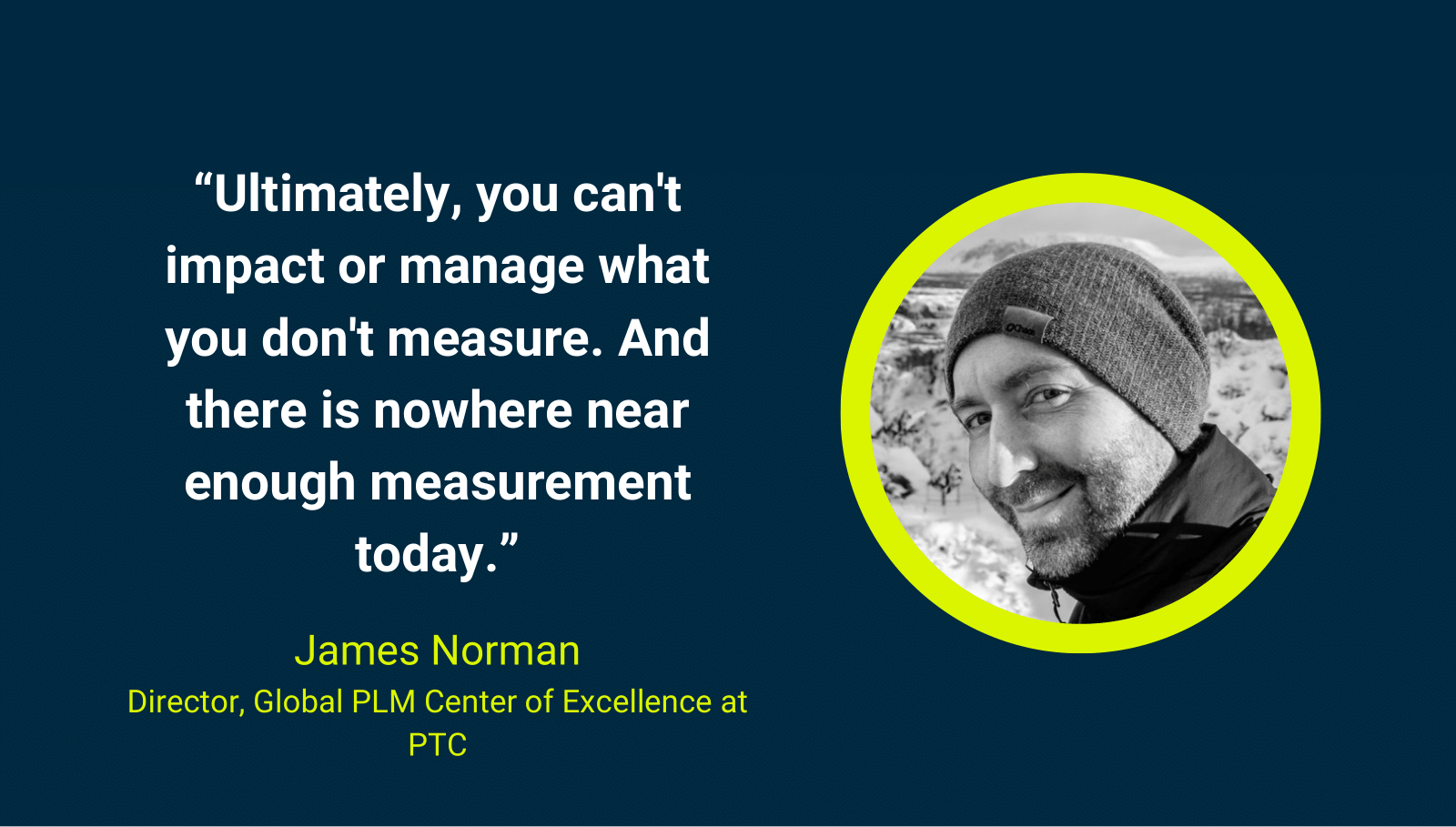
James: Ultimately you can’t impact or manage what you don’t measure. And there is nowhere near enough measurement today. It’s great that we’re starting to see more of the greenhouse gas protocol measurements starting to happen. And while carbon is a relatively good proxy for other environmental impacts, and it’s not wholly sufficient to drive the sustainable change the present moment and our future requires.
To improve their approaches to sustainability, I think companies should orient around how they will provide value to their customers in an increasingly constrained world. Companies need to be asking themselves ‘if we want to be the same company or a better company than we are now in 20 years, what do we need to do now to get things in order to drive true sustainability?’ I think that’s where I feel like it’s still lacking, and it rings a little hollow in some of the conversations I’ve been having the last couple years that focus primarily on regulations and narrowly defined shifts in consumer preferences. Not taking that more holistic and strategic view misses the opportunity for business and society to realize what sustainability can and should mean.
Dave: I think a lot of the work that Makersite is doing – like automating some of the calculations that LCAs were never able to do at scale manually and making that data available to buyers in a way where they can compare suppliers – that’s going to move things forward a lot.
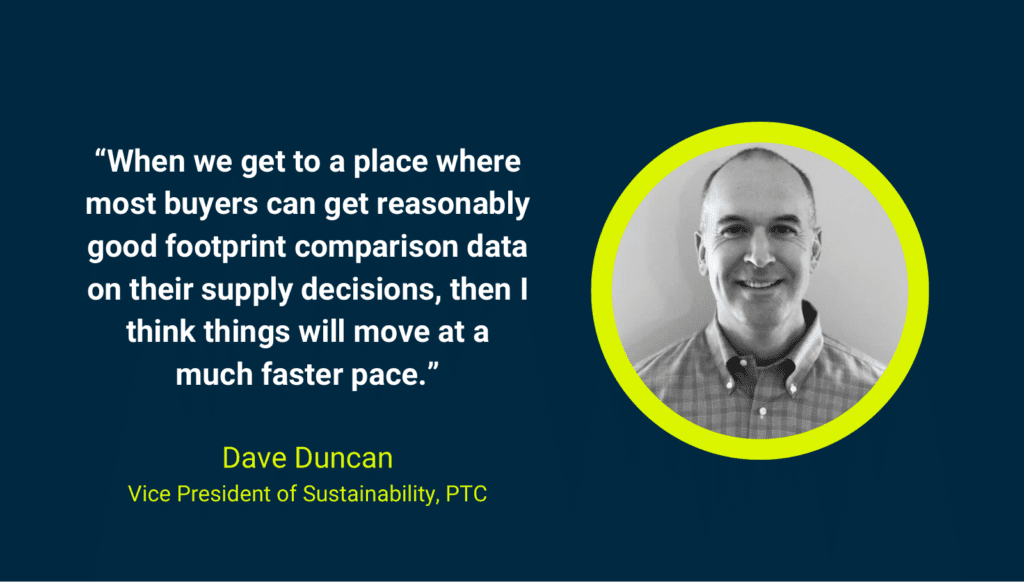
Because today when people make decisions based off global average data or qualitative data, then there isn’t as much of an urgent top-line incentive for corporations to do things. But when we get to a place where most buyers can get reasonably good footprint comparison data on their supply decisions, then I think things will move at a much faster pace.
All businesses know where they are in cost leadership today. They have the competitive intelligence to understand what all their competitors are doing on price and cost and when they get there with footprint, that’ll be a wonderful time. I don’t think it’s that far away with a lot of things that Makersite is doing.
Makersite: In terms of legislation and regulation, is there anything we don’t have yet that you would wish to see?
James: Yes, I think I’d like to see more incentives. More carrots and perhaps less sticks. And I know that sometimes sticks are the path of least resistance and generally perceived to move the needle faster. But an interesting counter to that can be seen in the Inflation Reduction Act that passed in the US Congress almost two years ago.
When you look at what that’s done for creating a fully-fledged EV supply chain in places in the United States that had been resistant in less than 18 months, it’s incredible and it was all done through incentives, not penalties. If the legislation had been driven by penalties alone, this and many other notable projects that have broken ground since probably never would have happened.
There are still inefficiencies and it’s not a perfect piece of legislation (if such a thing exists), but it is a good example that shows if you design incentives in the right way, they can be very motivating and effective in driving change.
Dave: I think incentive based is a great way to get out of first gear into say, because then you get a critical mass of support and infrastructure moving. And once you have scaling at 1% to 2% or a superior approach, it’s going to move. But incentive-based does cost money. It’s less efficient and that won’t be lost on people and politicians will scream from the rooftops about it at some point.
Really the only efficient way to do it is with a carbon tax. But unfortunately, it’s called ‘carbon tax’.
Maybe it could be called carbon price, or somehow communicated in a way where it’s not about tax but about redistribution or properly priced pollution. That’s the only way to really generate the capital allocations that would be most efficient as well as the motivations, and would finally harmonize greenhouse gas accounting with financial accounting.
Makersite: Where do you think we’ll be in 2050, when it comes to sustainability and how we approach it? And where do you hope it will be?
Dave: My best guess and my hope is that we’ll be at Net Zero because we had some technology breakthroughs that helped us get there, in particular things like mechanical carbon capture or hydrogen.
I think the reality is we’ll be close, but unfortunately it will get close because there’ll be some really bad things that will happen and it will happen to rich people that finally move the ball. Like how much wealthy real estate is located in environmentally sensitive areas where insurers no longer provide coverage. Like Manhattan doesn’t have to have a very high sea level rise for there to be an impact.
I think the trajectory of greenhouse gas emissions and other pollutants will be largely solved. My concern is how much damage would have done before that and how quickly would we be able to unwind that damage when everything is more expensive to do?
James: I oscillate between optimism and pessimism on this topic. I do worry that a myriad of factors will prevent society from being as far as along as we need to be in 2050 to avoid the some of the worst outcomes, and that the resulting tumult will be the primary driver for the global cooperation and investment needed to advance the technology and policy breakthroughs required for a more sustainable future.
Then there are countless regional and local examples of incredible sustainability innovations in the public and private spheres that give me great hope we’re building momentum towards a more bottoms-up, proactive, and collaborative approach to sustainability that will pave the path to much more sustainable society in 2050.
In either scenario, I’m more convinced than ever that technological innovations will be at the core of the most impactful approaches to sustainability we’ll see between now and 2050. Technologies that drive sustainability are progressing so much faster than policy, and I think we’ll see that trend continue to accelerate.
Makersite: How do PLM and sustainability align, or how should they align?
James: Going back to the point about how you can’t manage what you don’t measure, you can’t measure what isn’t well defined. As the backbone of the Digital Thread, PLM is intended to deliver the right product definition at the right time in the right context to the right person. At PTC, we think about PLM as more than a singular tool or platform, but rather a suite of enterprise cross-functional tools that enable true closed loop product lifecycle management.
Managing product sustainability requires a robust understanding of the inputs and outputs at each stage of a product’s lifecycle and in the context of how that product is designed, manufactured, used, serviced, and handled at end of life. PLM provides the digital infrastructure and framework to connect all that product data in context so that cross-functional teams can drive meaningful and impactful decision about a product’s sustainability impacts. To put it simply, PLM enables sustainability to be integrated as core strand of the Digital Thread.
Dave: PLM is the ‘home system’ for design engineers. Accountants use ERP. Systems and finance folks use Bloomberg terminals. Our design engineers are in Windchill or Arena all day, every day, and they use it to aggregate data for multi criteria analysis on design decisions. And design decisions could be ‘what material should I use?’, ‘What supplier should I use? ‘How should I shape this part? ‘How should I manufacture it?’, ‘What sort of product service system would I put on this product?’, ‘Am I meeting my sustainability design requirements and how are they validating?’
It’s really the central decision making tool. And it can call out to a wealth of different data sources outside of PTC or supply chain data, material data, other data. And then it can also run subroutines of simulations, whether that’s for a streamlined LCA or for performance validation or other things.
But the promise that PLM has is it’s done multi criteria analysis on design decisions ever since it was incepted. More and more, it’s extending across the full product lifecycle, and the data that they’re able to gather in it and the simulations that they’re able to run for decision support are increasing.
Makersite: What are your frustrations with what PLM best practice is currently seen as, and how do we frame it to make it be more successful in the future? To be more adaptive to what we’re facing?
Dave: Some of the academic papers on design for sustainability say that you really don’t have to overhaul the PLM process, you just need to include sustainability as an additional criteria with performance, cost and time to market, and then everything else kind of takes care of itself.
So I don’t think that PLM needs to be radically overhauled. Rather, I think it’s a case that some of the foundations of PLM most of the market has not yet progressed to. A lot of customers just use PLM to vault their CAD designs and Word documents that inform designs. They need to get towards bill of material management, modular design, derivative bills of materials for manufacturing and service, and then the information and instructions that link to that.
Those are all foundations that have value, that had value even before sustainability was a big thing. But that sets the plate nicely to add on another dimension of criteria for footprint.
Makersite: What about you, James?
James: As Dave said, I’d like to see the expansion from engineering-centric PDM or product data management to a more comprehensive and cross-functional vision of PLM supporting the connected model-based enterprise.
Having an openness that allows collaboration and connectivity with PLM being the foundation for the Digital Thread and product digital twin is also crucial, as it allows you to go wild with microservices and APIs to different systems of engagement as well as niche tools that help you solve very targeted and specific problems. You can then bring all that data and analysis back into a centralized view where you can manage it in the right context with the right product information delivered to the right person at the right time.
We need to get to more of a federated approach with PLM as the foundation for product definition and fanning out from there. It’s about more collaboration, more connected data, a faster exchange of information, and ultimately more precise and actionable data. This is critical to making enterprise PLM and sustainability initiatives efficient and effective. It must involve more than just R&D and engineering. It necessitates more of that systems thinking and collaborative, multidisciplinary approach to developing a product referenced many times in our discussion, which in and of itself should drive us to a much better place.
All that said, technology alone will only get you so far. These evolved business and product lifecycle management strategies require disciplined and robust organizational change management to make them successful. This is something I think a lot of companies take for granted, and we’ll need a lot more focus there to drive alignment and best practices if we hope to realize the benefits at scale.
In an age where sustainability is no longer optional but crucial for business longevity and global well-being, product lifecycle analysis (LCA) stands as an invaluable tool for measuring and reducing the environmental impact of products. However, the complexities involved in traditional LCAs, as well as the dependence on specific expertise, often lead to time and resource-intensive processes, which can be barriers to widespread adoption, particularly for smaller businesses.
Enter artificial intelligence (AI), with its capabilities to automate, analyze, and scale. The integration of AI into LCA processes offers a new horizon for manufacturers and sustainable innovators to conduct more thorough and frequent analyses, leading to more informed decision-making and, ultimately, greener products. This blog explores the role of AI in revolutionizing product LCAs, the benefits it offers, and the challenges it confronts, as well as real-world examples of AI-driven LCA in action.
Product Lifecycle Analysis (LCA) can be categorized mainly into two types: “cradle-to-gate” and “cradle-to-grave.”
Cradle-to-gate LCA focuses on assessing the environmental impact of a product from the extraction of raw materials (the cradle) up to the point where the product leaves the factory gate, ready for distribution. It doesn’t consider the use and disposal phases of the product’s life cycle.
In contrast, cradle-to-grave LCA encompasses a more comprehensive assessment, extending from raw material extraction through to the product’s end-of-life disposal, including its use, recycling, and landfill stages.
The principal advantage of cradle-to-grave LCA lies in its holistic approach. By considering the entire lifespan of a product, this method provides a more accurate picture of its environmental impact.
This thorough analysis enables manufacturers and businesses to identify potential areas for reducing environmental damage not just in production, but in product use and disposal as well, leading to more sustainable products and practices. Consequently, cradle-to-grave LCA is often regarded as superior for those aiming to make genuinely eco-friendly decisions.
Challenges in conducting cradle-to-grave LCA
Undertaking a cradle-to-grave life cycle assessment poses distinctive challenges for sustainability professionals. One major obstacle lies in the difficulty of acquiring precise and comprehensive data concerning the environmental impact of raw material extraction and processing. This data is crucial for conducting a thorough LCA but can prove elusive due to proprietary processes or the dispersed nature of supply chains.
Another hurdle is the intricate nature of contemporary supply chains themselves. Products often traverse multiple countries and manufacturing stages before reaching the final disposal stage, complicating the tracking of their precise environmental impact. Moreover, standardizing this data for comparison purposes can be laborious, given the diverse production techniques and materials utilized across various industries.
These challenges demand advanced expertise, significant resources, and frequently, innovative data collection and analysis methods, underscoring the intricacy and significance of conducting precise cradle-to-grave LCAs.
Overcoming challenges in LCA with AI
AI plays a pivotal role in revolutionizing cradle-to-grave life cycle assessment (LCA) by offering unparalleled advantages in data collection, processing, and mapping across diverse systems. Firstly, AI streamlines the collection process by automatically gathering data from a myriad of sources, such as online databases and enterprise systems. This automation not only saves time and resources but also guarantees the inclusion of up-to-date data in the analysis.
Secondly, AI’s capability to handle vast datasets enables sophisticated mapping and processing, significantly bolstering LCA efforts by intelligently inferring and filling gaps in datasets, thereby providing a more complete and accurate picture of a product’s environmental impact.
Manufacturers can proactively identify and address potential environmental risks through AI-driven simulations of various scenarios like material changes or production process adjustments, thus bolstering sustainability efforts.
Moreover, AI facilitates real-time monitoring and optimization by providing continuous feedback loops. For instance, product data models built with AI can help engineers quickly identify alternative material or supplier choices, based on multiple criteria such as cost or environmental impact. This real-time insight empowers organizations to make informed decisions promptly, ensuring efficient resource utilization and environmental lifecycle thinking.
Benefits for manufacturers and sustainable innovators
AI brings a multitude of benefits to those invested in sustainable practices, ranging from efficiency and innovation to market competitiveness.
Improved decision-making processes
By enhancing the speed and accuracy of LCA, AI empowers decision-makers to develop and implement sustainability strategies more proactively. With AI insights, product teams can prioritize areas for improvement and make smarter choices that align with business and environmental goals.
Enhanced product innovation and market competitiveness
AI’s contributions to LCA enable businesses to innovate sustainably. Through a deeper understanding of their products’ lifecycles, companies can develop eco-friendly products that resonate with consumers’ growing environmental consciousness, thereby gaining a competitive edge in the market.
Challenges and considerations
While the prospects of AI in LCA are promising, there are challenges that need to be addressed.
Data accuracy and reliability
The effectiveness of AI-driven LCAs depends on the quality of the input data. Ensuring the accuracy and reliability of data sources, especially those feeding predictive models, is critical to generate meaningful and actionable insights.
Integration with existing systems and workflows
Adopting AI solutions for LCA needs careful integration with existing systems and workflows. For successful implementation of AI in LCA, it’s important to integrate product data from Product Lifecycle Management (PLM) systems and map this information to transaction data held in Enterprise Resource Planning (ERP) or purchasing systems, ensuring a seamless flow of information and heightened efficiency in sustainability analysis.
Examples of AI-enabled LCA
Several industries have begun to leverage AI for LCA:
Amazon and Flamingo: With the assistance of Flamingo, an AI-powered algorithm, Amazon is now able to swiftly and precisely measure the carbon footprint of its products. In a specific trial, the algorithm decreased the time required by scientists to map 15,000 Amazon products from a month to just a few hours.
Microsoft’s LCA 2.0 powered Makersite: Microsoft is committed to reducing the environmental impacts of its products through structured Ecodesign approaches and LCA. Microsoft’s innovative approach involves leveraging AI and data analysis provided by Makersite to automate and scale the product modeling process, focusing on supply chain-specific environmental impact accounting. The transition to Version 2.0 has improved quality, increased accuracy, and better identification of environmental hotspots in their supply chain. The methodology shift aims to enhance transparency, collaboration, and consistency in LCA results, and product emissions, across Microsoft’s entire product portfolio
These examples demonstrate the potential of AI to transform LCA into a more agile and strategic product carbon footprint environmental management tool.
Conclusion
AI will be a game-changer in many industries. Its role in accelerating and enhancing product design processes makes it a powerful solution for managing complex products and their supply chain. With its ability to clean, connect and enrich cross-departmental data with third-party sources, it removes the dependency on sustainability, cost and risk experts.
With AI, product engineers and designers are able automatically detect and connect product components and manufacturing processes to the right supply chain data from a harmonized and hyper-connected database, instantly solving one of the most time-consuming problems: mapping data to multiple sources at a granular level. The result is a detailed, extremely specific view into deep-tier supply chains, giving users a better understanding of environmental footprints, should-costing, and compliance risks at an unprecedented speed.
As manufacturers and innovators realize the benefits of AI-driven LCAs—better decision-making, deep-tier supply chain visibility, reduced environmental impact, and enhanced competitiveness, to name a few—it’s not a question of whether AI should be integrated, but instead of how quickly and effectively it can be done.
The AI tightrope: Balancing automation, accuracy and trust in LCA/EPD
You are currently viewing a placeholder content from Hubspot Embedded Content. To access the actual content, click the button below. Please note that doing so will share data with third-party providers.
You are currently viewing a placeholder content from Hubspot Meetings. To access the actual content, click the button below. Please note that doing so will share data with third-party providers.
You are currently viewing a placeholder content from Intercom. To access the actual content, click the button below. Please note that doing so will share data with third-party providers.
You are currently viewing a placeholder content from Wistia. To access the actual content, click the button below. Please note that doing so will share data with third-party providers.