Makersite Acquires Siemens' SiGREEN

Read more
Close

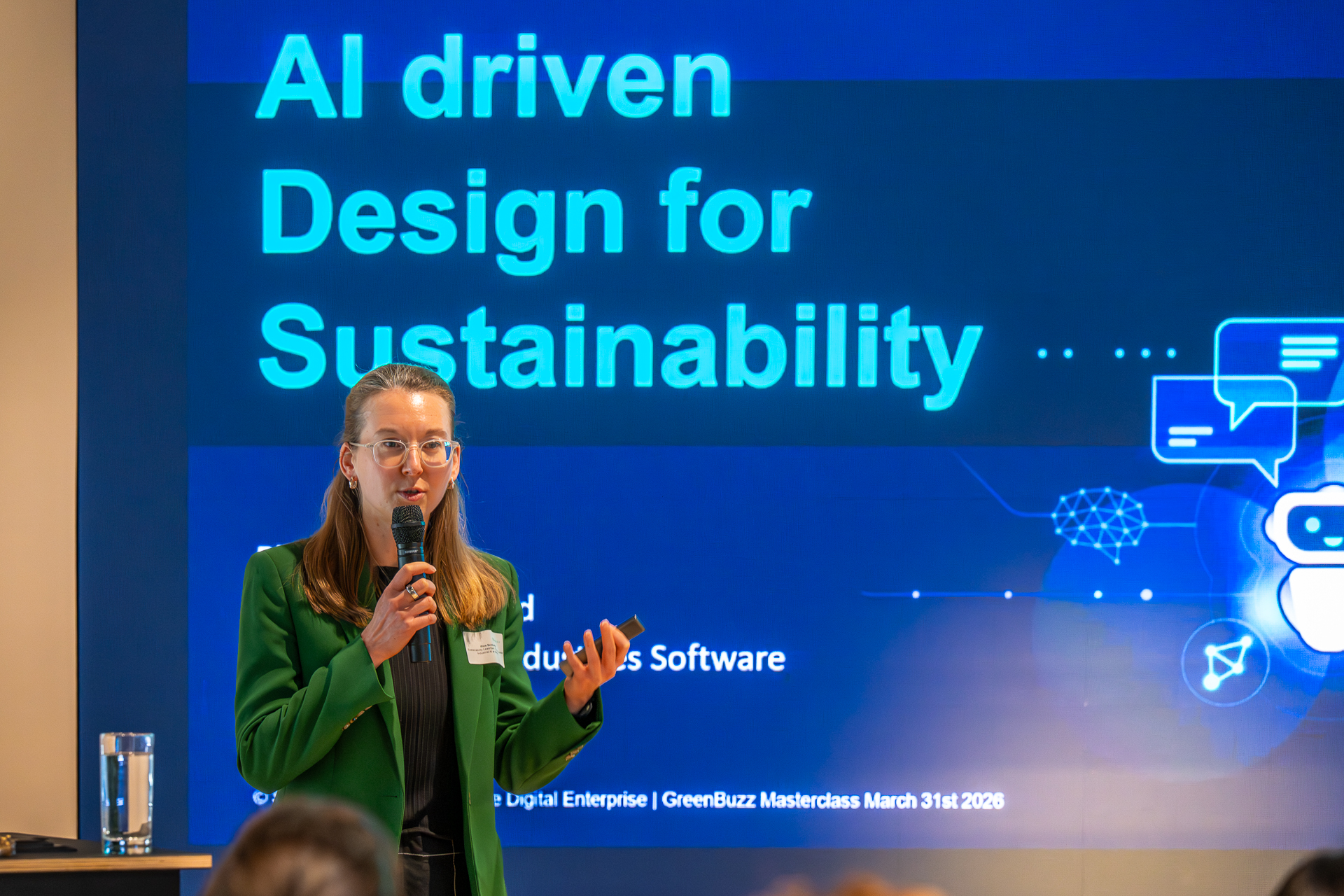
Mastering Sustainability with AI: From Data to Product Impact

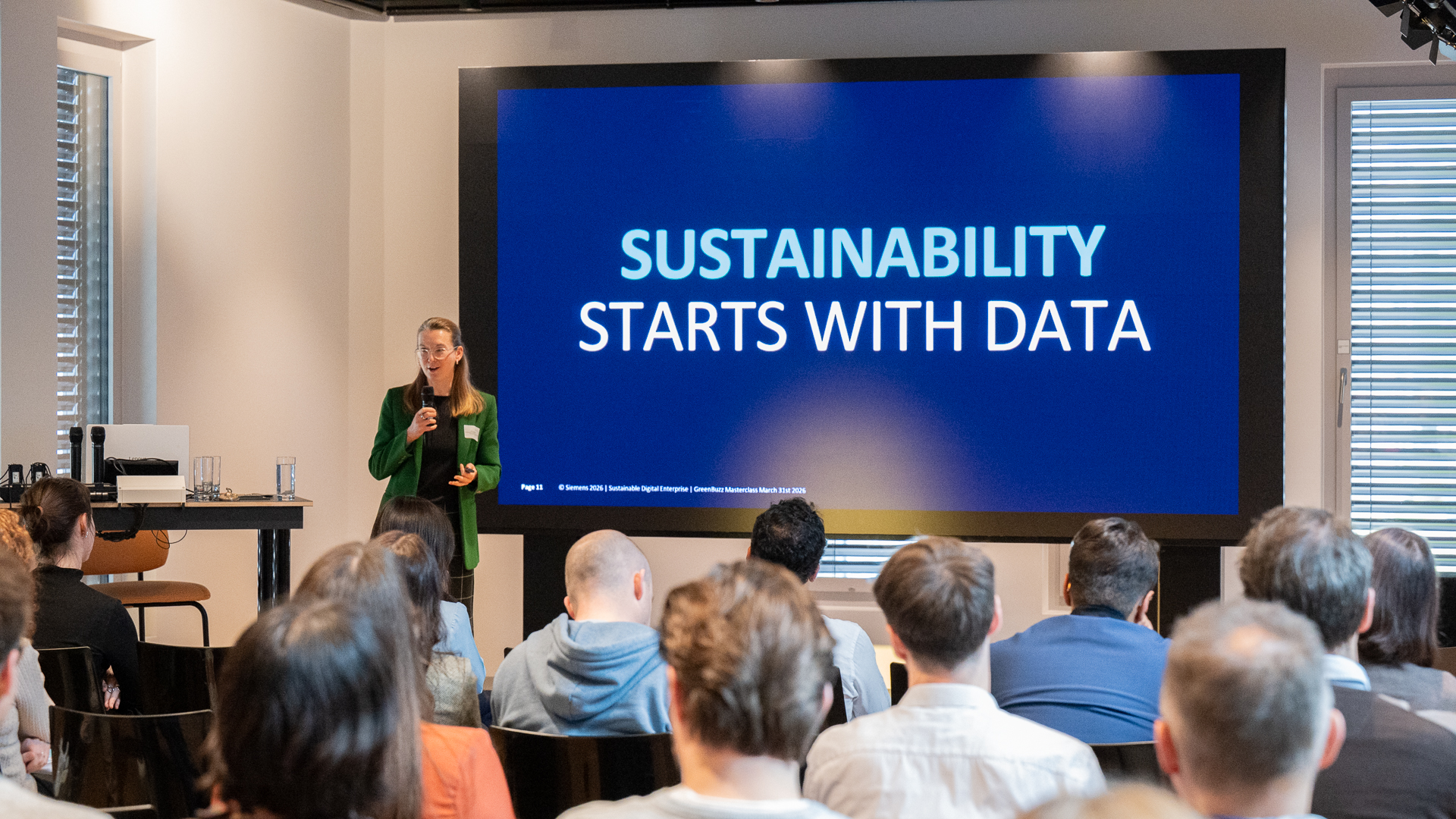
The session was led by Pina Schlombs, Sustainability Lead and Senior Thought Leader on Industrial AI at Siemens Digital Industries Software, and Maryam Bahrami, Global Partnerships & Alliances Director at Makersite. Pina brought a practitioner’s perspective from inside one of the world’s most complex manufacturing organizations. Maryam brought the product intelligence view from Makersite’s work, helping industrial companies close the gap between sustainability strategy and what engineers actually decide at their desks.  
 
The audience was a mix of ESG, sustainability, procurement, and consulting professionals from organizations including Deloitte, EY, PwC, ABB, Sulzer, Google Switzerland, ETH Zurich, WBCSD, Siemens, and Makersite. 

The Structural Problem: Strategy and Engineering Still Operate in Isolation

Most organizations have sustainability goals set at the portfolio level by leadership, while the hundreds of material and supplier decisions that actually determine environmental outcomes are made at the component level by engineers, and there is no live mechanism connecting the two. This is not a communication failure. It is a data architecture failure. 

Portfolio-level targets for carbon footprint, regulatory compliance, and ecodesign are established at the board level. Meanwhile, engineers making daily decisions about materials, suppliers, and component specifications have limited to no visibility into how those decisions aggregate against those targets. Reporting outputs are disconnected from engineering workflows. Misalignment only surfaces when products are near launch, when change is expensive, and design leverage is at its lowest.

Pina’s slide put it plainly: “Individually sound decisions. Collectively misaligned outcomes.” Ecodesign cannot scale as an isolated sustainability function. It has to be embedded in the engineering workflow itself, with sustainability, cost, compliance, and supply chain risk visible at the point of design, not reported after the fact. 

Why 80% of Sustainability Impact Is Determined Before Manufacturing Starts

The European Commission’s proposal for ecodesign requirements for energy-using products makes a well-established claim that is still underestimated in practice: 80% of a product’s environmental impact is determined during its design phase. 

The practical implication is that sustainability teams focused on manufacturing efficiency, logistics, or end-of-life optimization are optimizing the wrong part of the problem. The decisive interventions are upstream, in material selection, component architecture, supplier choice, and design configuration, all of which happen in engineering systems before a product ever reaches a factory floor.

That is the core argument for why AI-driven ecodesign is not an extension of sustainability reporting. It is a prerequisite for actually moving the needle on Scope 3, LCA, and EPD at scale. And it requires sustainability intelligence to be embedded in the tools engineers already use, PLM, CAD, ERP, not maintained in parallel systems that no one consults during design. 

The Three Structural Barriers to Scaling Ecodesign

As the barriers to ecodesign at scale were mapped with a precision, the practitioners in the room recognized all the bottlenecks right away. They fall into three interconnected categories. 

  1. Targets don’t translate into design decisions. Sustainability goals are set at portfolio level. Engineers make decisions at component level. There is no live mechanism connecting the two. A sustainability manager publishing a carbon reduction target has no direct line to the engineer selecting a PCB substrate or a housing material three levels down the BOM.

  2. Product data is fragmented. Impact, cost, compliance, and supplier data sit in separate systems. Decisions are made without a complete product view. LCA data lives in one tool. Compliance watchlist data lives in another. Supplier declarations sit in spreadsheets. When these inputs are never unified at the product model level, the analysis simply never runs.

  3. Feedback cycles are too long and misdirected. Insights arrive too late in the design cycle. Teams optimize the wrong levers, or discover problems when change is expensive. A sustainability review at the pre-launch stage does not prevent impact. It just documents it. 

Each of these barriers is a data and systems problem, not a knowledge or motivation problem. The people in the room understand the stakes. What they lack is infrastructure that connects sustainability intelligence to design decisions in real time. 

What the Makersite x Siemens Integration Actually Solves

Makersite’s platform works as a shared product intelligence layer between engineering systems and sustainability analysis. BOM data flows from Siemens’ engineering environment, PLM, CAD, Teamcenter, into Makersite, where it is enriched with material intelligence, sustainability impact data, compliance status, and supply chain risk signals drawn from 150+ supply chain databases. The enriched product model flows back into engineering decisions. 

The result is that every material and supplier decision can be evaluated against portfolio sustainability targets in real time, during design, not after it. Cost, performance, and sustainability trade-offs become visible when engineers are actually making choices, not weeks later when a sustainability team runs a retrospective analysis. 

For leadership and sustainability teams, this means live progress against portfolio and science-based targets, visibility into which product families and components drive the greatest impact, and the ability to translate strategic goals into measurable design constraints within the product model itself. For engineering and procurement teams, portfolio impact updates automatically as designs change. Trade-offs get resolved early in the development cycle. Supplier decisions can be weighed against sustainability impact rationale, not just cost. 

Maryam described this transition as moving from “manual sustainability,” where analysis is handled offline, fragmented, and reported retrospectively, through “connected intelligence,” where BOM data begins to flow between engineering and analysis systems, to “automated ecodesign,” where sustainability is optimized during design, continuously, as an integrated design parameter rather than a downstream check.

That final state is achievable.

The organizations making real progress have structured their engineering and sustainability systems around a unified product data layer. Those that have not are still generating retrospective LCAs and struggling to demonstrate product-level emissions performance to customers and regulators. 

AI’s Role: Enabler, Not Oracle

One of the most important takeaways: AI is not the solution. It is the enabler of scale. The real value of AI in this context comes down to three things. 

  1. Bridging data gaps at the design stage. In early-phase product development, actual material and supplier data is not yet available. A well-trained AI and ML models, based on previous generations of a product or similar products, can generate data for missing inputs, substance properties, process emissions, supply chain characteristics, so that sustainability analysis can run before the design is finalized, so even every product designer can access and leverage relevant historic data at very early design phases. As the design matures, AI-generated estimates improve in accuracy by actual product specifications. The critical technical requirement here is that AI-generated data must be highly granular and accurate, so that early decisions reliably translate into real-world outcomes. Aggregate estimates or generic proxies do not meet that bar.

  2. Automating calculations that are too complex for manual approaches. A single complex product can involve hundreds of materials, thousands of substance-level interactions, and supply chain relationships spanning dozens of tiers. Running a full LCA or PCF at the configuration level, across a product portfolio, on a continuous basis as designs evolve is not a human-scale task. AI makes it tractable.

  3. Translating data into actionable decisions. The output that matters is not a report. It is a design recommendation: this material substitution reduces the product carbon footprint by X%, brings the assembly into REACH compliance, and costs Y more per unit. That decision-level output requires AI to synthesize cost, sustainability, compliance, and supply chain data simultaneously, which cannot be done from disconnected systems. 

What AI cannot do is substitute for the underlying data quality. This point was central to the masterclass, and it is consistent with what Makersite sees across enterprise customers. More data is not automatically better data. Quality, structure, and accessibility are the actual constraints. An AI model running on fragmented, unstructured, or unvalidated product data will generate confident sounding but unreliable outputs.

The foundation must be right first. 

The Business Case: How to Frame It Across Stakeholders 

The business case for ecodesign doesn’t stall because it lacks merit. It stalls because it’s presented as a single narrative to stakeholders who evaluate it through entirely different lenses. 

    • For the C-suite, the relevant frame is cost, risk, and growth: protecting revenue through market access and regulatory compliance, reducing COGS through material cost reduction and dematerialization, and accelerating growth through faster time to market and stronger product differentiation. The regulatory and commercial cost of inaction is rarely quantified, and that absence of hard numbers is itself a barrier to urgency. 
    • For engineering and procurement leaders, the frame is decision quality and workflow efficiency: clear design priorities backed by live impact data, fewer late-stage surprises, faster iterations. The value is in reducing rework and compressing the concept-to-execution cycle. 
    • For sustainability teams, the shift is from retrospective reporting to proactive input at the design stage. Sustainability insights that are there when they can still influence decisions, not bolted on at launch. 
    • For marketing and communications, the value is defensible claims. Sustainability narratives aligned to real, auditable environmental performance data that hold up to scrutiny in enterprise tenders, regulatory filings, and public reporting. 

The resistance map laid out was really useful. On the business side, change management overhead, tool overload, supply chain complexity introduced by new data requirements, and the underestimated cost of inaction. On the technical side, a workflow disruption to established engineering cycles, low confidence in data that feels abstract, and the frustration of having portfolio visibility without clear design-level agency.

Knowing where resistance will come from, and having specific, evidenced answers for each objection, is what separates ecodesign programs that gain organizational traction from those that stay confined to the sustainability team. 

Key Takeaways 

    • From ambition to product-level decisions. AI enables teams to move from high-level sustainability goals to concrete product-level decisions, LCA, carbon footprint, compliance status, at the component and configuration level. The portfolio-to-product translation is the central technical challenge, and it requires unified product data infrastructure. 
    • AI as an enabler, not the solution. The real value of AI is in simplifying complexity, automating calculations, and translating data into actionable design insights, freeing engineering and sustainability capacity for judgment calls that machines cannot make. AI is not a replacement for methodological expertise or domain knowledge. 
    • Data is the bottleneck. More data is not better data. Quality, structure, and accessibility are the real constraints and directly determine what AI can produce. Organizations that invest in data quality before deploying AI generate defensible outputs. Organizations that skip this step generate faster noise. 
    • Progress over perfection. Waiting for complete, perfect data before beginning ecodesign analysis delays real impact. Informed decisions made with structured but incomplete data already create value, particularly in early-stage LCA and design exploration, where directional guidance is more useful than post-hoc precision. 
    • Ecodesign needs integration, not isolation. Scaling ecodesign requires embedding it across engineering, procurement, sustainability, and finance functions, with top-down alignment from leadership and bottom-up empowerment of engineers. A sustainability team running ecodesign in a silo cannot move at the speed or scale the problem requires.

    • Sustainability is a competitive parameter, not just a constraint. Organizations that treat sustainability as a design input alongside cost, performance, and quality open up product innovation, differentiation, and market access that compliance-driven approaches miss entirely. The companies building this capability now will have a structural advantage in regulated markets and enterprise procurement within the next three to five years. 

The Digitalization-Sustainability Loop 

Why this is not just a sustainability technology story? Digitalization empowers sustainability, and sustainability drives digitalization. They are not sequential. They are mutually reinforcing. 

The organizations that will meet their science-based targets and remain competitive in increasingly regulated industrial markets are the ones building the product intelligence infrastructure now. Not because regulators require it yet in every jurisdiction, but because the alternative, continued misalignment between strategic sustainability commitments and the engineering decisions that actually determine product impact, is not a viable operating model for the next decade. 

What Organizations Can Do Now 

If your organization is facing the structural challenges above, targets that do not reach engineering, fragmented product data, sustainability analysis that arrives too late; the path forward is not a single technology deployment. It is a sequenced build. 

    • Start with the data foundation. Map what product and supply chain data you have, where it lives, and where the highest-impact gaps are. Identify which product families and material categories drive the greatest sustainability risk and opportunity. This scoping work shapes everything that follows. 
    • Connect engineering and sustainability systems. BOM data needs to flow into sustainability analysis in real time, not through periodic manual exports. This integration is the prerequisite for moving from retrospective reporting to design-stage intelligence. 
    • Define methodology before scaling AI. LCA system boundaries, allocation approaches, and error margin conventions must be agreed across sustainability, engineering, and commercial teams before AI-generated outputs are used for external disclosure or internal design decisions. Methodology alignment is not detail. It is the foundation of credibility. 
    • Build for reuse. Component-level sustainability models validated once and reused across product families are the architecture that makes scale tractable. Product-by-product manual LCAs are not. 
    • Engage suppliers structurally. Scope 3 and full lifecycle analysis require primary data from suppliers. That means building supplier data collection processes, full material declarations, process data, emissions factors, into procurement workflows, not treating it as a one-time data collection exercise. 

The Makersite and Siemens partnership exists to make this path shorter. For organizations using Siemens’ engineering environment, the integration with Makersite’s product lifecycle intelligence platform provides the shared data layer that connects design decisions to sustainability outcomes, without replacing engineering workflows or requiring sustainability expertise to be embedded in every engineering team.


Makersite participated in the GreenBuzz Masterclass: AI & Sustainability with Siemens at The Dome, Zurich, on March 31st, 2026. The session was part of Makersite’s ongoing program of practitioner-focused events on product lifecycle intelligence, AI-driven ecodesign, and sustainable product development. 

Interested in how Makersite and Siemens can support your product portfolio in ecodesign and product sustainability?  

Book a conversation with Makersite 

Why Your Supplier Data Strategy Is Blocking Your PCF Program

If you have tried to scale a Product Carbon Footprint program, you already know the calculation itself is rarely the main problem.

The harder challenge is turning supplier data into something that can support product-level decisions.

As customer and regulatory expectations change, that gap is becoming more visible. A few years ago, broad model-level estimates were often enough. Increasingly, manufacturers are being asked for configuration-specific Product Carbon Footprints (PCFs) tied to actual materials, suppliers, components, and manufacturing routes.

Many companies already collect carbon data from suppliers, but it often arrives disconnected from the product structure it is supposed to describe.

One supplier sends a spreadsheet. Another sends a PDF. One provides company-level emissions data when the request was product-specific. Another shares a number without a clear methodology, boundary, region, or reporting year. Some suppliers respond late. Some do not respond at all.

At that point, the challenge is no longer just emissions calculation — it becomes a data structure problem.

Supplier carbon data only becomes useful when it connects to the product

A PCF depends on more than a single emissions value. It depends on how materials, components, suppliers, manufacturing processes, transport, and energy use connect to the product itself.

That sounds straightforward in theory, but in practice supplier data often sits outside the systems used to manage products.

As a result, sustainability teams spend time interpreting inputs before they can use them. Does this figure apply to a material, a component, a supplier site, or broader company operations? Is it current? Can it be reused across product variants? Was the methodology comparable to the previous supplier submission?

Those judgement calls determine whether a PCF can be trusted.

This is one reason many PCF programs become difficult to scale. The issue is not simply collecting supplier data. It is maintaining enough structure around that data for teams to reuse it consistently across products, suppliers, and reporting cycles.

The spreadsheet problem is really a product model problem

Spreadsheets are not inherently the issue. Most companies start there because spreadsheets are easy to distribute across supply chains.

The problem emerges once PCFs move beyond a pilot exercise.

A manufacturer preparing PCFs for enterprise tenders may need footprints for multiple configurations of the same product, each with different suppliers, components, materials, or manufacturing locations. If supplier carbon data sits in disconnected files, teams are forced to manually determine which values apply to which configuration, often under commercial deadlines.

That creates operational fragility.

A supplier update may affect dozens of products. A component may appear across multiple product families. A methodology change may alter previously published values. Without a connected product model, those dependencies become difficult to track reliably.

Lenovo’s ThinkPad line illustrates how this changes once supplier and component data are tied directly to the product structure. Enterprise customers increasingly required configuration-specific, ISO-aligned PCFs rather than broad model-level estimates. In response, and with the help of Makersite, Lenovo built a configuration-level modelling approach using primary supplier data and audited methodology.

Lenovo has now structured more than 2.5 million supplier FMDs into a shared component foundation that can be reused across product families. That shifts PCF generation away from rebuilding calculations product by product and toward a more repeatable modelling approach tied to actual product configurations.

Sustainability teams cannot spend all their time interpreting supplier files

When supplier data remains disconnected from the product model, sustainability teams end up acting as translators between spreadsheets, supplier submissions, engineering structures, and reporting requirements.

Some of that work is unavoidable, but too often specialist time gets consumed by checking files, reconciling assumptions, validating formats, and explaining why one supplier submission can or cannot be used.

That has practical consequences beyond reporting. If PCFs are needed for customer tenders, they have to be available before commercial decisions are made. If procurement teams want to compare suppliers, the underlying data has to support like-for-like analysis. If engineering teams want to reduce product impact, the footprint has to connect early enough to influence design decisions.

A PCF generated after the fact supports reporting. A PCF connected to the product model can support decisions.

The next bottleneck is data exchange between companies

Internal product modelling is only part of the challenge. Supplier PCF data also has to move between manufacturers, suppliers, and broader supply chain networks. In many industries, that exchange still happens through spreadsheets, PDFs, emails, and custom templates.

That creates another scaling problem.

Even when suppliers provide carbon data, manufacturers still need a reliable way to exchange, validate, and interpret it across systems, regions, and reporting frameworks.

This is part of the reason industry-led exchange frameworks have gained momentum. Manufacturers increasingly need product-level carbon data that can move across company boundaries without requiring every supplier to work inside the same platform.

SiGREEN, which Makersite announced it will acquire effective June 2026, was designed around that exchange problem. Siemens developed the platform to support the collection and exchange of verified Product Carbon Footprint data across supply chains. It currently powers the Together for Sustainability (TfS) PCF Exchange and connects frameworks including TfS, Catena-X, and PACT.

Structured exchange reduces friction between companies, but exchange alone is not enough.

Exchanged data still needs to connect to product decisions

Supplier PCF data only becomes operationally useful once it connects back to the wider product structure inside the manufacturer. That includes materials, components, suppliers, manufacturing processes, regions, methodologies, cost structures, and regulatory requirements already managed across PLM, ERP, and supply chain systems.
Without that connection, carbon data may move more efficiently between companies while still remaining disconnected from the decisions it is meant to support.

This is where the problem shifts from data exchange to product intelligence.

Connecting supplier carbon data to the wider product model makes it easier to understand where supplier changes affect multiple products, where components can be reused across product families, and where footprint assumptions influence commercial, engineering, or compliance decisions elsewhere in the portfolio.

At that point, a PCF stops behaving like a one-time reporting output and starts becoming part of the operational product data manufacturers use for decisions.

Scaling PCFs depends on data flow, not more templates

Most manufacturers do not lack supplier carbon data entirely. What they often lack is a reliable way to structure, connect, and reuse that data across products, suppliers, and decisions.

That is why scaling PCFs is becoming less about calculation methodology alone and more about how product and supplier data move through the organisation.

The companies that scale PCFs successfully will not necessarily be the ones collecting the most spreadsheets. They will be the ones that connect supplier data directly to the product decisions it is meant to inform.

Key Takeaways: AI-Driven Digital Transformation in EHS & Sustainability

The Core Problem: Complexity Has Outpaced the Tools

The complexity of modern product portfolios and multi-tier supply chains has outpaced what traditional EHS and sustainability tools can handle. Companies are now being asked product-specific, substance-level questions by customers, regulators, and investors. Most lack the integrated data infrastructure to answer them.

This is not a niche problem. Enterprise manufacturers managing millions of products and tens of thousands of chemical substances cannot generate reliable life cycle data, Scope 3 emissions figures, or audit-ready compliance records using spreadsheets, disconnected ERP systems, or manual research. The volume and precision required make human-scale processes structurally unworkable.

AI is entering this space not because it is fashionable, but because there is no other path to scale.

What Is Actually Working vs. What Is Still Hype

The panel was direct on this. AI in EHS and sustainability is generating real value today in specific, well-scoped use cases, and falling short where the underlying data foundation is missing.

What’s working today:

Automated LCA and PCF generation at product and configuration level, where AI processes full material declarations, maps substance-level data to background databases, and generates traceable life cycle inventories without manual modeling effort. AI-assisted chemical data modeling for substances where no emission factors or LCI datasets exist, using synthesis and pathway data to fill gaps rather than defaulting to averages or proxies. Continuous compliance monitoring against expanding regulatory frameworks, where AI matches BOM-level data to substance watchlists in real time. Scope 3 supply chain mapping across multi-tier supplier networks, surfacing hotspots and prioritizing data collection where it matters most.

Still more promise than reality:

Fully autonomous sustainability decision-making without expert validation. AI cannot produce ISO-compliant outputs without human oversight of methodology and data quality. Generic large language model deployments without deep sustainability domain training, the specificity of EHS methodology, LCA system boundaries, and substance-level compliance cannot be approximated by general-purpose models. And AI layered on top of structurally broken data processes will only create fragmented, siloed, unvalidated inputs produce unreliable outputs regardless of the model.

The consistent finding: AI works when it is applied to specific, high-impact use cases on a structured data foundation. It does not work as a substitute for that foundation.

The Real Bottleneck Is Data Readiness, Not Model Capability

One of the most technically substantive discussions in the keynote focused on where enterprise organizations actually get stuck. Not in AI capability, but in data readiness.

Consider what it takes to generate a product carbon footprint for a manufacturer with a complex chemical portfolio. Measured LCI datasets and emission factors exist for only a fraction of the substances involved. The remainder must be modeled from synthesis pathways, process data, or representative chemical categories. For a single product, dozens of custom LCA datasets may need to be generated from hundreds of candidate substances. Across a portfolio of millions of products, this is a multi-year data engineering challenge.

The approach that works is incremental and methodologically rigorous.

  • Map existing coverage first. Identify what background database coverage already exists and where manufacturer-provided LCA data can be matched exactly. This scopes the true gap before any modeling begins.
  • Prioritize by impact. Focus custom dataset generation on substances with the greatest frequency and material contribution across the portfolio. Starting with the most-used materials delivers meaningful coverage without attempting to solve everything at once.
  • Model the long tail by category. Remaining substances can be grouped into chemical categories, solvent classes, inorganic groups, and represented by datasets with defined variance, min/max ranges, and documented error margins. This is scalable and auditable.
  • Handle marginal contributors appropriately. Substances that contribute negligible quantities to the final product can be represented using high-level grouped data, such as average organic or inorganic chemical classifications, without materially affecting output accuracy.
  • Align on methodology before scaling. ISO compliance requirements, error margin conventions, and how averages are applied in reporting must be agreed between technical and sustainability teams before outputs are used for external disclosure.

This is not a “plug in AI and get answers” workflow. It is a structured, expert-guided process in which AI dramatically accelerates each step. The methodological rigor is still required. Makersite is built to support exactly this kind of layered, scalable approach, from data ingestion and substance-level mapping through to audit-ready LCA and PCF outputs.

How the Sustainability Leader Role Changes in 3 to 5 Years

The panel’s view here was grounded rather than speculative.

The shift is not from human judgment to automated decision-making. It is from reactive reporting to real-time insight generation. Sustainability leaders who today spend significant time on data collection, supplier follow-up, and manual LCA modeling will increasingly function as analysts and strategists, interpreting AI-generated outputs, setting data quality standards, and embedding sustainability criteria directly into product design and procurement decisions.

The implication for organizations is clear: the value of the sustainability function is increasingly determined by the quality of its data infrastructure, not its headcount. Teams that build structured, auditable data pipelines now will have a structural advantage in regulatory readiness and decision speed within the 3 to 5 year window.

Where Scope 3 Is Hardest

Scope 3 emissions, particularly Category 1 purchased goods and services, remain the most difficult area, and the panel was specific about why.

The problem is not the emissions calculation. It is the absence of primary data at the supplier level. Most Scope 3 analyses rely on spend-based or industry-average approaches because supplier-specific, product-level emissions data does not exist in structured, accessible form. AI can model gaps with defined uncertainty, but it cannot compensate for missing primary data.

Organizations making the most progress on Scope 3 share three characteristics. They have built structured supplier data collection processes, full material declarations, BOM-level inputs, that feed directly into LCA and PCF workflows. They have invested in component-level modeling that can be reused across product families rather than rebuilt product by product. And they have established methodology alignment across sustainability, engineering, and commercial teams so that AI-generated outputs are trusted and acted upon.

The approach that consistently does not work: attempting to resolve Scope 3 at the portfolio level with aggregate methods while continuing to operate disconnected, product-level data systems.

What an AI-Enabled Sustainability Decision Looks Like at the Design Level

The most forward-looking discussion centered on product design, where the greatest leverage exists.

In the next three to five years, engineers making component selection decisions will have real-time access to sustainability impact data at the substance and configuration level. Selecting a different supplier or substituting a material will immediately surface its LCA, compliance, and Scope 3 implications before the decision is finalized, not weeks later during a sustainability review.

This is technically achievable today for organizations that have built the necessary data infrastructure. The constraint is not AI capability. It is the availability of structured, substance-level product and supplier data in a form that AI can use.

The leadership implication is significant: Sustainability decisions in the next decade will increasingly be made by product engineers, not sustainability teams in isolation. The function of the sustainability team shifts to building and maintaining the data systems, methodological standards, and AI tooling that make those decisions possible at scale.

One non-negotiable: AI-generated sustainability outputs require full audit trails. ISO-aligned PCFs and LCAs need traceable, validated data lineages. Explainability is a technical requirement, not an optional feature.

Watch-Outs as AI Gets Embedded in EHS Workflows

The panel closed with a frank assessment of where AI adoption fails in EHS and sustainability.

Treating AI as a substitute for data quality is the most common mistake. AI can model gaps and generate datasets for missing substances, but it cannot produce defensible outputs from structurally flawed inputs. Organizations that skip data foundation work before deploying AI will generate results that fail audit, regulatory, or customer scrutiny.

Neglecting methodology alignment is the second failure pattern. Different LCA system boundary definitions and allocation approaches can produce materially different results from the same underlying data. If sustainability, engineering, and commercial teams are not aligned on methodology before AI outputs are generated, those outputs will be contested internally before they reach any external stakeholder.

Underestimating the supplier engagement requirement is the third. Scaling sustainability data across complex supply chains is not purely a technology problem. Thousands of suppliers must participate in structured data collection for AI-generated outputs to reflect primary data rather than estimates. That requires change management and supplier enablement, not just software.

And finally: confusing speed with accuracy. AI generates outputs faster. Faster outputs with unquantified uncertainty are not more useful than slower outputs with defined error margins. Speed and methodological precision must be calibrated together.

The One Thing Leaders Should Understand Right Now

Organizations that will use AI effectively for sustainability in 3 to 5 years are the ones building structured data foundations today.

The technology is ready. The bottleneck is data, specifically, the absence of product-level, substance-level, supplier-validated data organized in a way that AI can work with. Progress comes from practical, incremental steps: mapping what data exists, identifying the highest-priority gaps, and systematically closing them through supplier engagement, AI-assisted modeling, and expert validation.

As Manuel noted ahead of NAEM OPEX/TECH26, “Progress tends to come from practical steps that build confidence, not from trying to solve everything at once. It’s an evolution, not a revolution.”

That remains the right starting point.

In Practice: How Lenovo ThinkPad Solved This at Scale

The challenge described throughout this keynote is not theoretical. Lenovo’s ThinkPad team worked through it directly with Makersite.

ThinkPad faced increasing pressure in enterprise procurement bids requiring configuration-specific, ISO-aligned Product Carbon Footprints. A single model-level PCF cannot represent variation across customer configurations. Without configuration-level visibility, ThinkPad could not demonstrate how component choices influenced the final footprint. This was a measurable gap in competitive tenders.

The approach Makersite and Lenovo took maps precisely to the methodology described in this here in this article. Supplier Full Material Declarations were ingested and automatically converted into substance-level LCA models. More than 2.5 million FMDs processed through Makersite. Rather than modeling every product variant independently, ThinkPad shifted to a shared-component approach: SSDs, displays, memory, and chassis were validated once and reused across product families. Makersite then generated the highly granular substance-level LCAs for the parts and assemblies behind each shared component. Work that would have taken years manually.

The outcome: configuration-level, ISO-aligned PCFs generated at scale, certified, and usable in enterprise sales conversations. ThinkPad sellers can now demonstrate how specific component choices move the carbon footprint up or down, using traceable data rather than estimates.

Internally, sustainability, engineering, and commercial teams now work from the same data. That alignment between people, methodology, and system is what makes the outputs usable, not just accurate.

Next Steps

If your organization is navigating product-level sustainability data challenges, whether for LCA, Scope 3, PCF, or compliance, the starting point is understanding where your data stands and where the highest-impact gaps exist. Makersite works with enterprise manufacturers to build and scale that foundation.

Book a conversation with Makersite >

How Data, Standards, and Automation Are Reshaping Environmental Product Declarations

Key Takeaways from the Digital EPD Session at eClad Conference

1. The EPD market is Scaling Fast, but the Foundation is Still Fragmented

EPDs are growing rapidly across industries, driven by regulatory pressure, customer demand, and procurement requirements. But the underlying systems have not kept pace. As Robert highlighted, the EPD ecosystem has evolved organically over time. Different regions, standards, tools, and workflows have developed independently.

The result is a fragmented landscape where:

    • Data formats are inconsistent
    • Processes vary by region and program operator
    • Digital workflows are not fully standardized
    • Scalability remains limited

This creates a fundamental challenge. The industry is trying to scale outputs without first standardizing the data infrastructure.

2. The Real Bottleneck is Not EPD Creation – It’s the Data.

Across every EPD workflow, the same bottlenecks appear:

    • Data collection
    • Data transformation
    • Data completeness and consistency
    • LCA modeling
    • EPD & LCA verification
    • Non-harmonized calculation rules

These challenges are not new. But they become exponentially more complex as companies try to scale across hundreds or thousands of products. The takeaway is clear: EPD challenges are not primarily about reporting. They are about data architecture.

3. Digital EPDs are the Path Forward. But Only if Done Correctly

Digital EPDs have the potential to solve many of these challenges.

They enable:

    • Automated data validation
    • Structured, machine-readable datasets
    • Faster integration into downstream systems
    • Scalable lifecycle assessments

However, the current reality is more complicated. In many cases today, the process is still reversed. Teams generate a PDF first, then manually transfer data into digital formats. This introduces errors, inconsistencies, and inefficiencies.

The future state is the opposite. A digital dataset should be the single source of truth. From that, any human-readable format, including PDFs, can be generated.

4. Verification Must Evolve to Support Automation and Scale

As EPD volumes grow, traditional verification approaches become a bottleneck.

The current verification guidelines are often:

    • Tool-specific instead of tool-agnostic
    • Lacking detailed requirements
    • Not designed for automated workflows

To address this, new approaches are emerging that focus on:

    • Tool-based verification frameworks
    • Logging and traceability of data and mapping
    • Scalable validation processes
    • Integration of AI-assisted verification

The goal is not just faster verification. It is more consistent and reliable verification at scale.

5. The Shift to Digital Enables Interoperability and Global Alignment

One of the biggest barriers to scaling EPDs today is lack of harmonization. Different program operators, regions, and standards require different formats and calculations. This creates duplication, inefficiency, and inconsistencies.

Digital EPD initiatives aim to solve this by:

    • Standardizing machine-readable formats
    • Enabling interoperability across systems
    • Reducing reliance on region-specific PDF formats
    • Supporting global comparability

This is a foundational shift. It moves EPDs from static documents to interoperable data assets.

6. EPDs are Not the End Goal. Decision-Making Is.

One of the most important points from the session was simple but critical. Companies are not creating EPDs just to have EPDs. They are creating them to enable better decisions.

Whether at the product level, building level, or portfolio level, EPD data should support:

    • Material selection decisions
    • Product design improvements
    • Procurement strategies
    • Regulatory compliance

Without this connection to decision-making, EPDs remain a reporting exercise rather than a business capability.

The Core Problem: EPD Workflows Are Not Built for Scale

Across industries, the challenge is consistent. Organizations are trying to scale EPDs using processes that were never designed for volume, speed, or interoperability.

This leads to:

    • Manual, time-intensive data collection
    • Inconsistent and non-harmonized datasets
    • Duplicated effort across regions and standards
    • Limited ability to reuse or integrate data
    • Slow and costly verification processes

The result is a system that struggles to keep up with growing demand.

The Solution: From EPD Documents to Product Lifecycle Intelligence

The path forward is not just digitization. It is transformation. Instead of creating EPDs one by one, the model shifts to:

    • Ingest all available product and supply chain data
    • Structure it into a unified, digital data model
    • Create digital twins of products
    • Apply logic to generate lifecycle insights
    • Output results across multiple use cases

This approach enables:

    • Automated EPD generation
    • Substance compliance analysis
    • Lifecycle impact modeling
    • Continuous data improvement

All from the same underlying data foundation. This is what Makersite defines as Product Lifecycle Intelligence.

From Data to Decisions: Why This Matters Now

For manufacturers and construction stakeholders, this shift is critical. The market is demanding:

    • More EPDs
    • More specific EPDs
    • Faster turnaround
    • Higher data quality
    • Greater transparency

At the same time, products are becoming more complex and configurable. This creates a new requirement: the ability to generate accurate, scalable, and decision-ready environmental data.

Companies that can do this gain a significant advantage:

    • Faster compliance and reporting
    • Improved product design decisions
    • Reduced operational effort
    • Stronger, more credible sustainability claims

What the Market Is Moving Toward

The conversation is changing. Organizations are no longer asking: “Can we create EPDs?”

They are asking:

    • Can we scale EPDs across entire product portfolios?
    • Can we trust and verify the data consistently?
    • Can we integrate EPDs into digital workflows and systems?
    • Can we use EPD data to drive real decisions?

This reflects a broader shift:

    • From static documents to dynamic data
    • From manual workflows to automated systems
    • From reporting outputs to decision intelligence

Final Thought

The biggest takeaway from the session: EPDs are evolving from documents into infrastructure. Digital EPDs, standardized data models, and automated workflows are not just improving reporting. They are enabling a new foundation for environmental decision-making.

By moving toward connected, digital, and scalable data systems, organizations can turn EPDs from a compliance requirement into a strategic capability.

Want to Scale EPDs Without Scaling Manual Effort?

If your team is working to:

    • Automate EPD generation
    • Improve data quality and consistency
    • Reduce verification bottlenecks
    • Connect EPDs to product and design decisions

See how Makersite enables digital EPD workflows, lifecycle intelligence, and scalable sustainability insights across your product portfolio.

Download Makersite’s EPD ebook 

Electronics On-Demand: Turning Component Data into Sustainable Product Decisions

You are currently viewing a placeholder content from Articulate 360. To access the actual content, click the button below. Please note that doing so will share data with third-party providers.

More Information

Key Takeaways

Pressure is mounting from every direction. Customers demand product carbon footprints and configuration-level reporting. Regulators are raising expectations for material transparency and compliance documentation. Engineering teams must move faster. Procurement needs better supplier visibility and alternatives. Sustainability teams are expected to deliver precise answers that legacy product data environments cannot support. 

That is why we hosted the Electronics On-Demand Masterclass with SiliconExpert. The session showcased a practical shift across the electronics industry. Manufacturers must move beyond fragmented BOMs, generic assumptions, and manual supplier outreach by connecting component-level intelligence to lifecycle modeling. This enables faster, more accurate sustainability, and compliance decisions. 

At the center of this shift: SiliconExpert supplies authoritative component intelligence and materials and compliance data. Makersite transforms that data into lifecycle insights and product-level decisions. Put simply, SiliconExpert supplies the ingredients, and Makersite is the chef that turns them into five‑star sustainability outcomes.

1. Component-level data is the missing link in electronics sustainability

Ambition is not the barrier. Usable data is. Most manufacturers only have MPNs on their BOMs. What is missing is validated material composition, environmental impact metrics, and compliance status needed for PCFs, LCAs, and eco design. Without component-level intelligence, sustainability work relies on estimates instead of defensible insights.

2. PCFs require part-specific modeling, not generic assumptions

Demand for PCFs across data center infrastructure and enterprise electronics exposes the limits of average weights and generic datasets. These approaches fail to support: 

    • Supplier-level comparisons 
    • Component-level optimization 
    • Configuration-specific reporting 
    • Defensible customer disclosures 

Manufacturers need part-specific, BOM-level modeling to be credible and actionable.

3. Compliance and sustainability converge into a single workflow

RoHS, REACH, and other compliance data are increasingly the same inputs required for sustainability analysis. Leading companies combine compliance and sustainability into one workflow. Component intelligence feeds both regulatory reporting and environmental decision-making.

In this collaboration SiliconExpert delivers compliance data, IPC material declarations, and component specifications. Makersite automates lifecycle modeling and sustainability insights from that data

4. Eco design becomes actionable when data enters engineering early

A powerful outcome from the session was the ability to compare qualified component alternatives by environmental impact. Example results included: 

    • Approximately 10 percent reduction in carbon footprint from a single part swap
    • Additional reductions in water use 

This is the difference between reporting an impact and reducing it. When sustainability data is available inside engineering and sourcing workflows, it becomes a lever for product improvement.

5. Scale is unlocked by reducing manual supplier data collection

Manual FMD requests, spreadsheet harmonization, validation, and model building does not scale across thousands of components. Makersite and SiliconExpert change the equation: 

    • 75 to 85 percent or more of electronic components already have data coverage 
    • Supplier data collection effort can be reduced by up to approximately 90 percent 

This turns sustainability from a resource-heavy project into a scalable capability across product portfolios. 

The Core Problem: Lacking Usable Component Data

The industry faces consistent challenges: 

    • BOMs listing MPNs but lacking material composition 
    • Fragmented compliance datasets 
    • Manual supplier workflows 
    • Disconnected sustainability modeling 

These gaps make it difficult to answer critical questions: What is the PCF for a product or configuration? Which component alternative lowers impact? Where are high-impact materials or compliance risks? How do we scale across thousands of parts? 

The issue is not the absence of data. It is the absence of connected usable component-level data. 

The Solution: Connect Component Intelligence to Product Decisions

The Electronics On-Demand approach turns disconnected component data into usable sustainability and compliance insights. It starts with the BOM and MPNs, enriches parts with material and compliance context, and translates that into lifecycle insights for full product impact assessment. Outcomes include: 

    • Product carbon footprints at BOM and configuration levels 
    • Lifecycle impact insights across multiple categories 
    • Compliance and material risk visibility 
    • Supplier and alternative comparisons 

Instead of manual collection and modeling for thousands of parts, teams can adopt a scalable flow where sustainability and compliance insights are generated alongside product decisions. 

This is a shift from data collection to decision intelligence. 

From Data to Decisions: Why This Matters

For data center suppliers and electronics manufacturers, this is a business capability, not a side project. Customers expect: 

    • Product carbon footprints 
    • Configuration-level reporting 
    • Material transparency 
    • Fast, defensible responses to sustainability questionnaires 

Products are becoming more configurable and more dependent on complex supply chains. This creates a requirement to generate accurate, component-level sustainability insights at speed. Companies that can do this gain a clear advantage: 

    • Faster customer response times 
    • Stronger, credible sustainability claims 
    • Better product design decisions 
    • Lower operational effort 

The Market is Moving

Electronics Manufacturers have moved beyond asking, “Can we do LCA for electronics?” 

They are now asking: 

    • Can we scale across thousands of components? 
    • Can we trust the data? 
    • Can we use it in real decisions, not just reports? 
    • Can we embed it into PLM and engineering workflows? 

The market is shifting from data collection to data confidence to decision intelligence. 

Real World Examples

ThinkPad can now generate more precise, traceable, and defensible PCFs that look beyond model-level estimates

Lenovo used Makersite to deliver configuration‑level, ISO‑aligned PCFs across enterprise products. By structuring millions of supplier FMDs and adopting component‑level modeling, Lenovo replaced portfolio averages with auditable, configuration‑specific footprints—speeding reporting, strengthening sustainability claims, and improving bid competitiveness.

See how Makersite helped Lenovo >

Microsoft reduce the carbon footprint of Surface Pro 10 by up to 28%

Makersite partnered with Microsoft to operationalize a repeatable, auditable LCA methodology that scales supplier‑validated LCAs across product lines. By ingesting supplier FMDs and integrating BOM‑level modeling into engineering workflows, Microsoft moved from generic portfolio estimates to traceable, configuration‑ready lifecycle insights—raising supplier data coverage from ~20% to ~70%.

Learn how Makersite is used for ecodesign >


Final Thought

Sustainability in electronics starts at the component level. Value is unlocked when that component data drives decisions. By combining SiliconExpert component intelligence with Makersite’s AI-driven lifecycle modeling, manufacturers can move from fragmented data to scalable, decision-ready sustainability insights.

Curious to Learn More?

Book a Demo >

9 AI-Powered PLM Software Solutions for Manufacturers in 2026

What is AI Powered PLM?

AI-powered PLM refers to Product Lifecycle Management systems enhanced with artificial intelligence to improve how manufacturers manage, analyze and act on product data across the lifecycle. Traditional PLM systems are systems of record. They store CAD files, manage engineering change orders, track part structures and maintain BOM integrity. AI-powered PLM systems go further. They transform structured product data into decision intelligence.

In practice, AI in PLM can mean:

  • Automatically classifying and cleansing part data
  • Predicting the impact of engineering changes
  • Optimizing simulation models
  • Mapping multi-tier suppliers
  • Filling gaps in material or process data
  • Enriching BOMs with cost, risk, carbon or compliance signals
  • Enabling real time trade off analysis across engineering and procurement

For enterprise manufacturers managing thousands of components across global supply chains, AI-powered PLM becomes less about automation and more about infrastructure. It connects engineering, procurement, compliance and sustainability inside the digital thread.

However, not all AI in PLM is equal.

Some vendors embed AI directly into engineering workflows. Some apply AI primarily to simulation and digital twins. Some use AI to harmonize enterprise data across ERP and PLM. Others focus on sustainability intelligence and supplier risk modeling. For global enterprise manufacturers above operating complex, configurable BOMs, the critical question is not whether AI exists inside the platform.

The critical question is: Does the AI operate at BOM level and influence real product decisions across engineering, sourcing and compliance?

Below are nine AI-powered PLM software solutions shaping enterprise manufacturing in 2026.

1. Makersite

Makersite is a granular, AI-powered Product Lifecycle Intelligence platform purpose built for complex manufacturing sectors, with a strong presence in electronics, automotive, industrial machinery, construction, chemicals and industrial goods.

Makersite tackles the core issue of enterprise PLM environments: structured product data exists, but cross functional intelligence does not. BOMs sit in PLM. Supplier data sits in ERP. Environmental data lives in separate tools. Critical decisions are made without a unified intelligence layer. Rather than replacing PLM systems, Makersite connects to them and enriches structured product data using deeply specialized AI.

How AI is used:

  • Context rich gap filling: Dedicated industry trained AI agents infer missing supplier, material and process data by analyzing BOM structure, manufacturing context and sourcing patterns across multi tier supply chains.
  • Automated background database matching: AI automatically maps BOM inputs to environmental datasets, risk databases and compliance indicators, reducing manual mapping effort dramatically.
  • What if scenario modeling: AI enables real time trade off analysis across carbon, cost, supplier risk and regulatory exposure at configuration level.
  • Multi tier supplier mapping: AI reconciles inconsistent supplier naming and identifies relationships across complex global networks.

Differentiator:

Makersite’s differentiator is its combination of a large structured manufacturing data foundation with highly specialized AI agents trained on industrial context. Its AI understands manufacturing logic, making it highly accurate for complex, configurable BOMs. Best for enterprise manufacturers managing complex BOMs who need accurate environmental, cost and compliance modeling integrated into engineering workflows.

2. Siemens Teamcenter with AI Capabilities

Siemens Teamcenter is a leading enterprise PLM system with embedded AI-focused on engineering optimization and digital twin enablement. Teamcenter addresses the need for structured product data governance at global scale. Its AI capabilities enhance internal engineering processes rather than external supplier intelligence.

How AI is used:

  • Intelligent part classification to reduce manual categorization
  • Change management automation through predictive impact analysis
  • Digital twin optimization using simulation driven AI
  • Knowledge reuse across engineering programs

Differentiator:

Teamcenter’s differentiator is the depth of AI embedded directly inside core engineering workflows and digital twin environments. The AI operates within the system of record rather than as an external layer. Best for large global manufacturers with mature PLM environments focused on engineering performance and simulation optimization.

3. PTC Windchill

PTC Windchill combines PLM with IoT data through its broader ecosystem, using AI to enhance lifecycle visibility and configuration management. Windchill addresses the need to connect product data with real world performance signals.

How AI is used:

  • Predictive analytics on product performance
  • Configuration optimization across variants
  • Closed loop lifecycle insights from connected product data
  • Automated impact analysis across engineering changes

Differentiator:

Windchill’s differentiator is its integration of PLM with IoT and service data, allowing AI to inform decisions using real world performance feedback. Best for industrial machinery and heavy equipment manufacturers managing connected assets and configurable products.

4. Dassault Systèmes 3DEXPERIENCE

Dassault’s 3DEXPERIENCE platform embeds AI primarily within simulation and advanced modeling workflows. The platform addresses the need for design optimization and performance simulation in highly engineered environments.

How AI is used:

  • Simulation driven optimization of materials and structures
  • Predictive modeling of performance scenarios
  • AI-assisted design exploration
  • Digital twin refinement

Differentiator:

Dassault’s differentiator lies in simulation depth. AI enhances computational modeling rather than multi tier supplier intelligence. Best for aerospace and automotive manufacturers with heavy reliance on simulation and advanced materials engineering.

5. SAP PLM with AI

SAP integrates PLM functionality into its ERP backbone, using AI for data harmonization and predictive enterprise analytics. SAP addresses enterprise wide data consistency and financial integration.

How AI is used:

  • Master data harmonization across systems
  • Predictive supply chain insights
  • Demand forecasting and risk identification
  • Intelligent workflow automation

Differentiator:

SAP’s differentiator is enterprise integration. AI connects lifecycle data with financial and procurement systems at scale. Best for global enterprises prioritizing unified ERP and lifecycle data governance.

6. Aras Innovator

Aras Innovator is a flexible PLM platform that supports AI extensions through configurable architecture. Aras addresses manufacturers that require adaptable lifecycle workflows across diverse product portfolios.

How AI is used:

  • Custom analytics and reporting extensions
  • AI powered document search and knowledge retrieval
  • Configurable workflow automation

Differentiator:

Aras differentiates through architectural flexibility. AI capabilities are shaped by implementation rather than delivered as fixed modules. Best for manufacturers seeking customizable PLM infrastructure with tailored AI workflows.

7. Oracle Agile PLM

Oracle Agile remains strong in compliance driven PLM environments, particularly in electronics and high tech sectors. Agile addresses structured documentation, regulatory management and controlled product record environments.

How AI is used:

  • Automated classification and search
  • Compliance analytics through Oracle Cloud services
  • Risk monitoring across supplier documentation

Differentiator:

Oracle Agile differentiates through compliance centric PLM strength, with AI augmenting documentation and regulatory tracking. Best for electronics manufacturers managing strict compliance and documentation requirements.

8. Propel PLM

Propel is a cloud native PLM built on Salesforce infrastructure, targeting modern manufacturing companies. Propel addresses collaboration and lifecycle visibility in cloud first environments.

How AI is used:

  • CRM integrated product insights
  • Workflow automation through Salesforce AI
  • Analytics across customer and product lifecycle data

Differentiator:

Propel differentiates through tight CRM and PLM integration, bringing AI insights across customer and product domains. Best for growth oriented manufacturers aligning product management with customer intelligence.

9. Sustainability Platforms Adjacent to PLM

Platforms such as Sphera focus on compliance databases and environmental risk monitoring that operate adjacent to PLM systems. These platforms address regulatory intelligence rather than engineering integrated intelligence.

How AI is used:

  • Automated regulatory tracking
  • Risk signal monitoring
  • Data normalization for reporting

Differentiator:

These platforms differentiate through regulatory database breadth and compliance depth rather than embedded product level intelligence. Best compliance focused sustainability programs that operate parallel to engineering workflows.


When evaluating AI-powered PLM Software Solutions, enterprise manufacturers should ask these questions

1. Is the platform a system of record or an intelligence layer?

Some platforms replace or serve as core PLM systems. Others operate as AI intelligence layers that integrate with existing PLM and ERP environments.

If your organization already runs Siemens Teamcenter, PTC Windchill or Dassault, replacing PLM may not be realistic. In that case, an AI enrichment layer may be more strategic.

Clarify whether you are modernizing infrastructure or augmenting it.

2. Does AI operate at BOM level depth?

High level dashboards are not enough for complex manufacturing.

Ask:

• Can the platform ingest multi level BOMs?
• Can it analyze configuration variants?
• Does AI enrich individual line items?
• Can it model trade offs at component level?

For manufacturers managing thousands of components per product, BOM level intelligence is critical.

This shifts sustainability from retrospective reporting to proactive design decision support.

3. How does the platform handle missing supplier or material data?

Incomplete data is the norm, not the exception.

Evaluate:

• Does the system rely solely on declared supplier data?
• Does it use context aware AI to infer missing attributes?
• Are modeling assumptions transparent and traceable?
• Can estimated values be replaced with primary data later?

The ability to manage uncertainty intelligently often determines scalability.

4. How well does it integrate with existing enterprise systems?

AI-powered PLM should not create new silos.

Assess:

• API depth with PLM and ERP systems
• Compatibility with supplier portals
• Ability to export structured outputs for reporting
• Security and data governance controls

Enterprise adoption depends on seamless integration into current workflows.

5. Does it support cross functional decision making?

PLM historically served engineering.

Modern AI-powered PLM must also serve:

• Procurement teams evaluating supplier risk
• Sustainability teams modeling Scope 3 impact
• Compliance teams tracking regulatory exposure
• Finance teams analyzing cost exposure

Ask whether the platform enables concurrent evaluation of carbon, cost and compliance trade offs.

6. Can it scale across global, multi-tier supply chains?

Enterprise manufacturers operate across regions, currencies and regulatory regimes.

Evaluate:

• Multi tier supplier mapping capabilities
• Localization for regulatory frameworks
• Ability to support digital product passport requirements
• Performance at enterprise data volumes

Scalability is not just about user count. It is about data complexity.

7. Does it influence decisions before design freeze?

Many tools accelerate reporting. Fewer influence product design.

The most strategic AI-powered PLM solutions:

• Integrate directly into early design workflows
• Enable what if scenario modeling
• Provide insights during sourcing decisions
• Support engineering trade off analysis in real time

If intelligence only appears after the product is finalized, the strategic value is limited.

Final Thought: The Future of PLM Is Decision Intelligence

PLM modernization is no longer a technology upgrade.

It is a strategic shift in how manufacturers make product decisions.

As supply chains become more complex and regulatory expectations intensify, intelligence cannot remain siloed in reporting tools or disconnected systems. AI-powered PLM must operate inside the digital thread, linking engineering structure with supplier visibility, cost dynamics and sustainability impact in real time.

The competitive advantage will not come from managing more product data.

It will come from transforming product data into actionable intelligence at the exact moment decisions are made.

Still Have Questions? Let’s Dig Deeper

What makes PLM software “AI-powered” versus traditional PLM systems?

Traditional PLM systems act as systems of record. They manage CAD files, BOM structures, engineering change orders and product documentation. Intelligence typically comes from human analysis layered on top of structured data.

AI-powered PLM introduces machine learning, semantic mapping and predictive modeling directly into the lifecycle workflow. Instead of simply storing product data, AI enriched systems classify components automatically, infer missing attributes, predict the impact of engineering changes, map suppliers across inconsistent naming structures and generate scenario based insights in real time.

The key difference is that AI-powered PLM transforms product data into decision intelligence rather than static documentation.

How does AI in PLM handle incomplete or inconsistent BOM data?

Incomplete BOM data is one of the biggest constraints in enterprise manufacturing. Supplier declarations may be missing. Material compositions may be partially defined. Multi tier sourcing data is rarely transparent.

AI-powered PLM platforms address this through context aware modeling. Instead of relying solely on declared attributes, AI analyzes the component’s category, application, manufacturing context and known supplier patterns to infer likely material compositions or process assumptions.

More advanced platforms also reconcile duplicate supplier records, normalize inconsistent naming conventions and map parts to standardized datasets automatically. This reduces manual cleansing and accelerates time to insight without compromising engineering governance.

Can AI powered PLM replace sustainability or compliance tools?

In most enterprise architectures, AI-powered PLM does not replace sustainability or compliance platforms. It complements them.

PLM remains the system of record for structured product data. Sustainability tools manage regulatory reporting frameworks. Compliance systems track substance declarations and documentation.

AI-powered PLM acts as a connective layer. It enriches product data with environmental, cost and risk intelligence before reporting begins. Instead of exporting static BOMs to downstream tools, manufacturers can integrate intelligence upstream in the product development lifecycle.

This shifts sustainability from retrospective reporting to proactive design decision support.

How accurate are AI generated environmental or supplier estimates?

Accuracy depends heavily on the platform’s underlying data foundation and modeling methodology.

Some tools rely primarily on spend based emissions or generalized industry averages. Others use contextual AI trained on manufacturing datasets to infer missing attributes more precisely.

For exploratory portfolio level analysis, estimated modeling may be sufficient. For regulatory reporting, digital product passports or configuration level carbon footprints, manufacturers typically require platforms grounded in verified engineering logic and structured lifecycle datasets.

AI should enhance data quality, not obscure it.

When should AI-powered PLM be used in the product development lifecycle?

Historically, lifecycle analysis and risk assessments were conducted after product design was largely finalized. This limited the ability to influence outcomes.

AI-powered PLM shifts intelligence earlier into R and D and sourcing workflows. Because AI can instantly evaluate alternative materials, suppliers or configurations, engineering and procurement teams can compare carbon, cost and compliance trade offs before tooling or production begins.

The greatest value of AI in PLM is realized when intelligence informs decisions before design freeze, not after product launch.

Is AI-powered PLM relevant for companies with mature PLM systems?

Yes. In fact, mature PLM environments benefit the most.

Enterprise manufacturers using systems such as Teamcenter, Windchill or 3DEXPERIENCE already have structured product data. What is often missing is cross functional intelligence layered across cost, supplier risk and sustainability dimensions.

AI-powered PLM does not replace core engineering systems. It supplements them by enriching structured data and connecting it to broader enterprise objectives.

For organizations with global supply chains, AI becomes an infrastructure enhancement rather than a system replacement.

7 Product Compliance Software Solutions for Manufacturers in 2026

What Is Product Compliance Software?

Product compliance software helps manufacturers prove that materials, substances, and chemicals used in their products are not restricted or banned in the regions where they sell.

Modern products contain thousands of components and tens of thousands of materials and chemical substances. Regulations such as the Registration, Evaluation, Authorisation and Restriction of Chemicals (REACH), the Restriction of Hazardous Substances Directive (RoHS), the Toxic Substances Control Act (TSCA), the Substances of Concern In Products database (SCIP), and expanding per- and polyfluoroalkyl substances (PFAS) restrictions continue to grow in scope.

For many manufacturers, the challenge is not understanding the rules. It is proving,at component level, that substances inside products comply across every market where they are sold.

Compliance teams are often:

  • Chasing suppliers for material declarations
  • Reformatting substance data for different reports
  • Reassessing entire portfolios when regulations update
  • Paying external service providers for recurring compliance reports

The real issue is data structure and ownership. If material and substance data are not connected to structured bills of materials (BOMs), compliance becomes manual, slow, and expensive.

Below are seven product compliance software solutions manufacturers evaluate when modernizing their product, material, and chemical compliance programs.

Makersite

Software-first product compliance embedded into structured digital product models. The platform is designed to assess compliance across entire product portfolios rather than generating one-off reports for individual products.

Key Compliance Capability

  • Bill of materials screening against REACH, RoHS, PFAS, TSCA, and SCIP
  • Dynamic restricted substance list management
  • Component-level substance mapping
  • Integration of full material declaration (FMD) and IPC-1752 data into product models
  • Portfolio-wide reassessments when regulations update

Positioning
Compliance is calculated inside the product model, not as a downstream reporting layer or outsourced service.

Best For
Large manufacturers seeking in-house control and full portfolio visibility at component level.

Assent

Supplier-driven material and substance compliance with regulatory expertise. Assent also maintains a large supplier engagement network, which can reduce duplicate declaration requests across shared suppliers.

Key Compliance Capability

  • Supplier outreach and declaration collection
  • Regulatory content covering REACH, RoHS, TSCA, PFAS, and SCIP
  • Documentation management and reporting workflows

Positioning
Emphasizes regulatory experts and a shared supplier data network.

Best For
Organizations whose compliance workload is centered on supplier declaration management.

iPoint

Global product and chemical compliance with automotive integration. iPoint is widely used where International Material Data System (IMDS) reporting is mandatory.

Key Compliance Capability

  • Screening against REACH and RoHS
  • SCIP submission support
  • Integration with the International Material Data System (IMDS)
  • Support for automotive compliance and sustainability workflows

Positioning
Strong footprint in automotive and industries where IMDS reporting is required.

Best For
Automotive and complex manufacturers with established compliance infrastructure.

Source Intelligence

Software platform combined with managed compliance services. The company brings these together with regulatory expertise to help manage ongoing compliance program execution.

Key Compliance Capability

  • Automated supplier declaration workflows
  • Regulatory reporting for REACH, RoHS, and TSCA
  • Program management and compliance oversight

Positioning
Flexible SaaS and managed service delivery model.

Best For
Manufacturers seeking structured supplier engagement with service support.

GreenSoft Technology

Material and substance compliance management with service orientation. GreenSoft has a strong footprint in electronics manufacturing, where detailed material declarations are frequently required.

Key Compliance Capability

  • Material data collection and validation
  • Substance screening for major global regulations
  • Documentation and reporting management

Positioning
High-touch supplier engagement, particularly within electronics supply chains.

Best For
Manufacturers managing large electronic component portfolios with recurring reporting needs.

SAP Green Token

Material traceability within SAP enterprise environments. GreenToken is typically deployed as part of broader SAP sustainability and supply chain programs rather than as a standalone substance screening engine.

Key Compliance Capability

  • Traceability of certified and regulated materials
  • Integration with SAP Enterprise Resource Planning (ERP) systems
  • Documentation of material provenance

Positioning
Enterprise-native traceability solution for SAP-centric organizations.

Best For
Companies operating heavily within SAP ecosystems requiring material transparency.

Sphera BOMcheck

Sphera BOMcheck operates as a shared declaration platform that enables suppliers to submit standardized data to multiple customers through a single interface.

Key Compliance Capability

  • Collection and standardization of supplier material declarations
  • Screening against REACH and RoHS substance lists
  • Support for SCIP workflows

Positioning
Structured declaration exchange network rather than component-level modeling engine.

Best For
Organizations focused on standardized supplier declaration collection across global supply chains.


How to Choose Product Compliance Software

1. Where does your compliance complexity actually sit?

If your primary challenge is supplier declaration collection and documentation management, you need a platform built for structured supplier engagement. If your challenge is screening large, complex bills of materials at component level across multiple product lines, you need software that embeds substance compliance directly into structured product data.

Choosing the wrong category leads to ongoing manual work and service dependency.

2. Do you need compliance embedded in engineering systems, or managed externally?

Some platforms integrate directly into Product Lifecycle Management (PLM) and Enterprise Resource Planning (ERP) systems, enabling compliance checks during product design and sourcing. Others focus primarily on supplier outreach and regulatory documentation workflows.

If compliance decisions must happen early in the design cycle, integration depth matters. If the burden sits in supplier documentation, workflow tooling may be sufficient.

3. How will the system handle regulatory updates at portfolio scale?

Regulations such as REACH and PFAS restrictions evolve frequently. The key question is whether the platform can automatically reassess your full product portfolio when substance lists change, or whether updates require manual rework or external service support.

Scalability and dynamic restricted substance list management are critical for long-term cost control.


Vendor Core Focus Key Compliance Capability Best For
Makersite Software-first product compliance Component-level substance screening and portfolio reassessment Manufacturers embedding substance compliance into product design workflows
Assent Supplier-driven compliance Material declaration collection and regulatory services Supplier-heavy compliance programs
iPoint Automotive and global compliance REACH, RoSH screening and IMDS integration Automotive and global manufacturers
Source Intelligence SaaS and managed compliance Supplier outreach and regulatory reporting Structured supplier programs
GreenSoft Technology Service-led material compliance Data collection and substance screening Electronics-heavy portfolios
Sap Green Token SAP-based traceability Certified material tracking and ERP integration SAP-centric enterprises
Sphera BOMcheck Declaration exchange platform Standardized supplier declaration screening Global supplier networks

Still Have Questions? Let’s Dig Deeper

Can one platform handle all stages of product compliance?

No. Most organizations use multiple tools because compliance spans distinct activities: regulatory research, early design analysis, supplier data collection, and ongoing change monitoring. Each stage has different data inputs, users, and workflow requirements. Platforms that excel at supplier declaration management, for example, are not typically designed for early-stage BOM screening or regulatory horizon scanning. Mature compliance programs layer tools based on where they need intelligence applied.

When should compliance screening happen in product development?

The earlier the better. Identifying restricted substances or regulatory gaps during early design avoids costly late-stage redesigns, supplier changes, or market access delays. However, many organizations still treat compliance as a final validation checkpoint because their tools only work with finalized BOMs. AI-powered platforms that can analyze incomplete or inconsistently formatted data enable compliance screening earlier when design changes are still feasible.

How do compliance tools handle incomplete or messy product data?

Regulatory change monitoring tracks updates to existing regulations—amendments, new substance additions, threshold changes. Horizon scanning goes further by identifying emerging regulations, policy signals, and legislative trends before they become formal requirements. Change monitoring is reactive (what changed today); horizon scanning is predictive (what’s likely coming). Organizations use both: change monitoring for operational compliance, horizon scanning for strategic product planning.

8 AI-Powered LCA Software Solutions for Manufacturers in 2026

What Is AI-Powered LCA Software?

AI-powered Life Cycle Assessment (LCA) software uses machine learning (ML), large language models (LLMs), and predictive algorithms to quantify the environmental impacts of a product across its full value chain. Traditional LCA is notoriously labor-intensive, requiring months of manual data collection and consulting hours. AI disrupts this by automating the most painful friction points: filling data gaps when supplier data is missing, matching complex bills of materials (BOMs) to background databases, and running what-if scenario models at scale.

In 2026, regulatory pressure has accelerated the demand for these tools. However, not all AI is built the same. The market is currently split between platforms built on robust, industry-specific data foundations that use AI to enrich existing data, and newer platforms relying heavily on “synthetic” LLM-generated models to estimate impacts rapidly.

Quick Summary

  • Makersite: Manufacturing-focused LCA platform that uses proprietary industry AI agents for context-rich gap filling and automated BOM-to-database matching.
  • Sphera: Enterprise, service-led LCA platform using AI to automate matching to its proprietary GaBi database, embedded within a broader EHS ecosystem.
  • One Click LCA: Construction-focused platform using AI to automatically map Building Information Modeling (BIM) elements to LCA datasets and EPDs.
  • Minviro: Mining and battery materials platform utilizing automated, data-driven parameterization to instantly update complex geological LCA models.
  • Muir AI: Rapid assessment platform relying heavily on LLMs to create “synthetic” supply chain models and deconstruct products without primary supplier data.
  • CarbonCloud: Food and beverage LCA tool using an AI-driven classification engine to map products to representative agricultural supply chains.
  • Watershed: Enterprise carbon platform utilizing AI to deconstruct purchased goods (Scope 3.1) into sub-materials and production processes.
  • Terrascope: GHG and decarbonization platform using ML for missing data imputation and automated emission factor matching.

Makersite

Makersite is a granular, AI-powered LCA platform purpose-built for complex manufacturing sectors, with a strong presence in electronics, automotive, industrial machinery/construction, consumer goods and chemicals.

Makersite tackles the core issue of manufacturing LCAs: modeling products with thousands of components when primary supply chain data is missing. Rather than relying on generic estimates, it ingests structured product data (BOMs) and enriches it using deeply specialized AI.

How AI is used:

  • Context-rich gap filling: Uses dedicated, industry-level proprietary AI agents to infer missing material or process data. The AI analyzes the context of the product (materials, components, and likely manufacturing processes) to accurately fill gaps.
  • Automated background database matching: AI automatically maps BOM inputs to the most accurate LCA datasets and emission factors (e.g., Ecoinvent) across any impact category, reducing mapping time from months to minutes.
  • What-If Scenario Modeling: AI powers real-time recommendations for material and supplier substitutions, allowing engineering and procurement teams to compare environmental, cost, and compliance trade-offs concurrently.

Differentiator:
Makersite’s differentiator is its combination of a large data foundation with highly specialized, industry-trained AI agents. Unlike generic AI tools, its AI understands manufacturing context, making it highly accurate for complex, multi-tier supply chains.
Best for: Manufacturers managing complex BOMs who need highly accurate environmental, cost, and compliance modeling.

Sphera

Sphera is an enterprise-grade, service-led LCA provider that combines purpose-built software solutions with its legacy GaBi database to automate specific areas of the LCA process for large organizations.

How AI is used:

  • Automated background matching: Uses AI algorithms to automatically match client activity data to its proprietary Managed LCA Content (GaBi) database, which contains over 20,000 verified datasets.
  • Predictive EHS insights: Through “Sphera AI”, the platform leverages machine learning to embed predictive insights into broader Environmental, Health, and Safety (EHS) and operational risk workflows, linking product sustainability to operational safety.

Differentiator:
Sphera’s main strength is its deep integration into enterprise EHS ecosystems and its proprietary GaBi database. It is a service-led offering designed to reduce manual modeling for multinational corporations rather than a pure self-serve software play.
Best for: Large enterprises looking for a service-led approach combined with EHS infrastructure.

One Click LCA

One Click LCA is a construction-focused platform that utilizes AI to automate carbon assessments for the highly fragmented built environment.

How AI is used:

  • Automated material matching: Uses AI to read Building Information Modeling (BIM) files and Bills of Quantities (BOQs), automatically matching architectural design elements to an extensive database of verified LCA datasets and EPDs.
  • Early-stage conceptual modeling: AI-driven tools (like Carbon Designer 3D) help users model the carbon impact of different structural layouts and material choices before finalizing designs.

Differentiator:
Vertical depth. AI in construction LCA is highly specific, requiring the ability to understand architectural plans and regional building codes. One Click LCA’s AI eliminates the manual translation of building designs into LCA models.
Best for: Architects, engineers, and construction firms needing automated EPD matching and green building compliance.

Minviro

Minviro operates in a highly complex niche: the energy transition. It focuses on the cradle-to-gate LCA of mining operations, electric vehicles (EVs), and battery materials.

How AI is used:

  • Data-driven parameterization: While the exact ML architecture is proprietary, Minviro uses automated, data-driven parameterization to manage complex geological variables (ore grade, local energy mix, processing routes).
  • Real-time model updating: Automates LCA recalculations instantly when upstream mining or supplier data changes, ensuring battery compliance models reflect “live” operational realities rather than static industry averages.

Differentiator:
Sector specificity. General-purpose LCA AI cannot account for how a specific mining site’s ore grade impacts total Global Warming Potential (GWP). Minviro provides defensible, site-specific environmental data crucial for EV OEMs.
Best for: Mining companies, battery manufacturers, and EV supply chain teams.

Muir AI

Muir AI is a rapid assessment platform. It takes a fundamentally different approach to LCA, prioritizing speed and portfolio-wide coverage by relying heavily on Large Language Models (LLMs) to generate “synthetic” data.

How AI is used:

  • AI-driven deconstruction: Uses LLMs to break down simple procurement data or generic product descriptions into assumed material components and manufacturing processes.
  • Synthetic supply chain mapping: Employs AI to estimate the likely flow of materials across sourcing countries and assigns synthetic emission models when primary data is entirely absent.

Differentiator:
Speed at the expense of primary data foundations. Because Muir AI relies almost entirely on LLMs to build synthetic LCAs, it can instantly assess entire product portfolios. However, this approach lacks the contextual accuracy and data foundation of tools like Makersite, making it better for high-level hotspotting than precise engineering trade-offs.
Best for: Consumer goods and apparel companies needing rapid, high-level portfolio assessments where primary supplier data is completely unavailable.

CarbonCloud

CarbonCloud is an AI-enhanced LCA platform built specifically to map the immense variability of agricultural and food supply chains.

How AI is used:

  • AI Category Tree Mapping: Uses an AI-driven classification engine to categorize complex food products based on their properties and automatically map them to representative agricultural supply chains.
  • Automated Modeling Engine: Uses predictive mapping to generate climate footprints for large food portfolios in a matter of days by filling ingredient data gaps with verified agricultural metrics.

Differentiator:
CarbonCloud excels at creating automated “digital twins” of food products, providing F&B brands with a consistent baseline for entire product portfolios, even when upstream farm data is missing.
Best for: Food and beverage brands looking to scale carbon footprinting across massive product lines.

Watershed

While traditionally known as an enterprise carbon accounting platform, Watershed has developed specific AI LCA capabilities to tackle Scope 3.1 (Purchased Goods and Services).

How AI is used:

  • Product deconstruction: AI models deconstruct purchased items—from basic office supplies to industrial chemicals—into their sub-materials and likely production processes based purely on spend and procurement descriptions.
  • Automated regional mapping: The AI automatically applies regional emission factors and manufacturing assumptions to these deconstructed components to build rapid Product Carbon Footprints (PCFs).

Differentiator:
Watershed uses AI not for deep product engineering, but for procurement intelligence. It is designed to give enterprise sustainability teams a fast, AI-generated LCA of the things they buy, rather than the things they make.
Best for: Corporate sustainability and procurement teams needing to estimate the footprint of large volumes of purchased goods.

Terrascope

Terrascope focuses on using machine learning to improve the efficiency, accuracy, and scalability of enterprise greenhouse gas accounting and product footprinting.

How AI is used:

  • Missing data imputation: Uses ML models to automatically check for data quality, identify anomalies, and impute (estimate) missing values in bulk supplier data.
  • Intelligent emission factor matching: An AI engine matches company activities and materials with the most appropriate emission factors in minutes, assigning confidence scores and flagging low-confidence matches for human review.

Differentiator:
Terrascope is built for scale and ease of use, utilizing AI to clean up messy corporate data and democratize the emission factor matching process for non-sustainability experts.
Best for: Large enterprises needing scalable ML solutions to clean data and automate GHG/PCF accounting.

How to Choose: Key Questions

  1. Are you engineering complex products, or doing rapid portfolio estimates?If you are a manufacturer designing complex, multi-tier products and need high accuracy for engineering trade-offs, Makersite offers the necessary industry-specific AI and strict data foundation. If you just need a fast, high-level estimate across a consumer portfolio and are comfortable with LLM-generated “synthetic” data, Muir AI provides rapid speed.
  2. What industry are you in? AI in LCA works best when it understands your specific sector. One Click LCA is unmatched for construction and BIM integrations. Minviro is the only logical choice for the geological complexities of battery and EV mining. If you are in food and agriculture, CarbonCloud and HowGood hold the specialized AI engines for crop and ingredient mapping.
  3. What is the end goal of the assessment? If the goal is product design, cost optimization, and supply chain substitution, Makersite connects those workflows natively. If you need to satisfy enterprise Scope 3 reporting and EHS compliance, Sphera or Terrascope are ideal. If you are trying to map the footprint of the products you buy rather than make, Watershed is built specifically for procurement deconstruction.


Vendor Core Focus Key AI Capability Best For
Makersite Manufacturing, BOM-level PCF, supply chain LCA Industry-specific AI gap filling; semantic DB matching; AI scenario modeling Manufacturers managing complex, multi-tier supply chains (Electronics, Auto, Industrial)
Sphera Enterprise LCA and EHS integration Automated matching to GaBi database; predictive EHS risk insights Large enterprises wanting a service-led approach with EHS infrastructure
One Click LCA Construction and built environment AI matching of BIM/BOQ files to EPDs; early-stage conceptual modeling Architects, engineers, and construction firms
Minviro Mining, EVs, and battery materials Automated data-driven parameterization; real-time model updating Mining companies, battery makers, EV supply chain teams
Muir AI Rapid supply chain assessment LLM-driven product deconstruction; synthetic supply chain modeling Consumer goods needing fast, high-level estimates without primary data
CarbonCloud Food and beverage portfolios AI category tree classification; automated agricultural supply chain mapping Food & beverage brands mapping large product portfolios
Watershed Enterprise Scope 3.1 (Purchased Goods) AI deconstruction of procured items; automated regional mapping Corporate procurement teams measuring supply chain emissions
Terrascope Enterprise GHG and PCF automation ML data imputation; intelligent emission factor matching engine Enterprises needing scalable data cleansing and automated GHG accounting

Still Have Questions? Let’s Dig Deeper

What makes LCA software “AI-powered” versus traditional lifecycle assessment tools?

Traditional LCA software relies on manual data entry, extensive supplier surveys, and human experts spending weeks mapping components to background databases (like Ecoinvent or GaBi). “AI-powered” platforms automate these bottlenecks. They use machine learning and semantic algorithms to automatically match complex Bills of Materials (BOMs) to the correct emission factors, use predictive models to fill in data gaps, and enable real-time “what-if” scenario modeling without requiring a sustainability consultant to recalculate the entire assessment.

How do AI LCA tools handle incomplete or missing primary supplier data?

Missing data is the biggest hurdle in traditional LCA, but it’s exactly where AI excels. Instead of stalling an assessment, AI platforms use context to bridge the gaps. For example, tools built for manufacturing (like Makersite) use industry-specific AI agents to infer the likely materials and manufacturing processes based on the component’s context. Other platforms use machine learning to impute missing values from corporate spend data, or rely on LLMs to generate “synthetic” supply chain estimates to keep the assessment moving.

Are AI-generated or “synthetic” emission estimates accurate enough for regulatory reporting?

It depends heavily on the platform’s data foundation and your end goal. If you are doing rapid, portfolio-wide hotspotting to see where your biggest emissions are, “synthetic” models (relying heavily on LLMs and spend data) are incredibly useful. However, for strict regulatory compliance (like the EU Battery Regulation or CSRD) and precise engineering trade-offs, you need platforms that use AI to enrich a rigid, scientifically verified data foundation (like Makersite, Sphera, or Minviro) rather than relying entirely on AI-generated estimates.

When should AI-powered LCA be used in the product development lifecycle?

Historically, LCA was a retrospective exercise—done after a product was manufactured to create a report. AI-powered LCA shifts this entirely to the left, straight into the R&D and design phases. Because AI can instantly map impacts and run “what-if” scenarios, engineering and procurement teams can use these tools during the early design phase to instantly compare the carbon, cost, and compliance trade-offs of switching a material or supplier before the product is ever built.

From Manual LCAs to Cloud-Scale Measurement: Microsoft’s CHEM Methodology

The challenge: You can’t decarbonize what you can’t measure

For hyperscalers and data center operators, embodied carbon in ICT hardware represents a major share of Scope 3 emissions. In a recent whitepaper, Microsoft notes that reducing this impact requires reliable and granular measurement across a rapidly evolving hardware landscape and a deeply layered global supply chain.

While life cycle assessment (LCA) is a well established methodology for quantifying environmental impacts, Microsoft states that traditional approaches are difficult to apply consistently at cloud scale. Manual steps such as reconstructing complex BOMs and mapping materials to life cycle inventory datasets can take more than 100 hours per server, which makes it difficult to scale process-based LCA across thousands of hardware configurations without significant effort.

The shift: From manual modeling to scalable measurement

To overcome these limitations, Microsoft developed the Cloud Hardware Emissions Methodology, or CHEM. CHEM is an LCA based methodology designed to automate and scale embodied carbon measurement across Azure hardware, while preserving the level of detail needed to identify emissions hotspots and evaluate decarbonization interventions.

How CHEM is built

CHEM was developed using Azure data services alongside cloud based automated LCA software, including Makersite, which Microsoft uses to implement and scale process based  LCA models across complex hardware configurations. This is combined with proxy mapping tooling and state of the art semiconductor life cycle inventory data from the imec Sustainable Semiconductor Technologies and Systems program.

Integrating product data
To reduce manual effort and improve consistency, CHEM integrates directly with Microsoft’s internal product data management systems and full material declarations. This allows complex BOMs hierarches to be transferred automatically into the LCA modeling environment, helping assessments stay aligned as hardware designs evolve.

Automating material to inventory mapping
CHEM automates the mapping of material compositions to representative life cycle inventory datasets from third party sources such as ecoinvent. By reducing manual modeling work, this approach allows practitioners to focus on data quality, supplier specific inputs, and interpretation rather than data entry.

Modeling semiconductors at higher resolution
Microsoft identifies semiconductor components as the primary drivers of embodied carbon in datacenter hardware. To improve accuracy, CHEM incorporates detailed manufacturing data from the imec Sustainable Semiconductor Technologies and Systems program.

Microsoft integrates this data into custom LCA models and uses its automated LCA software environment, including Makersite, to run and scale those models across large numbers of hardware configurations.

Why this matters

By applying CHEM across its cloud hardware fleet, Microsoft describes several practical outcomes:

  • More robust Scope 3 reporting
    Process based data replaces high level financial proxies, supporting disclosures that are more consistent, auditable, and repeatable at scale.
  • Clearer supply chain hotspot identification 
    Granular modeling makes it possible to trace embodied carbon impacts multiple tiers deep and evaluate where targeted interventions could have the greatest effect.
  • Carbon informed hardware design
    CHEM data can be used by system architects to consider embodied carbon alongside power, performance, and cost during hardware design decisions.
  • More precise carbon roadmapping
    Aggregated results across parts, assemblies, and configurations support carbon reduction roadmaps that reflect real manufacturing processes rather than estimates.

A signal for the industry

Microsoft presents CHEM as part of a broader shift toward more scalable, data driven approaches to understanding and reducing the embodied carbon impact of cloud hardware. Th company also highlights ongoing collaboration with industry groups such as the Open Compute Project and the Semiconductor Climate consortium to help improve consistency and standardization in LCA based carbon accounting.

Together, these efforts point toward a future where embodied carbon data is not just reported but operationalized. For organizations managing complex hardware fleets, the CHEM approach illustrates what is required to move from high level estimates towards measurement that can support real supply chain, design, and roadmapping decisions.

This blog is an interpretive summary of Microsoft’s whitepaper ‘How Microsoft is advancing embodied carbon measurement at scale for Azure hardware’, published in 2026. 

You are currently viewing a placeholder content from Articulate 360. To access the actual content, click the button below. Please note that doing so will share data with third-party providers.

More Information

Still Have Questions? Let’s Dig Deeper

How does Microsoft measure embodied carbon for Azure hardware?

Microsoft measures embodied carbon for Azure hardware using the Cloud Hardware Emissions Methodology (CHEM), a process based life cycle assessment methodology. CHEM integrates internal product and supply chain data with environmental lifecycle inventory data to quantify emissions across the full hardware lifecycle.

What is the difference between spend-based and process-based LCA for data centers?

Spend-based methods estimate emissions using financial proxies, which can obscure the true drivers of embodied carbon. Process-based LCA, as used in CHEM, models emissions based on physical manufacturing processes and material flows, enabling more granular and actionable insights into where emissions originate.

How does Microsoft handle the complexity of semiconductor emissions?

Recognizing that semiconductors are a major contributor to embodied carbon, Microsoft incorporates detailed semiconductor life cycle inventory data into CHEM.This includes the use of advanced “virtual fab” models developed with data from the imec Sustainable Semiconductor Technologies and Systems program to represent specific manufacturing process steps rather than generic averages.

Can Life Cycle Assessment (LCA) be automated for hyperscale hardware?

Microsoft’s CHEM methodology demonstrates that significant parts of process-based LCA can be automated when product data systems are connected to cloud-based LCA modeling tools. This reduces the manual effort required to reconstruct BOMs and map materials to life cycle inventory datasets at hyperscale.

What role does Makersite play in the CHEM methodology

Microsoft uses Makersite as part of the CHEM implementation to support automated LCA modeling across complex hardware configurations. Makersite is used to map product structures and materials to environmental datasets, enabling scalable, process-based emission modeling.

Greener and Cheaper: Five Key Insights from Makersite’s Approach to Better Products

At Makersite, our mission is simple: help companies design and manufacture products that are more affordable, safer, and more sustainable. With the world’s largest supply chain database and over 10 million detailed lifecycle assessments completed, we’ve proven that sustainability and profitability are not mutually exclusive. Businesses can reduce environmental impact, cut costs, and manage risks at the same time.

Neil D’Souza was recently interviewed by Stefanie Hauer at podcast – Planetary Business.Here are five key insights from the interview, that define how we work — and how our platform is helping global manufacturers thrive in an era of geopolitical complexity, evolving regulations, and resource constraints.

You can listen to the podcast below.

1. Green Can Be Cheaper — and More Profitable

Our experience shows that it is possible to improve the environmental performance of any product without increasing its price. The key lies in understanding its complete supply chain. Once you know where and how materials are sourced, and how products are made, you can make design changes — such as sourcing from lower-impact suppliers or selecting better materials — that lower lifecycle costs while improving sustainability.

2. Transparency Drives Better Decisions

Historically, environmental data rarely reached engineers, limiting its impact. Makersite changes that by providing granular component-level data on cost, environmental impact, compliance, and supply chain risk. This transparency empowers teams to act on the biggest levers for improvement instead of small, symbolic changes. For example, understanding which steel grades have significantly lower carbon emissions can reshape product design choices.

3. Regulations Like the Digital Product Passport Unlock Opportunity

The EU’s Digital Product Passport represents a major step toward enabling product circularity. Much like nutritional labels for food, it standardises information on product composition, environmental footprint, and disposal instructions. This transparency helps companies reclaim and reuse materials already in circulation — a strategy that reduces dependency on imported raw materials and strengthens long-term resilience.

4. Avoiding the Survival Mode Trap

40% of supply chains have already changed in the past 18 months due to global volatility. Many manufacturers have responded by cutting investment to preserve cash. In our view, this can delay essential innovations and prolong vulnerability. Using the right tools and data to adapt supply chains now — rather than waiting for a “steady state” — is critical to building long-term strength and sustainability.

5. A Clear Vision Enables Change

Change requires a clear picture of a desired future. We have observed a steady increase in companies genuinely committed to doing better. No engineer wants to design a harmful product; they simply need the information to make better decisions. Providing accurate, actionable data on cost, impact, and compliance enables rapid product improvements and accelerates positive change.


Conclusion

At Makersite, we focus on improving products at their source — in design and manufacturing — rather than relying solely on reporting or compliance frameworks. By combining powerful data, AI-driven insights, and a clear product-centric view, we help companies win on margin, risk, and impact simultaneously.

Our ambition is bold: within the next decade, put one billion products on the market that are the most sustainable they can be — without compromising profitability.

If you would like to explore how Makersite can help your organisation make better products, contact us to arrange a demonstration of our platform.

You are currently viewing a placeholder content from Articulate 360. To access the actual content, click the button below. Please note that doing so will share data with third-party providers.

More Information