
Makersite Acquires Siemens' SiGREEN

Read more
Close

Forrester study offers crucial insight into competitive advantages of sustainable product development

A note from Makersite CEO Neil D’Souza

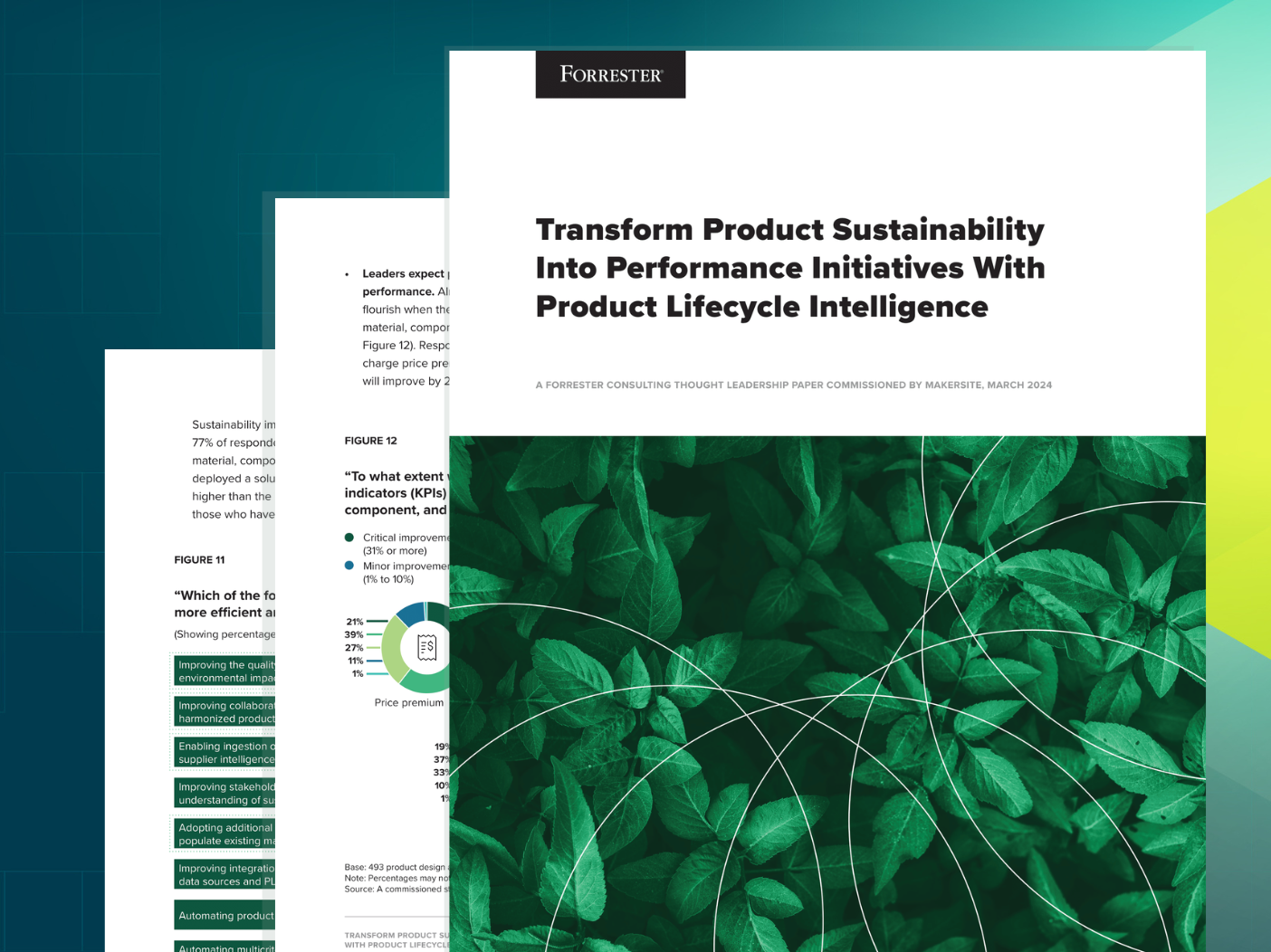
Makersite is proud to announce the launch of our co-authored study with Forrester, titled “Transform Product Sustainability into Performance Initiatives with Product Lifecycle Intelligence”. Not only is it a pivotal moment in Makersite’s journey and growth as a company, but it is also a confirmation of our vision and a validation of the underlying goals and objectives that serve as the foundation on which our software has been built.
Makersite Forrester

Make it better, not make it faster

As a society, we have reached a critical turning point. More and more companies are producing high-profile, single-use products which, in turn, has created a new normal – a continuing acceptance that increased consumption and rapid wastage is fine. And that doesn’t even consider the fact that some 80% of the ecological impact of a product happens in the design phase alone.

We exist in a place and a time where “take, make and waste” has become the norm. But there is a different future, one based around “make it better” rather than “make it faster.”

In order to make that vision a reality, however, we have to give those leading the charge the right platform to succeed. That is the purpose of Makersite. I see a future where those people who make and manufacture products – our product engineers and product designers – drive strategic transformation underpinned by a shared, compelling vision, financial support based on more than just commercial imperatives, and a dynamic ecosystem that is agile, efficient and geared toward ethical, criteria-driven innovation.

The power of data

Empowered with the right tools and best practices to make better products faster, engineers can provide the solutions needed to collaborate and take the actions that will make a difference. Products can be more sustainable, more efficient and more cost-effective while still making money and ensuring a profitable, healthy business. However, we must give them a foundation to work from first.

If we present engineers with the data they need, they will use it – and use it well. No one wants to make a ‘bad’ product, but ‘good’ products can only be made with the right decisions informed by the right data.

Some may argue that this is wishful thinking or is not worth the effort. However, a Bain & Company study found that while only 40% of businesses are on track to meet their sustainability goals, companies have an increasingly conscious and proactive base of consumers willing to pay 11% more for sustainable products and employees that will help.

A recent IBM report also noted that organizations that embed sustainability in their product design processes experience a 16% higher rate of revenue growth. They’re 52% more likely to outperform their peers on profitability. And they’re two times more likely to attribute great improvement in operating costs to sustainability efforts.

It’s not just blue-sky thinking for a greener future either. The most significant driver for companies to do anything has always been growing revenue. A 2022 report – the Sustainable Market Share Index – by NYU Stern’s Center for Sustainable Business examined what actually happened in the last decade and found that the share of CPG products marketed as being sustainable grew twice as fast as conventional products and accounted for one-third of the total revenue growth in the industry. Customers paid 27% more for those products.

Now is the time

With a massive demographic shift bringing more environmentally conscious buyers into the market already well underway, the time never has been better to build better products. This is what our study with Forrester reiterates. We have seen it and we have talked about it and we have translated ideas into actions with some of our biggest customers – Microsoft, Barco, Cummins, Schaeffler. It is fantastic to see that validated here.

We are amidst an unprecedented revolution that is changing not just the products we make, but how we make them. Companies that are set up for rapid change are becoming the new leaders of tomorrow and we’re already witnessing this evolution. Unfortunately, companies have only a piece of the data needed to make decisions quickly – the internal view. Most of the data needed comes from the world outside – supply chains, costs, regulations, impacts and others. This is the external view. The ability to combine the two instantaneously to drive better decisions and tradeoffs will avoid costly mistakes, shorten time-to-market and create more sustainable and successful products.

Study findings

The study, which includes insights from 493 respondents with product design and sourcing decision-makers in manufacturing, found that the surge in customer expectations alongside stringent regulations is pushing leaders to revolutionize their approaches to product lifecycle management and supply chain operations.

These leaders are increasingly championing sustainability within their organizations. However, they face significant hurdles; they’re often without the backing of upper management to enact meaningful strategic transformation, and they lack the necessary tools to provide access to precise, detailed data on materials, components and suppliers. This scenario underscores a critical juncture for decision-makers in product design and sourcing, urging a radical shift towards integrated, sustainable practices that meet the demands of a dynamic global market.

Ultimately, the study offers compelling evidence for the hypothesis that we have long been promoting as a company: that harmonized access to a breadth of reliable data forms the foundation of efficient product design and sourcing, and that organizations that are able to leverage granular product lifecycle intelligence in product development will enjoy competitive advantage against their peers with a faster time to market and more successful and profitable products.

There is plenty more to uncover in the study itself – from a wealth of new data to in-depth insight on the importance of data quality to a selection of actionable key takeaways that organizations can apply to their own business operations. Take your time to read our findings in full here.

Thanks,

Neil
How increasing your carbon footprint reporting can drive sales – and profits 

Makersite and Forrester’s collaborative thought leadership paper has, at its heart, a simple objective: to redefine how businesses approach sustainability. 

Makersite commissioned Forrester to evaluate the state and impact of sustainability in product lifecycle management in the manufacturing industry. In order to do so, they surveyed 493 organizations, liaising directly with product design and sourcing decision-makers in manufacturing to build the fullest possible picture of the opportunities – and challenges – that lie ahead. 

In a series of blog posts designed to compartmentalize the report, we’re taking a deeper look at 5 of the key takeaways for manufacturing businesses based on the research. 

You can read part one in the series here. For this instalment, we’ll outline why increasing the carbon footprint reporting of your products will be a key driver for sales and profits in your organization. 

Sustainability, without doubt, remains a critical business issue. Whether from a regulatory, reputational or financial perspective, an organization with its house in order is better primed for success. For some, sustainability and the regulations surrounding its proper implementation have been seen as little more than a fad. A box to tick in order to satisfy stakeholders and regulators. But now we have irrefutable evidence that better and more complete carbon footprint reporting serves as an essential catalyst for supporting – and driving – sales.  

Within the manufacturing industry, key decision makers in product design and sourcing are taking action to balance sustainability, resilience, and top and bottom-line improvements. There is a growing realization that manufacturers must become quicker, smarter, and more sustainable to survive. They can leverage material, component, and supplier intelligence to improve data visibility, to guide better design and sourcing decisions. With a stronger foundation and a more granular approach, carbon footprint reporting is no longer such a burden. 

Why do organizations need to do this? 

When it comes to carbon footprint reporting, now is not the time to stand still. Good intentions will get you nowhere. In a competitive marketplace, meeting reporting obligations is an absolute minimum. Moreover, companies who neglect to accelerate their carbon footprint reporting will find themselves rapidly losing their share of the market to those who have been more agile and innovative in their approach. Efficiency and data granularity are key. Without a solution that ticks both boxes, you will very quickly find yourself losing position to a competitor who is able to move faster than you. And once you’ve fallen behind, it becomes twice as hard to get back. 

Similarly, a more proactive approach to carbon footprint reporting will leave you poised for greater success going forward. Better product reporting can open your organization up to new markets and new audiences, which in turn will increase sales and profitability. It will also likely open up new territories where, previously, different reporting obligations may have meant that prior attempts at entry into that marketplace were stymied. The potential is enormous. You don’t have to make new products to access new markets and new customer segments – you simply have to report better, and report faster. 

As the Forrester paper notes, manufacturers with a more mature approach to their carbon footprint reporting – those who sought out and actively implemented a solution designed to enhance previous practices – are likely to see greater success. Those who integrate a material, component, and supplier intelligence solution into their PLM practices expect to see high gains across a number of important KPIs. Most prominently, manufacturers equipped with the right solution saw a 25% improvement in win rate, with 26% also identifying the opportunity to command a greater price premium. 

The hypothesis speaks for itself: manufacturers that integrate PLM processes with material, component, and supplier intelligence will enjoy time to market advantage over less mature competitors and have the opportunity to scale their scarce design and supply chain expertise over a wider range of product variants. 

How can Makersite help? 

Transparency is central to accurate, detailed carbon footprint reporting. With Makersite, organizations are able to rely on deep-tier, up-to-date and consistent data that allows them to demonstrate their decarbonization strategy in absolute detail. 

Depending on the nature of the product being manufactured, reporting across numerous product groups can be a painstaking task – particularly if it’s being done manually. However, with Makersite’s AI-driven solution, organizations can use product and supply chain data – sourced from the largest product and supply chain database with 36,000+ industrial processes, 600,000+ environmental impacts, and 100,000+ materials – to automate reporting across all products groups. 

Additionally, Makersite’s dedicated eco-design dashboard allows users to make data-driven product optimization decisions across sustainability, costing, risk and compliance. With some 80% of ecological impacts occurring in the design stage of a product, full oversight is critical when it comes to achieving sustainable design goals and hitting reporting parameters.  

Users simply have to upload their BOM and, once uploaded, they will receive automated, AI-driven recommendations for switching out key product components, in turn optimizing carbon footprint while lowering costs, giving them the depth of knowledge they need to make crucial design decisions at the click of a button. 

At Makersite, several of our key clients have experienced this revolutionary approach to optimizing carbon footprint reporting first-hand. 

Belgian technology giant Barco faced challenges in efficiently reporting SKU-level environmental data due to data being siloed and scattered across the supply chain, resulting in slow and costly manual efforts.  

To solve the problem, Makersite provided Barco with automated Life Cycle Analysis (LCA) and Product Environmental Footprints (PEFs) at the SKU level, allowing them to accurately offset their emissions, comply with EU taxonomy reporting requirements, and implement more targeted eco-design principles across their product portfolio 

By doing so, Barco were able to consolidate and enrich their data, perform comprehensive environmental reporting, and make data-driven decisions to minimize their environmental impact while lowering costs. 

Automating their LCAs allows Barco to accurately offset their emissions and further promote their climate-neutral ambitions, as well as strengthen communication on sustainability with external stakeholders – all based on data. 

In a similar vein, the cosmetics pioneer Lush wanted to double down on their already impressive sustainability and carbon footprint reporting credentials. As a company, Lush are closely aligned with and well-known for their commitment to sustainable processes. Customers and stakeholders alike expect them to lead from the front. Falling behind would not only have an impact reputationally, but financially too. 

The team at Lush felt they were not doing enough to measure supply chain impacts from an environmental point of view. They lacked visibility around carbon emissions produced as a result of their supply chain activity, and needed more detailed insight into where the problems lay. They lacked harmonized, integrated data, which hampered their ability to plan and hit their target of being “carbon neutral, climate positive” by 2030. 

Makersite’s integrated data software provided the solution Lush were looking for. With relevant data on supply chains typically siloed away in different databases, Makersite’s ability to bring together the 3,000 ingredients the company purchased worldwide in one platform made a big difference, giving them “all of the emission factors and LCA databases at our fingertips.” Lush were able to analyze various impacts at a much deeper, more granular level, and had all of their choices laid out directly and simply in front of them, allowing them to make sense of complex data and measure it more easily. 

Makersite’s modelling capabilities gave Lush significantly deeper insight into their supply chain data. From energy sources to waste management, a better understanding of how their supply chain operated gave Lush the ability to go back to suppliers and suggest changes in order to help them achieve their goals. The company now has an automated and scalable way to manage and understand their supply chain in greater detail, giving them the speed, scale and granularity that they were seeking and a much better chance of hitting their ambitious 2030 targets. 

Lush are preparing to release their first TCFD report based on modelling powered by Makersite. Their supply chain makes up 42% of their total emissions – by far the biggest impact in their business. With Makersite they’ve been able to assess the impact of more than 3,000 materials this year, including remodelling FY21 materials based on better data that more closely reflects the practices in the suppliers they buy from. Doing so has shown that Lush have reduced their carbon impact by 25% against emissions in 2021 – and all because of increased data accuracy and improved granularity provided by Makersite’s software. 

Being smarter with data – and being able to accurately measure it – not only allowed Lush to see where they needed to do work, but also gave them the platform to increase their transparency efforts and advance their goals. 

Ultimately, as a result of using Makersite’s solution, both companies were able to use more detailed, more granular product and supply chain data to not only automate their carbon footprint reporting, but to position their organizations as pioneers in their industry, giving them a distinct advantage in markets both old and new. 

How to meet increasing sustainability regulations 

Makersite and Forrester have collaborated on a thought leadership paper with a grand – but simple – goal: to redefine how businesses approach sustainability. 

Makersite commissioned Forrester to evaluate the state and impact of sustainability in product lifecycle management in the manufacturing industry. In order to do so, they surveyed 493 organizations, liaising directly with product design and sourcing decision-makers in manufacturing to build the fullest possible picture of the opportunities – and challenges – that lie ahead. 

We’ll delve further into the report in future blog posts, starting off with a series on 5 key takeaways for manufacturing businesses based on the research. 

The first takeaway: organizations must be able to keep pace with and meet the increasing number of sustainability regulations. Let’s take a look at why. 

It is clear from our research that sustainability – now more than ever – is business critical. For many organizations, its importance lies on par with revenue growth. A huge increase in sustainability regulations, heightened customer expectations around supply chain transparency, compounded with complexities in the supply chain of materials and components, are compelling manufacturers to transform their product lifecycle management and supply chain processes. 

Within the manufacturing industry, product design and sourcing leaders are addressing the intersection of sustainability, resilience, and business performance, prioritizing initiatives such as enhancing sustainability reporting for compliance and to support sales, as well as optimizing materials sourcing reliability and efficiency. 

Why do organizations need to do this? 

Most importantly, however, companies who seek to increase regulatory sustainability reporting of their products and operations will reap two particular benefits. 

Firstly, no matter the size of your organization, you need to abide by the regulatory requirements of the region, or regions, in which you’re seeking to operate. With an enhanced focus on and alignment with regional regulatory obligations, businesses give themselves a license to sell in the market they’re targeting. With some 80% of emissions coming in the design phase of a product, it’s crucial that each stage of the process is rigorously mapped and evaluated. 

Secondly, a firmer grasp on sustainability reporting goes a long way to establishing – and maintaining – business continuity. In an environment where marginal gains and a keen sense of foresight can offer major advantages over peers and competitors, a lackadaisical approach to sustainability reporting can quickly result in major supply disruptions (for example, having to find supply chain alternatives at the last minute, or at much greater cost), ultimately leading to lost production and severe impacts on revenue. In a competitive environment, such missteps can be hard to recover from. 

What are organizations doing currently? 

The Forrester research underlines these findings. 66% of respondents showcased an awareness and understanding of the potentially severe impact on product and operations that not toeing the regulatory line would bring about. Furthermore, a full 10% of respondents ranked ‘strengthening regulatory compliance’ as their greatest business priority during the next 12 months, while 35% in total ranked it as being within their top 3 priorities. Out of the 10 options given to those surveyed, ‘strengthening regulatory compliance’ came top of the list. 

Despite that figure winning out, however, the relatively low number indicates there is some way to go before there is a proper acceptance of the importance of increasing regulatory sustainability reporting. With only 35% of organizations having the initiative to solve the challenge, the research suggests an element of indecision and uncertainty, exacerbated by competing priorities coming from different angles. A successful organization in 2024 and beyond will be defined by its ability to cut through the noise, manage competing expectations, and execute a vision firmly focused on removing the biggest barriers to market entry and success as a priority. 

How can Makersite help? 

Whilst there are many benefits to regulation – from better risk management to increased transparency to greater innovation to enhanced efficiency – the increase in reporting requirements comes with some obvious downsides. They put a greater strain on teams and distract from the important work at hand. In many cases, organizations simply do not have enough people to actually put together the reports. This results in a scenario where the time spent on reporting adds little-to-nothing to business value. 

At Makersite, some of our biggest clients experienced that exact dilemma.  

We partnered with Microsoft to transform their LCA methodology from directional modeling to a supply chain-specific environmental impact accounting process. In doing so, Microsoft were able to automate and scale the modeling of complex electronic products with an unprecedented level of primary data coverage. 

Of the multiple benefits, perhaps the most valuable was the reduction of the modeling time, allowing Microsoft to focus their efforts on collecting and processing suppliers’ primary data and performing data quality assurance and data analysis. As Kelly Stumbaugh, Microsoft’s Director of Devices, Ecodesign, Ecolabels, and Carbon Emissions, noted: “[With Makersite] we are efficiently scaling up our LCAs so our engineers can focus on designing the best and most sustainable products instead of only focusing on disclosures.” 

Similarly, with Cummins Inc., the company had a clear goal that they needed help in executing. They wanted to grow and create a circular lifecycle plan for every part of their reports so that they could, as Mousumi Mukhopadhyay, their Manager of Circular Economy, stated: “Use less, use better and use again.” 

They were looking to take the next step in their sustainability journey. For them, this included keeping pace with the growth in annual ESG reporting obligations (including scaling their reporting capabilities to handle 27 ESG reports annually), standardizing their data and enhancing supply chain transparency through digitization.  

With Makersite, Cummins were able to digitize their supply chains to show multitiered data aggregation layers, including data assurance, traceability and transparency as well as the collection and inspection of specific domains. With our solution, they were able to show how a product was generated, trace its journey through the supply chain and translate that information into the required sustainability reports, setting them on their way towards achieving their ambitious 2050 goals: reducing Scope 3 absolute lifetime GHG emissions from newly sold products by 25% and reusing or responsibly recycling 100% of packaging plastics or any other goal. 

Ultimately, thanks to Makersite, both companies were able to use product and supply chain data to automate reporting across all product groups, saving time, greatly increasing efficiency and giving their teams a priceless opportunity to execute their key tasks undistracted and to the best of their abilities.