Makersite Acquires Siemens' SiGREEN

Read more
Close

The end of the entrepreneur: Why ‘take, make, waste’ culture must end

2 hours, 11 minutes, 53 seconds. That was how long it took Ethiopia’s Tigist Assefa to complete the Berlin Marathon in September 2023. She smashed the women’s marathon world record. Beat it by more than 2 minutes. But it wasn’t Assefa who made the headlines afterwards. It was her shoes. 

On her feet were the Adidas Adios Pro Evo 1. They weight just 138 grams. They have a 39-millimetre heel. They cost $500. And they’re only meant to last for one race. A feat of design and engineering? Absolutely. A revolution in running technology? Of course. But at what cost? 

Despite their public proclamations to the contrary – their stated commitments to ‘people, product and planet’ – Adidas, Nike (who also have a foot in the single-use shoe game) and their contemporaries seem to value column inches over reducing GHG emissions, instant (but fleeting) acclaim over a sustainable and more efficient future.  

Yes, they’ll tell you they’re only producing these shoes in very limited numbers and that it’s the lowest carbon emissions performance running shoe they have ever created. But that’s not the point. In its promotion of such a high-profile single-use product, Adidas are creating a new normal.  A continuing acceptance that increased consumption and rapid wastage is fine. Our global climate crisis is driven by over-consumption, an overreliance on oil-derived materials, huge energy usage in production and shipping and a general disregard for our environment. The Adidas Adios Pro Evo 1 represents everything that is bad in microcosm. 

But this isn’t an article written to call out Adidas. Their approach is simply emblematic of a bigger problem that we’re facing. A problem that, in our approach to solving it, will define us. We live in a world weighed down by commercialism and individualism. We venerate waste and consumption. We exist in a place and a time where ‘take, make and waste’ has become the norm. 

It didn’t have to be this way. Today, most products are made with a singular goal in mind: to sell as much as possible. If our leading companies were not blinded by greed and an unerring focus on the bottom line, they might be able to see that there is another way forward. A future where single-use products aren’t seen as little more than a tool to increase brand power and drive visibility, where sustainability and consideration of the environment aren’t sacrificed at the altar of the dollar. We are a long way from where we need to be. 

Our focus on wealth and immediacy is damaging us. A culture and an economy underpinned by the ‘get rich quick’ mantra is no good for anyone. The people at the helm of our biggest organizations are leaving us with a legacy of poor-quality products that add little to no value. Commercialism, consumption and immediate availability come at a price – and are all concepts defined by low costs, oversupply and a lax attitude towards sustainability and the health of our planet. 

Our culture of consumption has been orchestrated by a very specific type of business person. A person who started out with good intentions but either found themselves at the head of a hydra they could no longer control, or who simply lost their purpose – their duty to people and planet – as soon as money became the primary goal.  

They were no longer the makers and innovators that set out to change entrenched systems. Great ideas, without enough support to hold off commercial imperatives, meant that these people simply became a part of the system themselves. They fell in love with the ‘celebrity’ of the entrepreneur and the financial rewards that come with it. They take actions first and ask questions later. We are left with a scenario where the masses are in awe of the product but don’t consider what goes into creating it. And by the time the curtain falls and the negative cost and supply chain impacts of such rapid consumerism become clearer, it’s already too late. The damage has been done. 

These disruptors of old have become something else. Ideals corrupted by wealth and greed. A symptom of our problems rather than a cure for them. Douglas Rushkoff recently wrote about the “unbearable hubris” of Musk, Bezos and the rest, about their “increasingly outlandish and imperial” behaviour towards the world around them. He’s not wrong. These are men – and they’re almost always men – who cast contemptuous glances at anyone without a similar vision, who view rules and regulations as little more than minor impediments on their quest for growth. 

Unlike the titans of the past – Rockefeller, Carnegie, Vanderbilt, Morgan – it is harder to track the impact of today’s billionaires. Unlike their forebears, they are not capped by the limits of the material world. But that does not mean their operations do not have an impact. As Rushkoff notes, we can still see the consequences of their undertakings in the form of “externalised harm.” 

“Digital businesses,’ he writes, “depend on mineral slavery in Africa, dump toxic waste in China, facilitate the undermining of democracy across the globe and spread destabilising disinformation for profit – all from the sociopathic remove afforded by remote administration.” This represents a new frontier. The imperiousness of this new billionaire class is unprecedented, their “disregard for people and places” without comparison. 

Today’s entrepreneurial leaders are essentially unlimited in the broadness of their reach – holders of what Rushkoff terms “horizontal power.” They donate from their own organisations, often in the form of their own stock, and make their own decisions about how the money is spent. They exist in an impenetrable bubble whilst the world – remade in their own interests – collapses around them. 

But there is still hope. Still time to make a change. Damage has been done, but it is not yet irreversible. We don’t require a complete realignment. It is time, says Rushkoff, to “get on with reclaiming the world from this new generation of robber barons rather than continuing to fund their fantasies.” But how, and when? 

I think now is the moment for a new thought process. A future defined by collaboration, not individualism. Working together for the greater good. Not ‘make it faster’ but ‘make it better’. But in order to create the better world that so many of us want, we have to give our innovators the right platform to succeed. We need to create an environment where success isn’t judged on how many extra zeroes there are on the balance sheet, but on how we build for the future we want and how we protect our planet in the process. 

I’m done with radical promises. I’m finished with sceptics and non-believers. I’m putting my faith in product engineers being able to lead us to a new, better future where they drive strategic transformation underpinned by a shared, compelling vision, financial support based on more than just commercial imperatives and a dynamic ecosystem that is agile, efficient and geared toward ethical, criteria-driven innovation. 

And how do we get there? That’s something we’ll talk about next time.


An edited version of this article also appeared on Forbes.com.

CSDDD: Where do we go from here?

Update, 15th March 2024:

EU member states on Friday (15th March) have voted in favour of a stripped-down version of CSDDD.

MEPs and government officials struck a tentative deal on the Corporate Sustainability Due Diligence Directive, or CSDDD, in December – but its future was thrown into doubt after last-minute hesitation from Germany and Italy.

Now the measures seem likely to pass into law, after Italy approved a stripped-down version of the legislation at a regular meeting of diplomats in Brussels.

The rules still need to be voted on by MEPs, and April is the last chance for them to do so ahead of June elections. Click here for more detail.

————————————————————————————

In light of the latest development in CSDDD’s (Corporate Sustainability Due Diligence Directive) labyrinthine path through the corridors of EU legislation, it seems pertinent to once again re-examine what it is, what its goals are, and what lies ahead now that it failed to achieve final approval by the European Council.

What is CSDDD?

The Corporate Sustainability Due Diligence Directive, more commonly shortened to either CSDDD or CS3D, is a key piece of EU legislation that seeks to set mandatory obligations for companies to address the negative impacts of their supply chains on human rights and the environment.

At its core CSDDD requires due diligence around companies’ business operations and supply chains. That means companies must look at not just who they buy from, but who those supply chain partners buy from as well.

The intention of CSDDD is to build on another EU directive – the Corporate Sustainability Reporting Directive (better known as CSRD) – which covers disclosures and operations. It requires companies to look at their carbon footprint and their impact on human rights and labor laws, among other ESG goals.

In its proposed format, CSDDD is meant to act as an enforcement mechanism for the EU – a vehicle for checking in and ensuring that ESG initiatives are being followed. Hypothetically speaking, if a company claims to make a reduction measure in environmental impacts, CSDDD will ensure that it’s actually being done. Essentially, CSDDD functions as the legal imperative to perform the due diligence, meaning that organizations cannot just create a report and claim adherence.

In tandem with CSRD, CSDDD also supports the due diligence of other regulations and directives, including but not limited to the Global Reporting Initiative, Carbon Disclosure Project and the Sustainable Finance Disclosure Regulation (SFDR).

Under the proposed directive, companies with more than 250 employees and a global turnover of over 40 million euros would be subject to the requirements. This contrasts with the previous draft, which set the limits at 500 employees and 150 million euros. To accommodate different company sizes, staggered transition periods of up to five years are suggested.

What’s the latest development – and what’s happened previously?

Although many assumed that the formal enacting of CSDDD was a foregone conclusion, a significant blow was dealt on 28th February 2024. Despite a provisional agreement having previously been reached by the EU Council and the EU Parliament, the directive failed to achieve final approval following objections from countries including Germany and Italy.

This follows a four-year process to advance the regulation, beginning with studies by the European Commission in 2020, which in turn lead to the Commission’s proposed CSDDD draft in February 2022. That draft set out obligations for companies to identify, assess, prevent, mitigate, address and remedy impacts on people and planet in their upstream supply chain and some downstream activities such as distribution and recycling. On 1st June 2023, the majority of Members of the European Parliament (MEPs) voted in favor of strengthening the original legislative proposal put forth by the EU Commission.

Agreement was reached on CSDDD with the EU Parliament in December 2023, but a vote on its approval in the EU Council was postponed last month after, according to ESG Today, “Germany threatened to not support the regulation on concerns of the bureaucratic and potential legal impact it would have on companies, and [it was] thrown into further doubt when Italy reportedly also subsequently pulled its support.” Recent rumors have also suggested that a last-minute effort by France to significantly scale back the scope of the new rules further scuppered any chance of approval.

What happens now?

Whether CSDDD is dead in the water – as it appears – or whether the recent troubles are something of a political bluff – a strategic move to tease out the opposition – remains to be seen.

After the failure of the approval the Belgian Presidency of the Council released a statement which concluded: “We now have to consider the state of play and will see if it’s possible to address the concerns put forward by member states, in consultation with the European Parliament.” What those concerns are – and whether they can be overcome – is fundamental to any future approval of CSDDD.

What is not in doubt, however, is the disappointment of key sustainability figures, who view the politicking and back-and-forth as little more than a scandalous attempt at obfuscation.

As Uku Lilleväli, Sustainable Finance Policy Officer at WWF European Policy Office, noted: “It’s scandalous that, in the 21st century, certain European lawmakers wish to permit companies to ignore human rights and environmental integrity, all under the guise of short-term profits. Let’s be clear: the law wouldn’t burden companies with unnecessary red tape; instead, it would secure a level playing field and help firms navigate necessary transitions in an informed and responsible manner.”

However, regardless of the future direction of travel of CSDDD, it remains clear that the push for increased regulation and legislation isn’t going anywhere. It is time for companies to get their houses in order.

In order to prepare, they must put together a holistic view of their supply chains along with a product-centric view of the lifecycle of their products.

Under a product-centric view, companies start upstream and follow each product all the way downstream so they can get a holistic view of their supply chain. This will better set them up for success when they try to align their efforts with regulations when the time comes.

As for when that will be – who knows? But it will be sooner rather than later, and forward-thinking organizations should start to get a handle on their supply chains now. As initiatives like CSDDD – or whatever guise it may take in the future – become more common, the thresholds for compliance will go down and more and more businesses will be required to pay attention.

One way or another – and with an eye firmly on the longer-term future – initiatives like CSRD and CSDDD are going to have an impact on your business.

Forecasting the future: From tightening budgets to the rise of Gen AI


We might not have a crystal ball, but we do have a very good idea of where the worlds of manufacturing and product development are heading in the months and years ahead. 

The pace of change – and the regulatory, market and stakeholder demands that accompany it – has, and will continue to be, rapid. For all of these predictions it is not a case of ‘if’, but ‘when’. 

For businesses looking to capitalize on this momentum, the time is now. Being ahead of the curve is much easier than catching up. 

Below, we offer some insights of our own alongside contributions from a couple of our closest collaborators.  

Predictions from Makersite: 

Supply chain disruptions will subside

Contrary to the fearmongering that we’ve seen in the news lately, we believe that disruptions will continue to subside in 2024, bringing immense relief to manufacturers and customers. Most of the supply chains have recovered from pandemic era disruptions, both in terms of production and logistics. While recent challenges in the Red Sea have caused concern, logistics have largely adapted with marginal increases in delivery times and costs thanks to the overcapacity that was created after the pandemic. 

Generative AI will not take our jobs, yet

This topic isn’t quite our wheelhouse, but as there is so much hype about GenAI we felt we had to say something. While a quarter of CEO’s anticipate significant AI-related job losses this year (Source: PwC, Global CEO Survey), we feel this is massively overblown. The truth is that these things take time in most functions where its applications are still immature. 

Companies will remain carbon neutral , experimenting with the use of generative AI to create marketing content, summarize customer service calls, unlock domain-specific knowledge via chatbots and generate workflows and apps. Jobs in supply chains are not going anywhere. In fact, it’s never been cooler to be in this space.

It’s also worth keeping a close eye on how some of our biggest and most innovative companies are embracing the possibilities of generative AI. Look to Autodesk and PTC’s use of generative design – “a form of AI that produces myriad solutions to defined engineering problems” – and its ability to boost innovation, reduce waste, and accelerate time-to-market. Both showcase a potential future where engineers and AI work in tandem to create something demonstrably better. As PTC puts it: “[With generative AI] engineers can interact with the technology to create superior designs and drive product innovation more quickly.”

Budgets will continue to tighten

While there is a lot more optimism amongst business leaders (PwC Global CEO Survey) and consumers (Source: Ipsos, Global Advisor Predictions 2024) than in 2023, Makersite CEO Neil D’Souza predicts that for the most part, 2024 will be a year when companies have to “do even more with even less.” There is still a lot of ambiguity in the EU,” he notes.

“The economy is growing in the US, but in the EU it’s stagnating. Across manufacturing, budgets are still getting cut and I don’t think that’s going to change any time soon.” Unfortunately, most of the primary levers of efficiency have been exhausted, so companies will need to make investments to drive the next level of savings.  

The “S” in ESG will become more important

When it comes to an increasing onus on rules, regulations and political optics, Sophie Kieselbach, Makersite’s Experts Team Lead, believes that the ‘S’ in ‘ESG’ is going to increase in prominence. “Driven by the Corporate Sustainability Reporting Directive (CSRD), 2024 will be the year when social indicators really begin to permeate business decisions along the supply chain. Businesses will need to start implementing more concrete methodologies that allow them to track human rights issues such as slavery or child labour or gender inequality more accurately.”  

Future Forecasting Quote

Predictions from friends of Makersite: 

We also reached out to a few close friends of Makersite for their input on what the future holds. Here are their predictions:

Leaders in sustainability will finally get to shine

Capgemini’s Lukas Birn, VP of Sustainability believes that as we navigate through 2024, the disparity between sustainability leaders and laggards will become starkly evident. Those lagging behind will find themselves grappling with increasingly stringent legislation designed to curtail unsustainable practices.

In contrast, sustainability frontrunners will intensify their investment in innovative products and services that bolster their commitment to a Net Zero future. With the likelihood of an economic downturn, there will be a heightened emphasis on cost-efficiency and the maximization of impact. Budget constraints will prompt a more judicious allocation of resources, ensuring that only the most effective sustainability initiatives are pursued.  

Customers and regulators will amplify calls for transparency

67% of chief supply chain officers now oversee environmental and social sustainability KPIs, with many setting ambitious targets for carbon neutrality within five to 10 years. To achieve green and circular supply chains, companies are building ecosystems that extend beyond their internal operations and Tier 1 suppliers, driving change across the entire value chain. This will require a greater level and quality of transparency internally – to drive better decision making – but also externally, due to regulations

As Microsoft’s Kelly Stumbaugh, Director Devices, Ecodesign, Ecolabels, and Carbon Emissions, says: “Something that is top of mind for me is growing demand for transparency around sustainability metrics, especially GHG emissions and circularity (at least for my industry, electronics). To accomplish this in an ethical manner, companies will need to continue to increase rigor around how these metrics are calculated and the input data that they are collecting, and to include these details and explanations of methodology along with the metrics themselves. Regulations and initiatives in Europe such as SPI, CSRD, and CBAM will drive much of this, but so will customer demand.” 

Power to the people: Why sustainability is an issue everyone must tackle

“The most important values to me are honesty and modesty. I think that’s something we all need in this context as well. The clock is ticking. We need to show modesty towards the people who actually have to do this stuff – we need to help them and not judge them for creating dirty products. It’s about guiding them along the right path.”

Berlin-based Lukas Birn is VP of Sustainability at the French company Capgemini, a global leader in consulting, technology services and digital transformation.

Lukas’ personal journey towards sustainability commenced as a teenager, at a time when individuals were first encouraged to sort their plastic waste by hand. Today, his understanding has evolved, fueled in large part by the profound impact of witnessing the world through his children’s eyes. This transformative change in perspective led him to transition his deeply held personal convictions into a fulfilling career dedicated to the advancement of sustainability.

We recently sat down with Lukas to talk through what sustainability means to him, his career path, and his thoughts on what the future holds.

Below, we discuss:

  • The perils of taking shortcuts and looking for easy solutions
  • The importance of not judging others for their decisions, and the need to follow your own path
  • Putting the power of change into the hands of everyday people rather than just a few specialists
  • To remember that the loudest voices in the room don’t necessarily belong to the most important people
  • The emergence of generative AI, and the impact it can have on our approach to sustainability challenges

Makersite: The first question I have is very open-ended. What does sustainability mean to you?

Lukas Birn: Obviously, sustainability in general is super broad. So I tend to think of it more for the planetary part. There’s always the ‘grandchildren perspective’ – what do we do for the upcoming generations? And I think if you have your own children, then it’s very clear and obvious. The question is simple: How can we ensure that the upcoming generations have a planet they want to live on as well?

M: In terms of your career path and your role now [as a VP of Sustainability] – what does that involve?

LB: ‘VP’ is just a title. It can be anything and nothing. It can mean different things to different people in different companies. In terms of my work at Capgemini, an IT consultancy, it’s of course not about the sustainability of our company, but what we offer to our clients. Both us and our clients are generally large and complex organizations. I see myself as a facilitator, walking around with my grease can and lubricating the wheels. Minimizing friction. Bringing together all the expertise that’s already there.

There are some people who have worked in sustainability for many years – for decades – but often they’ve been operating in silos. Now, it’s really about scaling and connecting. This is where I can help.

M: To that point – weaving things together, minimizing friction – what skills do you need to succeed in a role like yours?

LB: Sustainability is a complex project. One of the main challenges is about systematic thinking. It’s not just a simple trick here and there and then you’re done. If you use a trick in one place, you can easily be doing more harm than good elsewhere. And as an engineer by profession, I’m always wary of shortcuts and easy solutions. I think having a scientific approach – really looking at the numbers and avoiding wishful thinking – are core capabilities. It’s not only about what is technically feasible but what is viable, and having a holistic view on that. To me, that’s key.

M: What motivated you to work in sustainability? What put you on this path in the first place?

LB: For a long time, I was always only sustainable in my life outside of work. My father was actually my first touch point. He was a publisher of laws and he was already active in the circular economy 40 years ago. It has long been an old issue in the industry. It was more about chemicals and harmful materials that ended up in nature, but the topic was present.

And then having children, and also now being 50, I asked myself ‘what career change would be interesting for me?’ I saw some colleagues at Capgemini struggling with organizational complexity, so I thought ‘why not combine my private motivations with my ambition to master complex organizations?’ And that’s how the two things came together.

M: Was it always your intention to pivot your career in that direction at some point, or was it more that you just saw the opportunity and took it?

LB: It was not long-term career planning. Some people do that, but not me. It just happened. Maybe it was the Buddhist inside me – enlightenment. I just said ‘let’s do it.’ In your career there are always some motivations and some voids. So I filled the voids.

M: Going back to the personal/private side of things, how do you make your own life more sustainable?

LB: One thing I want to point out here is that people tend to overemphasize things they are already doing anyway. For instance, I’ve been a vegetarian for 35 years. But it just happened by chance when I was a child and now I stick to it. It’s not like I go around telling everyone ‘oh yeah, I’m a vegetarian.’ I’ve never had a car because I live in the center of Berlin. Under the given conditions, it’s easy.

I’m not a big traveler, so I don’t take the plane. It’s really about minimizing, but I’m also reluctant to preach about what is easy for me and not consider the other side. For people who love to travel and see different cultures, it’s much harder to say ‘I’m not going to take flights anymore.’

M: What about something new you learned in the last year? It could be around sustainability, but it can be broader. It can be positive or negative.

LB: Obviously anyone involved with sustainability has heard about the Greenhouse Gas Protocol, but as with many things in life it’s not as simple as it looks. The more you get into it, the more complexity there is. And then what if you’re shifting it from Scope 1 to Scope 3 or vice versa? So for me, I learnt a lot more not just about the simplicity of this protocol but also the challenges. It’s a common denominator for all of us, and it’s really helpful to close at least some gaps in the system.

M: Where do you think companies are lacking at the moment in their approach to sustainability? What can they do better and how can they do it?

LB: I always say, in the end, it’s simple. It’s all about getting to [Net] Zero. First of all, you need to know your baseline. And this can be quite complex, because most mid-sized companies are now global players. They have hundreds of legal entities, and are spread all over the world. The first step is always a challenge. They will say ‘oh, I wasn’t aware that it is part of my scope as well.’

Once you’ve had those discussions and established that transparency, it’s about going from ambition to action. I’m not talking about reporting and ESG and CSRD, but looking ahead to 2030. That’s what’s important. How do you get there? How do you really measure? You can do a sustainability report, and that’s great, but you need to really measure the impact correctly in order to tackle the challenges.

I had a discussion with a colleague from Volvo once, and he said his most challenging part is to look at the things they do already through the lens of sustainability. How do you get rid of  what is really hurting companies? That’s something we need to think more about.

Lukas Birn Capgemini

M: When you’re having those conversations with companies around sustainability, what resonates the most? What makes them realize that they really need to take action?

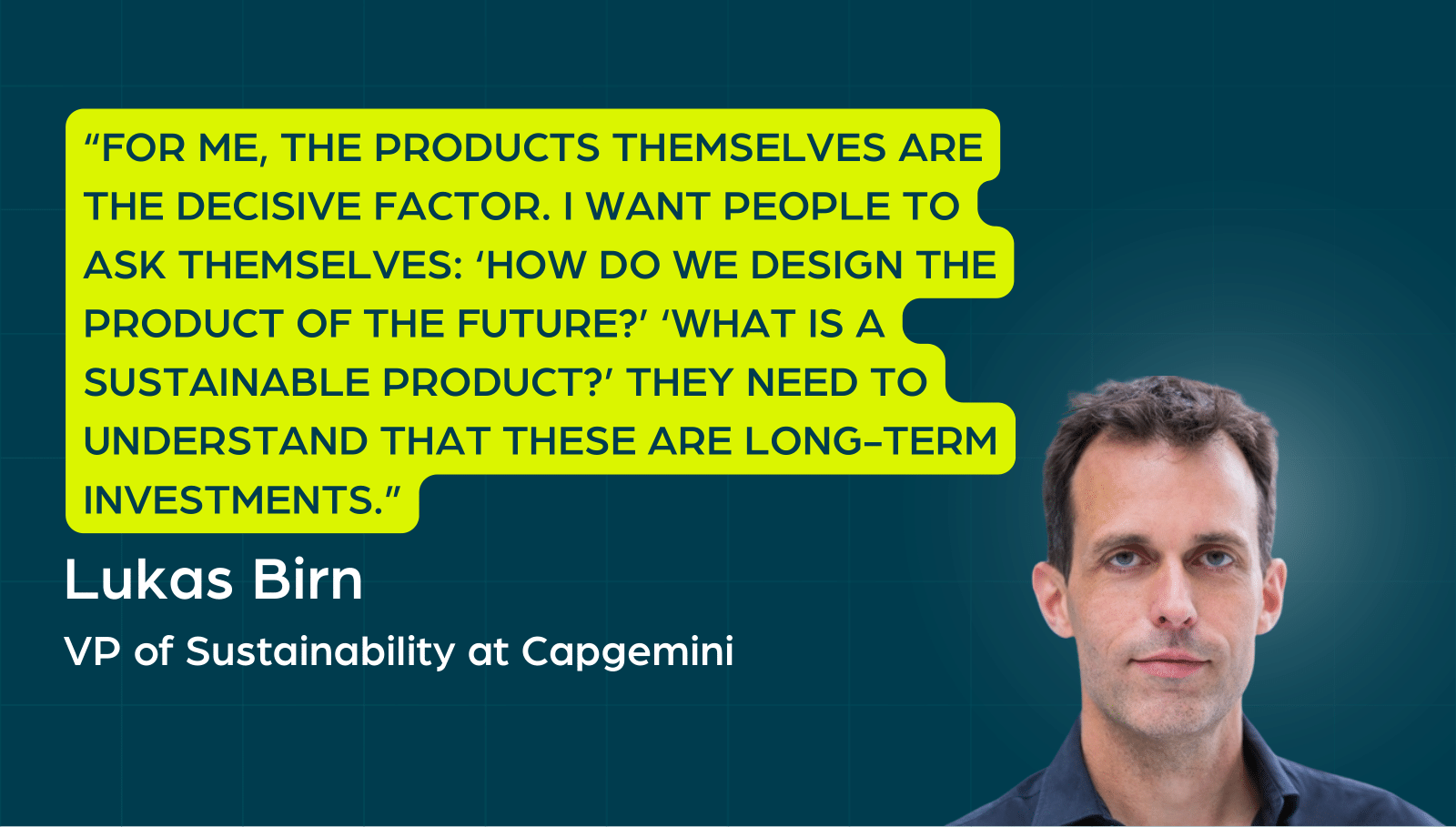
LB: Being an engineer, I’m a little biased. I think the products themselves are the decisive factor, and therefore I’m always shifting the scope away from minor impacts that for many customers are part of operating the supply chains. I want people to ask themselves: ‘How do we design the product of the future?’ ‘What is a sustainable product?’ ‘Which product contributes to the idea of a circular economy?’ They need to understand that these are long-term investments.

Above all, I think it’s important to take sustainability out of the hands of the dedicated sustainability professionals and give it to the ordinary people. They are the ones who need to make it happen. Maybe it’s all tiny steps, but eventually it adds up to making better, greener products. That’s where we need to be.

Capgemini has had the same seven core values for the last 50 years. The most important values to me are honesty and modesty. I think that’s something we all need in this context as well. The clock is ticking. We need to show modesty towards the people who actually have to do this stuff – we need to help them and not judge them for creating dirty products. It’s about guiding them along the right path.

M: In terms of today’s evolving regulatory environment, both in Europe and in the US, do you think we’re heading in the right direction? Are there areas that are neglected? What legislation would you like to see?

LB: I think there’s never a customer complaining about regulation. All of them realize that we need it. However, since sustainability or climate change is by definition a global problem, we need a level playing field globally. There’s no value in bankrupting an industry in one country and then importing dirty products from another. I think it’s important that we avoid going back to a protectionist approach. It’s a balancing act.

Especially with the EU, they’re really driving forward all the initiatives, which is a challenge for companies, but it’s manageable and it’s a real opportunity for change. When we had GDPR, many smart technologies emerged as a result and I think it will be the same here.

AI, for example, can help you streamline and cope with the bureaucracy and the paperwork. At their core, all regulations have a good purpose and a good intention.

M: Do you ever worry that the conversation around sustainability has become too politicized? Do you think it dilutes its importance?

LB: Yeah, but I think sometimes the loudest voices don’t necessarily belong to the most important people. You see it in every company. ‘We can’t afford sustainability, it will ruin our business.’ But maybe some businesses are doomed for good reasons. There’s always that free capitalism, too. On the one hand there are negative effects, but on the other hand it’s really transformative.

Today you see people leaving companies because they’re not doing what they promised to do. It’s important that we have that freedom. If companies are receiving government contracts, will they really feel the need to change things? Is the imperative still there? They are incentivizing the wrong behavior. That could be a challenge.

M: When it comes to promoting a long-term approach to sustainability, how would you do it?

LB: I think I kind of answered that before when I said it’s about thinking of zero. That’s it essentially. It’s about having a goal at the very end and working towards that. What it comes down to, when you’re thinking about 2030 or 2050, is to think of the strategy. It’s not just something for the end of the month or the end of the year. How do you really make it last?

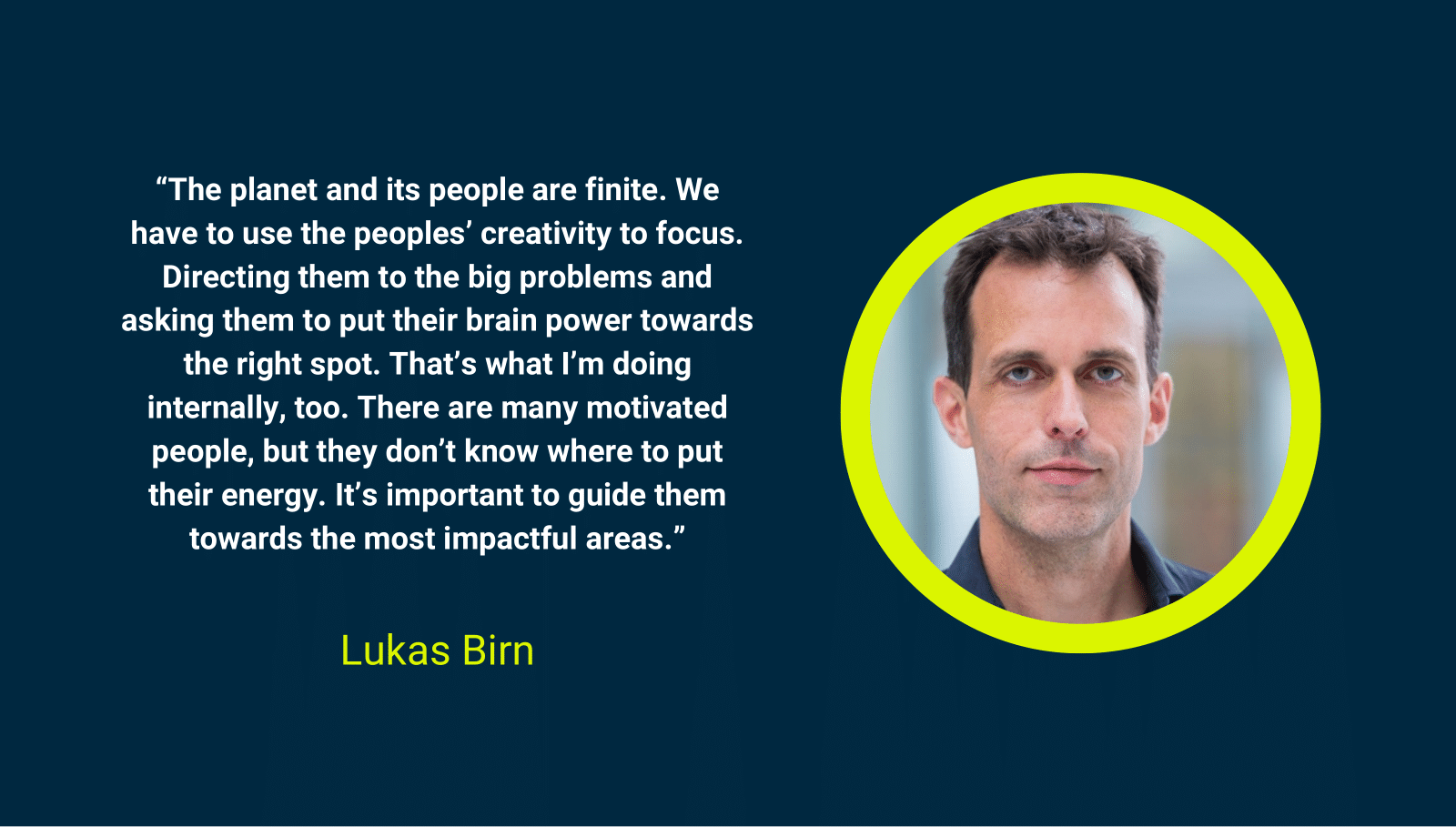
The planet and its people are finite. We have to use the peoples’ creativity to focus. Directing them to the big problems and asking them to put their brain power towards the right spot. That’s what I’m doing internally, too. There are many motivated people, but they don’t know where to put their energy. It’s important to guide them towards the most impactful areas.

M: Where do you hope the world will be from a sustainability perspective in 2050, and where do you think it’ll be?

LB: I’m an optimistic person. You have to be optimistic, especially if you have children. There’s no point in just saying that we’re all doomed. There are many things that should motivate us. There are different opinions, but it feels like a tsunami is piling up and I think there is movement. Did something like COP28 make a difference? I don’t know. But I’m positive that there will be massive changes and that a transformation  is underway, and  it will also change how the world functions.

We are going towards a more decentralized system. Both solar and wind are decentralized by design. It’s about taking something off the big energy producers, about reshuffling the cards to create a broader perspective. Let’s look at Africa and what’s at stake there. It is their right to do what’s best for themselves. That is critical. It’s not about telling them what they should do regarding climate, but we must support them.

M: Ok, last question. AI is everywhere. How do think generative AI and sustainability might align in the future? Is it good thing or a bad thing? Do you think about it much?

LB: I think it’s unavoidable. You can’t just say ‘let’s leave generative AI alone because it’s too energy intensive.’ We have to find a solution. It’s not having a hammer and everything being a nail. It’s about working out where it fits. I think it’s a really beautiful technology and there’s a lot of value to it. It blows my mind. I write something in my lousy English and then the AI transforms it and it’s so simple and easy. Someone else can grasp it.

Climate tech is important, too. Carbon capture and storage, for example. It’s about striking a balance, even if it’s only a few percent we can rescue. Even if we can only solve a small part of the problem or change the situation a little for the better, it is already important.

Hypocrisy at COP28: Are youth voices being ignored on climate change?


“Climate change and sustainability are global issues. It’s something everyone needs to be on board with. Not just on a personal level, but on a business level and a political level.”

At Makersite, our employees are here because of their expertise, their backgrounds and their belief in the ability of AI to solve today’s sustainability data challenges. Our staff across three continents have been hand-picked because of what they bring to the table. It’s no different with Alexa Born, one of our Enterprise Sales Managers.

Recently, as a key member of the UK Youth Climate Coalition (UKYCC), Alexa attended the COP28 summit in Dubai. With an M.Sc in Environmental, Economic and Social Sustainability and a background in sustainability-focused roles, she understands what’s at stake.

In the interview below, we sat down with Alexa to talk about her background in sustainability, her role in the UKYCC and COP28, and the hopes she holds for the future. We cover:

  • How Alexa’s role at Makersite – helping companies to decarbonize their supply chains – sits alongside her work with the UKYCC and COP
  • Concerns around Scope 3, sustainability reporting and a lack of action from big business
  • The inherent hypocrisy of hosting a climate conference in heavily oil-producing countries and using it as a platform to generate more oil deals
  • The difficulties of getting the concerns of today’s youth in front of our politicians and policymakers
  • The importance of building knowledge around climate and making sure that youth voices are heard

Makersite: Let’s start with the big question. What does sustainability mean to you?

Alexa Born: To me, sustainability is about being conscious of the impact of your actions and about thinking beyond just the here and now. I think people sometimes lose perspective that the greed of today is going to disrupt the needs of people in years to come.

M: Tell me about your background when it comes to sustainability. What got you interested? What motivates you?

AB: I have an older sister who entered the climate space when she was a teenager. As a little girl, that made me very aware of the topic from a young age. Because of her interest, I became interested. I then pursued Human Geography for my undergraduate degree and then went on to do a master’s in Sustainability. It’s something that has become embedded within me, both educationally and professionally.

M: So it was always your intention to pursue that kind of pathway?

AB: Yeah. I feel quite lucky. From a young age I always had it in my mind, quite clearly, that that was the kind of work I wanted to do.

M: Looking to the future, what do you hope to achieve from a sustainability perspective? Where do you see yourself – and the world – in the next 10 years?

AB: Sustainability is obviously a hot topic in terms of career paths. It’s something that a lot of people are very interested in at the moment. But it’s very hard to know what that landscape will look like in 10 years’ time. I certainly never saw myself in supply chain sustainability, but it’s something I became very interested in at university and now during my time at Makersite.

Looking ahead, I’ve always had a really strong interest in the intersectionality between health and sustainability and climate change. That’s something I’d like to move towards. But equally, where I am now with Makersite, and balancing that alongside climate activism, feels very fulfilling.

M: That segues nicely into my next question. Tell me a bit about what you do at Makersite, and how that dovetails with your work at the UKYCC and the recent COP28 summit in Dubai?

AB: Sure. At Makersite, I work on the business development side of the business. I speak to manufacturers in the UK and Nordic markets who are looking to decarbonize their supply chains, whether that’s due to regulatory pressure or ambitious targets (like achieving Net Zero by 2030) or whatever it may be. I reach out to them and see how we [Makersite] can partner with them to decarbonize their supply chains through sustainable procurement, better product design or another avenue.

In terms of how that relates to my work at COP, I was there predominantly as a youth activist and as a delegate of the UKYCC. The UKYCC runs a different campaign every year, and this year we campaigned on a Conflict of Interest (COI) policy – particularly relevant given where the event was held this year, and because of the obvious conflict of interest between the role of the presidency and the overarching goal of what the COP seeks to achieve.

I took the opportunity of being in that space to attend some really interesting side events around sustainability and to connect with some people from the industrial arena. I wanted to understand what people’s challenges are and what discussions are going on in relation to the problems that Makersite is seeking to solve.

From that perspective, Scope 3 emissions seemed to be a key pain point in pretty much every single one of the side events I attended. That definitely seems to be the biggest point of concern at the moment.

M: For those who don’t know, how would you describe COP? What are the goals of the event? Who attends?

AB: COP stands for Conference of the Parties. It basically provides an opportunity every year to bring together parties from all over the world and provide a platform for them to voice their concerns about what’s happening with climate change, as well as a chance to push their agendas on where they feel we should be globally on climate change. It is a global issue, after all.

I think the real beauty of COP is that it provides a platform to nations and parties that don’t tend to have as loud a voice in the global space. The small island states, for example.

M: And it’s those small island states that are the most vulnerable to the impact of climate change.

AB: Exactly. It gives those who are really suffering most a place to voice that and also an opportunity to contribute to the solutions that are being put in place to deal with, mitigate and adapt to the climate crisis.

M: You attended as a delegate of the UKYCC. You mentioned the campaign being undertaken this year, but what’s the goal of the Coalition more generally?

AB: Within the UKYCC we have different working groups. Each of those groups have a variety of goals. I’m in the COP working group. We send a delegation to attend the COP each year, where we seek to represent youth voices. When we’re recruiting for the UKYCC we make sure that we are as representative as possible geographically, demographically and so on so that when we go to COP and we’re lobbying UK negotiators and EU negotiators, we’re doing it on behalf of a true reflection of UK youth.

M: How do the negotiators treat you? Do they take what you have to say seriously? Do they understand the points you’re trying to get across?

AB: It’s a mixed bag. Every year we get told how important youth voices are to them and how much they want to know how we feel they’re doing, both positively and negatively. But getting time on calendars for the last few years has been increasingly difficult, which is frustrating.

For that reason, we’ve sought meetings with other important voices at COP. Members of the opposition, for example. We met with Ed Miliband. We met with some advisors of Humza Yousaf. When we’re unable to connect directly with negotiators, we do try and get a bit more creative. That being said, the second of the two delegations we sent this year did actually end up having some facetime with the UK negotiators and that allowed us to push our agenda a little bit.

M: Tell me more about your Conflict of Interest agenda. What does it mean? What’s the objective?

AB: We have a few asks. Our demands are that the UNFCCC (United Nations Framework Convention on Climate Change) formally recognizes the need to have a conflict of interest policy to prevent bodies or voices that don’t have our best interests at heart being in those spaces and lobbying for their own objectives.

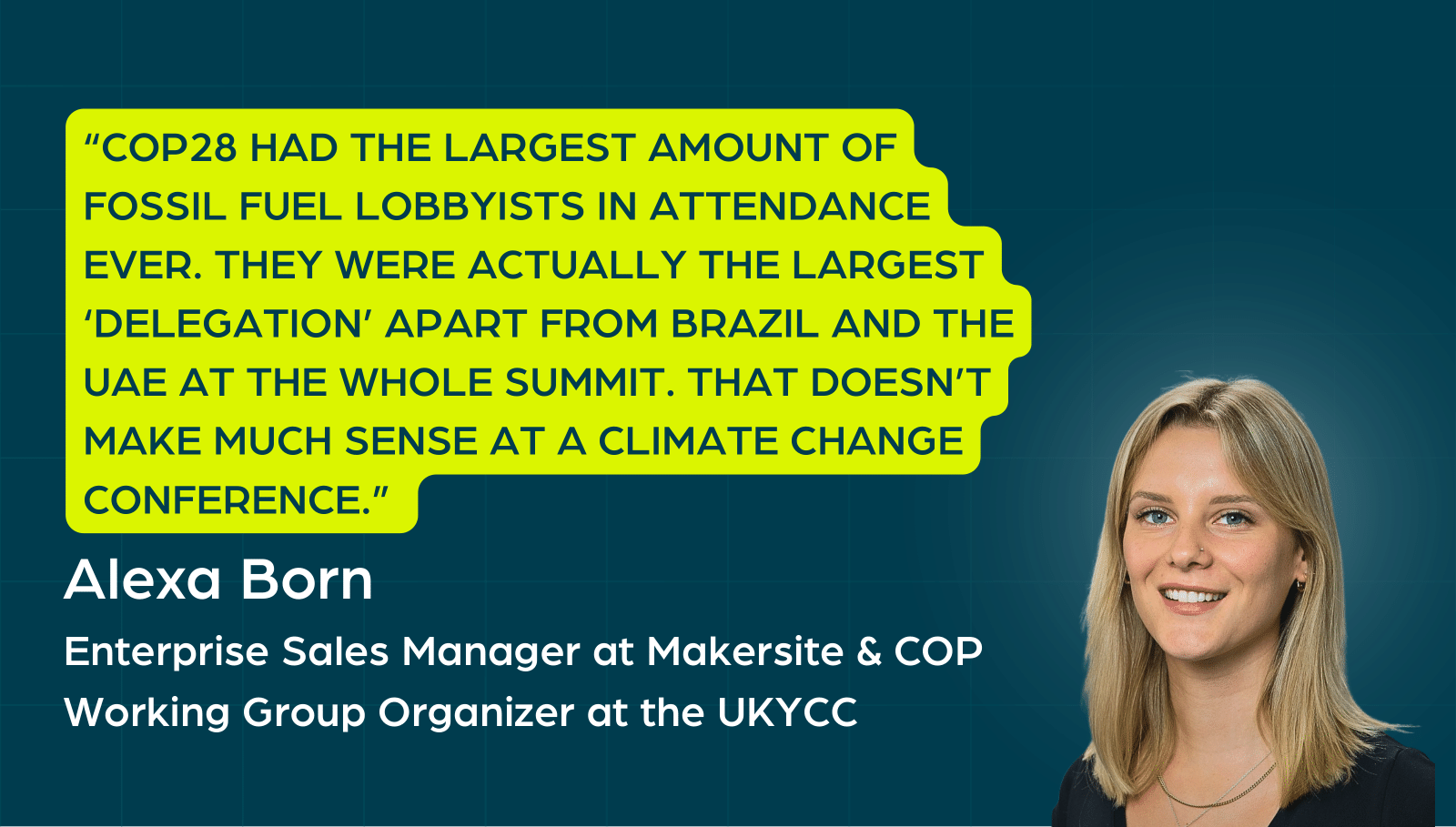
This year, for example, KBPO (Kick Big Polluters Out) released some astounding evidence. COP28 had the largest amount of fossil fuel lobbyists in attendance ever. They were actually the largest ‘delegation’ apart from Brazil and the UAE at the whole summit. That doesn’t make much sense at a climate change conference. And that’s what we do – we go to COP and we protest against these actions. You wouldn’t allow tobacco companies to organize a health conference. So why are we allowing fossil fuel companies to organize and contribute to a climate change conference? Ultimately, how do you square the goals of COP with hosting in a nation like the UAE?

M: There’s definitely some hypocrisy there.

AB: Yeah, absolutely. We discussed a lot whether we even wanted to attend this year or not. That’s what’s a shame about this particular COP. The conflict of interest angle sparked the interest of a lot of people, and a lot of people who wouldn’t have interest in COP28 normally. Like the fact that the COP president used the event as a platform to generate more oil deals. I had friends, who otherwise would have no interest, speaking to me about that.

But the whole hosting it in Dubai angle does reduce the legitimacy of what is a really important conference. Last year it was in Egypt, Next year it’s in Azerbaijan. That’s three years in a row where oil-producing nations are hosting the COP. We’re seeing language around phasing out fossil fuels being watered down too. That’s clearly for the benefit of the host nations.

The beauty of the COP is that it represents everyone’s voice. Climate change is a global issue. We need to make sure that everyone is included in developing and implementing these solutions. If nothing else, COP28 has shown that that’s not easy.

Alexa COP28 UKYCC

M: You mentioned Scope 3 previously. What are your key takeaways from this year’s event?

AB: There are literally thousands of side events at COP and I only have so much time, so I could only attend a small percentage of them. And the ones I did attend were focused on issues that matter to Makersite. But the onus seemed to be predominantly on the value chain / supply chain / decarbonization piece. The challenges around Scope 3 reporting came up consistently.

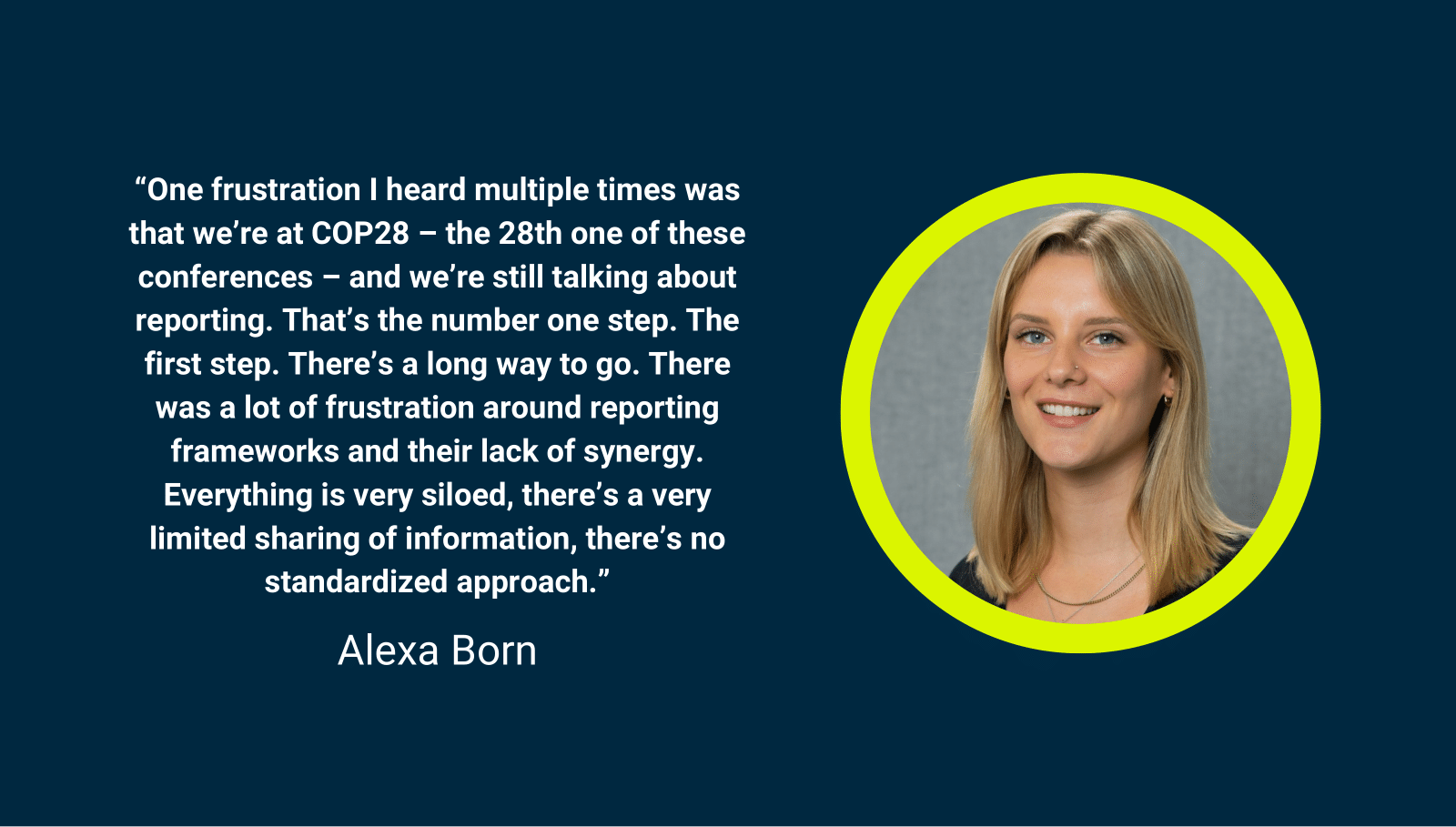
One frustration I heard multiple times was that we’re at COP28 – the 28th one of these conferences – and we’re still talking about reporting. That’s the number one step. The first step. There’s a long way to go. There was a lot of frustration around reporting frameworks and their lack of synergy. Everything is very siloed, there’s a very limited sharing of information, there’s no standardized approach.

All of that makes it very difficult for organizations. They’re spending way too much time on reporting rather than actually working and dedicating their capacity towards the things that matter. Reduction strategies, for example. There were some interesting announcements about different coalitions that are starting to emerge. We’re seeing different industrial organizations starting to work together to establish some kind of standardization, particularly when it comes to working with suppliers and dealing with all of the paperwork that goes with that.

M: You’re well versed in this space. How can anyone interested in learning more educate themselves? What advice would you give to companies and people looking to take the next step?

AB: It’s about standardization and regulation to guide different industries and different organizations. As I’ve said several times, climate change and sustainability are global issues. It’s something everyone needs to be on board with. Not just on a personal level, but on a business level and a political level.

Frameworks like ESPR can be valuable for companies seeking guidance, but they’re not perfect and more work needs to be done so that they can be adopted more smoothly.

Personally, I’m still very much in the process of building my knowledge. There are some amazing resources out there, but it’s impossible to be an expert in everything. Speak to family and friends. Find out where your interest lies. Look for key voices that resonate with you. Social media is great – LinkedIn and Instagram particularly. People share incredible resources and, for me at least, it snowballs from there.

M: Ok, last question. What role do you see your generation playing when it comes to the climate crisis? What do you hope to achieve?

AB: My generation is the first climate-literate generation. It’s been there since day dot. It’s always been present in our lives. We’ve had the unfortunate reality of climate anxiety since day one. But with that comes power.

People in my generation, people that I know, are very concerned about this, and they’re very interested and very aware. Knowledge is power. In terms of our role, leveraging youth voices is huge. Unlike most other movements, youth voices have real leverage here. We’re the ones who have to deal with the consequences.

M: You’re facing the repercussions.

AB: Exactly. I think it’s really important for us to make the most of this unique position and educate those around us, particularly older generations who perhaps didn’t have the opportunity to learn from such a young age like we have. And I think as the job landscape continues to shift, it’s something we’re all going to be involved in one way or another. We need to take those opportunities when they arise.

But the education piece is the biggest one. We all know someone from the older generations who either doesn’t know or doesn’t want to know. And as the first climate-literate generation, it’s our responsibility to change that.

Navigating complexities in the automotive industry: Product sustainability & global regulatory compliance  


While attending the Automotive Industry Action Group’s (AIAG) Hybrid IMDS & Product Chemical Compliance Conference in October this year, the Makersite team delved into what is driving — and hindering — the race to sustainability in the automotive industry. The challenges were clear: Regulatory changes, eco-design for sustainability, and new chemical replacement proposals are all ongoing issues, and ones that we’ve regularly encountered as we work with companies aiming to take the lead in sustainability and efficiency. 

With a heavy focus on global chemical regulations gradually converging with the core principles of product sustainability, it’s fundamental that responsible automotive organizations protect consumers, the environment, and the long-term viability of their industry. These efforts should be driven by a commitment to enhance environmental and human safety which, in turn, reflect a broader societal shift towards more sustainable manufacturing practices. However, there are still a few speed bumps on the way. 

The challenges of keeping up with chemical laws for the North American automotive industry 

The North American automotive industry is grappling with complex set of challenges when it comes to adhering to regional and global regulations, particularly regarding the complex chemical compliance directives coming out of the EU, Canada, South Korea, and China. While there is progress on the horizon, challenges remain within enterprises that are striving to innovate and move design forward.   

Rapidly changing regulatory environments, without a detailed roadmap, remain a significant barrier when it comes to making swift changes, driving innovation and remaining competitive, while also hindering consistent and valuable supplier engagement. 

Although the automotive industry appears to be unanimously onboard with working toward new compliance practices, the newest chemical restriction proposals, upcoming deadlines of reporting compliance, and maturing customer demands mean that many organizations are struggling to strike the right balance with regional and global governing bodies. Moving towards aspirational targets while staying within regulatory lines is a battle many are still fighting. This, in turn, leads us to the latest PFAS proposals, an area where many within the automotive industry still struggle. 

A love-hate relationship with PFAS 

The biggest challenge many automotive businesses face with PFAS (per-and polyfluoroalkyl substances) is that the chemical restriction proposals do not yet have seemingly solid replacements. There is particular concern around the proposed replacements’ applicable endurance and functionality. On one hand, PFAS have been utilized for their non-stick and water-resistant properties in products including car wax and windshield treatments, as well as in the automotive manufacturing process for certain components.   

However, the concern remains that when these chemicals are disposed of or released into the environment, they do not disappear quickly. Ultimately, those within the automotive industry must continue in their efforts to find alternatives that are just as effective but don’t have such a detrimental impact on the environment. In order to achieve this, more replacement options are needed. But without easy access to those replacements or more knowledge around where to source them, the challenge is clear – who exactly will supply them? 

The search for the supplier

Finding alternative suppliers of the essential elements and components for manufacturing a product is a painstaking process, and even the most sustainability-focused organizations can become confused. Once found, ensuring that suppliers are on board with the latest data requirements, quality standards, and delivery schedules is essential. The right collaboration tools and technologies help to streamline communication, share information, and keep everyone moving in the right direction. Transparency is also key, allowing everyone involved to see – and overcome – the challenges and obstacles that lie ahead. However, many automotive companies lack an all-in-one solution or something that can efficiently, sustainably and economically tackle the obstacles they face.  

The big data challenge   

From chemical proposals to 2050 goals, complex challenges abound. But without the standardization of data collection and enhanced visibility into multi-layered supply chain processes, the automotive industry remains somewhat in the dark. Harmonizing North American automotive standards with those of global markets is crucial for both consistent quality and seamless market access. Areas needing improvement range from supplier engagement to robust data management systems for harmonizing standards globally, but replatforming organizations and digitally transforming processes are offering the industry light at the end of the tunnel. 

Integrating AI into sustainability and compliance processes for data collection is pivotal. And with reporting requirements on the rise, digitizing supply chain data is an imperative. But what does a solution capable of addressing these challenges look like? 

Data management systems 

A properly constructed data management system that can unify these elements is key to ensuring that all stakeholders are working from the same foundations. AI is a new and evolving solution, and one that represents a huge – and logical – step forward. 

Ultimately, this isn’t about the human touch alone. Utilizing AI to meet compliance requirements and asses LCAs is a significant advance on current practices, providing instant granularity, transparency, and swift data scrutiny while allowing you to overhaul your product designs and supply chain choices for greener impact both now and in the future. 

With reporting requirements going through something of a growth spurt – now averaging more than 28 reports per organization – the demand for information has accelerated, making the digitization of intricate supply chain data more important. Ensuring that an organization can report at scale with the data transparency and traceability from in-house domains to the global supply chain landscape is a integral part of a smoother and more efficient operation. Archaic systems and processes risk hindering the futureproofing of a product’s sustainable life and design. 

Navigating sustainability with Makersite 

Sustainability data acts as the cornerstone of any project. Any organization truly seeking to succeed must futureproof product design, cross-referencing data to identify gaps and formulate a layer of aggregation. Unfortunately, many in the automotive or heavy equipment manufacturing industry have noted that their organization’s current processes or resources are keeping them from achieving those objectives. 

Managing your data and improving it rapidly is increasingly becoming an imperative. Integrating AI capabilities to evaluate your LCAs offers not only instant transparency but prompt data assessment, meaning that you can achieve granular visibility into the environmental footprint of your supply chains within months and make the necessary changes needed to your product designs within minutes. By opening up these possibilities, organizations are empowering their procurement teams to go fully green while maximizing their R&D teams’ design choices in the process. 

A SaaS solution that can not only simplify the roadmap to compliance, but also gives organizations the opportunity to make substantial efficiency gains is a game-changer. It enables innovation and industry-leading sustainability practices, casting the time-consuming days of manually navigating and interpreting regulatory complexities to the past.

While Makersite may not have the answer to what’s coming next with PFAS, we can provide the tools to drive product sustainability and enhance supply chain granularity, ensuring that automotive manufacturers can rapidly identify and address any issues from cradle, to gate, to grave.   


Why combining LCA and scope 3 removes the need for guesswork

Better together

There are many good reasons to take a more granular approach to measuring scope 3. Aside from meeting changing regulatory requirements, the more detail and the more data you have, the easier it will be to assess where the emission hotspots are across your value chain, allowing you to prioritise reduction strategies. Additionally, it’ll help you to identify which suppliers are leaders and which are laggards in terms of their sustainability performance.

So why aren’t more organisations concerned about a higher – and deeper – level of accuracy? At a time when sustainability teams are trying to strike a balance between regulatory reporting and compliance, it makes absolute sense to collaborate with product teams in the business in order to ensure that the products being created are as sustainable and as circular as possible. Doing so will also generate efficiencies within the sustainability process, avoiding wasted resources and allowing for greater speed. But how do you achieve it?

The answer is straightforward: Combine LCAs with scope 3 reporting. Putting together a granular LCA is a time-consuming and intensive process. So is figuring out where the data is for scope 3. Despite this, many businesses still separate the two. Perhaps it’s time for a rethink.

Moving away from a siloed approach

We can all agree that working together is better than working apart. At a time when regulatory demands are more stringent than ever before, customer and stakeholder expectations are heightened and sustainability reporting requirements are multiplying at an unprecedented pace, operating in siloes is not the way forward.

It’s an idea that’s very much applicable when it comes to using the same data foundation for both LCAs and scope 3 reporting. Across the product development process in any area where scope 3 is used – from product engineering to product design to product management – LCAs and PCFs are a key tool when it comes to understanding what’s going on in the product.

However, when it comes to corporate reporting, it’s often the case that different methodologies are used to analyse the same products. If different parts of the organisation are working with different types of data they are very likely to find themselves running in opposite directions when it comes to the insights they stand to gain from their reporting. By any measure, this is not a good outcome.

When considering scope 3 and product reporting at a corporate level, many organisations currently opt for a spend-based approach (i.e. taking the financial value of a purchased good or service and multiplying it by an emission factor – the amount of emissions produced per financial unit – resulting in an estimate of the emissions produced.)

However, such an approach will result in an entirely different picture from a scenario where direct purchased goods are being looked at from an LCA perspective. The likelihood is that the organisation will either end up reporting fewer emissions or too many emissions when reporting for category 1 in scope 3. The process of a spend-based approach is simply too broad and based too much on guesses and speculation, and pales in comparison to the granular analysis that an LCA is capable of.

Indeed, it’s highly likely that the insights gained at a corporate level will differ wildly from those gained by, for example, a product engineering department – due solely to the different approaches commonly in use. When it comes to scope 3, a spend-based  approach has a level of abstraction that is so high that it is essentially impossible to get a real and detailed picture of what’s going on with your product, leaving you working with nothing more than a best guess as to what kind of impact it might have.

An unnecessary risk

So what does the future look like? An organisation that works hand-in-hand with a product at all stages – from early on in design to when it’s being built and the materials are being sourced – is one primed for success. But that synergy is only possible if all parties work from the same data foundation in order to drive decisions.

In today’s reporting environment, it’s not an overreaction to suggest that failing to take a joined-up approach will lead to the failure of many corporate reduction initiatives. A disparity and a lack of consistency between departments – from procurement to product development to engineering – is a risk that’s not worth taking.

Besides the operational waste generated by a siloed approach, there are numerous other risks to consider. A lack of granularity in your scope 3 reporting may lead your organisation to spend money on entirely the wrong end of its portfolio and is also likely to drive transformation and innovation in the wrong direction, the financial and reputational consequences of which may be irreparable (from losing market position to damaging stakeholder relationships to falling behind peers and competitors.)

Ultimately, in a scenario where an LCA analysis is done with one tool and scope 3 analysis is done via a spend-based approach, the result is the same: the organisation invariably has to correct their scope 3 reporting further down the line. It might seem easier to do both separately, but separating the two processes is a mistake – one pockmarked by contradictory insights from different departments, and one that risks leaving your organisation far behind peers who have had the foresight to combine both LCA and scope 3 under the same banner.

The benefits of using an LCA approach for scope 3

When we discuss using an LCA to calculate scope 3, it makes the most sense to look at category 1: ‘Purchased goods and services.’ This category includes all upstream (i.e., cradle-to-gate) emissions from the production of products purchased or acquired by the reporting company in the reporting year. Products include both goods (tangible products) and services (intangible products).

The data granularity gained from an LCA approach is significantly better than what could be achieved by using a spend-based methodology, with some companies having seen reductions of up to 90% in their scope 3 category 1 GHG emissions as a result. Furthermore, LCA data can also be used to explore decarbonisation pathways. Using already existing LCAs and PCFs and utilising data that is significantly more precise makes by far the most sense.

The pros for using actual data for calculating scope 3 GHG inventory far outweigh the cons. It is more scientific and more accurate. It considers entire cradle-to-gate transmissions. It conforms with globally recognised standards. It enables true decarbonisation. And it offers the ability to evaluate suppliers on carbon emissions as well as price, quality and delivery. A spend-based approach – inaccurate and outdated – is simply no longer fit for purpose.

Finally, beyond the obvious risks and inefficiencies we’ve highlighted in this article, it’s worth remembering that this a decision potentially worth many multiple millions. If you’re only conducting LCAs right now but find yourself in a position where scope 3 reporting is coming very soon then you’re reading this at the right time. If you’ve already separated LCAs and scope 3 reporting, then now is very much the time for change.

Digging deep: Why supply chain resilience matters

The sum of all parts

Where are you reading this post? On your phone perhaps. Maybe at your computer. Wherever you are and whatever you’re doing, take a moment to think about the device you’re using. It’ll be made from numerous components, which in turn are constructed from numerous materials sourced – in all likelihood – from all over the world.

We live in a time of ease and availability. But what happens when a material we rely on to build something useful to us is, for whatever reason, no longer readily or easily available? Are you able to source an alternative, and are you able to do it promptly enough to ensure that all the other steps in the production process aren’t impacted?

When it comes to creating a complicated product, it’s unlikely that a company is going to know everything about every component and every material that sits within it. They’ll likely know – and have excess stock of – key components, but what about something deep down the supply chain?

However, without full oversight, one missing element can grind the whole process to a halt. Whether through restrictions, regulations, or shortage in supply, not being aware of material availability represents a huge risk to your business. That’s why supply chain resilience is vital. 

Supply chain resiliency is a term that refers to the need for supply chains to be malleable and adaptable, where oversight and planning means that a business is prepared for unexpected events and disruptions within its supply chain to the extent that alternative options are readily available and operational continuity is assured. Or, in the most basic terms, it’s about having the right contingencies in place at the right time.


Looking beyond logistics

In order to make sure that your supply chain is as resilient as possible, deep-tier transparency is key. When most businesses speak about conducting a supply chain analysis, they’re really just talking about logistics. When they talk about automation in procurement, they’re mostly referring to source-to-pay tools. In reality, it’s necessary to take that analysis to a much more granular level. 

It’s estimated that some 90% of value may sit in the upstream supply chain, and yet many businesses don’t even have information – whether that’s data files, transactional data, detail on environmental impact or various other factors – about their tier 1 suppliers. Furthermore, the majority of risk and non-compliance issues occur with suppliers in tier 2 and below, but 65% of companies have no visibility at this level. Why? The reasons are simple: outdated systems, incomplete or scattered data, supply chain complexity and a deliberate opaqueness from suppliers when it comes to revealing ‘secret’ or sensitive operational details. To stay competitive, manufacturing enterprises need to fully understand the risk in the deeper tiers of their product supply chains. The companies that succeed not only create demand but execute on delivery. 

Supply chain analysis needs to encompass everything from raw material extraction to the end-of-life of the products a company makes and sells. By building a complete picture of their supply chain, a business will find itself not only able to understand their lower tier suppliers’ sourcing, regulatory and sustainability implications but to deliver their own results faster and to operate in a more cost-effective manner. 


Solving the issue 

We’ve established that a more resilient supply chain not only drives value but also delivers efficiencies likely to have a major impact on how your business functions. But diving deep into a supply chain is a Herculean task, even for the most advanced teams. Meaningful change is only possible through casting off existing, outdated processes within your organization.  

In order to succeed, collaboration and synergy are essential. Efficient supply chain management and reporting is easily scuppered by a siloed approach, where data scattered across various sources results in slow and costly manual efforts to tie information together.  

Seeking out an automated approach to Life Cycle Analysis (LCA) is one solution. Doing so would enable organisations to not only consolidate and enrich their data, but to perform comprehensive reporting and analysis and make data-driven decisions that will help to minimise risk. 

Now is the time to make dynamic changes at a functional level. The pay-off? Accurate, real-time information through the implementation of a harmonised master data repository. An automated approach – augmented by AI – will allow real-time scenario analyses, reducing friction between departments and helping teams to arrive at the right solution faster. 


Gaining the advantage 

With increased oversight and understanding of earlier production phases, a company is positioning itself to act both more promptly and more effectively in the event of a supply crisis. Identifying issues and alternative solutions in advance offers a crucial advantage over competitors who are not doing the same, allowing your business to optimise your supply chain for cost, environment, compliance and a variety of other factors. 

Businesses, at a minimum, should seek to understand exactly what components their products are made from – to have an understanding not only of the raw materials, but also of where the potential risks and shortages in terms of material availability might lie. Maintaining a strong relationship with suppliers is also crucial, as is as a willingness to monitor and act upon events happening in the wider world – from politics to conflict to emerging regulation. Being ready for supply chain disruption is half the battle. 

In a highly competitive business landscape, it’s the fine margins that make a difference.