In recent years, legislators have passed down a glut of regulations that organizations have had to figure out how to deal with. While all have their merits, it’s almost a given that some get a little lost in the noise. However, every now and then a regulatory development occurs that has the power to change the design and manufacturing landscape as we know it, and for good.
That happened on 23rd April 2024. The European Parliament approved a new Ecodesign Regulation to make products sold in the EU more reusable, repairable, upgradeable, and recyclable.
Let’s take a look at what it means, who it will impact, and the actions you need to take.
What is the new Ecodesign Regulation?
After a somewhat tumultuous journey through the legislative corridors of the European Parliament, the version of the Ecodesign Regulation for Sustainable Products (ESPR) that passed on 23rd April was both final and unanimously agreed upon. It is a framework that will significantly alter how goods are introduced and sold in the EU.
The intention behind it is clear. As Italian lawmaker Alessandra Moretti said, it is “time to put an end to the ‘take, make, throw away’ model that is so harmful to our planet, our health and our economy”.
The new rules will update the current 2009 directive, which exclusively concerned energy-related products, in terms of efficiency and circularity. They call on the Commission to give priority to resource-intensive sectors such as iron, steel, aluminium, textiles, furniture, tyres, detergents, paints, lubricants, and chemicals. It’ll also enforce a Digital Product Passport to aid informed consumer choices.
A key element of the Green Deal, ESPR is part of the broader circular economy package, which aims for the EU to use and reuse materials far more efficiently. The package also contributes towards the EU’s goal of having net zero greenhouse gas emissions by 2050 and should reduce harm to the environment.
As Moretti summarized: “Sustainable products will become the norm, allowing consumers to save energy, repair and make smart environmental choices when they are shopping.”
The text now needs the final approval from national governments to enter into EU law.
Monique Goyens, director general of BEUC, the European consumer organisation, concluded that “the framework needs to be implemented quickly. It is essential that the European Commission and member state market surveillance authorities allocate resources to the development and application of the new rules.”
What happens next?
ESPR is due to be published in the Official Journal of the EU and enter into force by July 2024. The first delegated acts spelling out specific ecodesign requirements may not come into force until the second half of 2025. The first ecodesign requirements are expected to apply to textiles and steel, and are likely to enter into force by mid-2027.
In addition, the EU is expected to publish a three-year working plan prioritising ecodesign requirements per product in March 2025, providing further guidance as to when products will come under increased scrutiny.
However, given design and production cycles, manufacturers of products, especially those on the European Commission’s priority list, should begin to familiarise themselves with the ESPR’s requirements now and assess what needs to be done to ensure their products are compliant. If they don’t, they could risk losing access to the EU market as well as losing significant ground to better prepared competitors.
Without doubt, these requirements represent a pivotal moment for the manufacturing industry, challenging stakeholders across businesses to rethink their production methods. Those companies who are able to adopt a proactive approach to ecodesign will be ahead of the curve. Companies who leave it leave to the last minute – those who lack urgency until the regulation is live – will find it hard to catch up.
Indeed, at Makersite, we’re already seeing mature companies like Microsoft taking the necessary steps. For the last two years they’ve worked to rebuild and refine their Surface Pro 10, using Makersite’s automated LCA models to identify and evaluate hotspots in their supply chain. In doing so, they reduced its carbon footprints by up to 28% within a 24-month timespan.
This is the gold standard. It is what all businesses should be aiming for. It takes a long time to get to where you need to be. If we look back at similar regulatory developments that went on to facilitate a sea change in manufacturing approaches and consumer awareness (like nutrition labels in the early 1970s, for example), it’s obvious that it won’t take long for something like ESPR to reach critical mass.
Within a decade, it’s extremely likely that it will have reached mass adoption in Europe. It’s a plan as ambitious as it is comprehensive. And it’s one where a forward-thinking approach – utilizing a solution where environmental impacts can be determined in just minutes – will make all the difference.
What actions should you take – and when?
Now is not the time to hold back. Those organizations who wait for final approval will find themselves firmly on the back foot. Businesses who seek to get their houses in order immediately will reap the rewards further down the line.
The impact of ESPR on companies’ core operations will be significant. Beyond specific traceability elements, the requirements will directly affect products at all stages in the value chain, including recyclability, the use of recycled contents, and durability.
ESPR will require that companies look at products and their value chains, create transparency and evaluate impacts at that level, and report on that – all on a regular basis. It’s not something that can be done one product at a time. It needs a different approach.
Today, most organizations are not set up to deal with reporting on that scale. But in order to succeed, they need to equip their engineers and designers with tools that offer instantaneous feedback on the environmental impact of design alterations in order for them to ensure that sustainable products not only adhere to the new regulations but become the norm.
In order to comply with the regulation, businesses now need to take the proper steps to collect realistic data and create the necessary infrastructure to drive innovation, all while obtaining real-time insights into the impact of changes on the environmental impact of products.
In order align with ESPR and reduce a product’s environmental impact quickly, organizations need to be able to immediately see how material, manufacturing processes or supplier changes impact a product’s sustainability. Outdated methods – like manually conducted LCAs – will invariably fall short of providing those essential real-time insights which are critical when it comes to making efficient and significant progress in product sustainability.
As we stated earlier, ESPR aims to improve products by emphasising durability, energy efficiency, recyclability, and more. With access to immediate insights, design teams can align their efforts with ESPR objectives, in turn enabling them to test and discover a significantly higher number of possible solutions to improve their products. Those who do so are likely to dramatically outpace peers yet to embrace a new approach, with those lagging behind likely to find themselves waiting weeks or even months to find out if their new ideas positively affect their products’ environmental impact.
The journey to sustainable product design is paved with challenges, but each obstacle is an opportunity to innovate. Whilst new regulations might seem daunting, time consuming and even frustrating they also represent a chance to make meaningful change and to take alead over competitors not ready or aware enough to act quickly.
Don’t let poor data, slow LCA execution speeds and external dependencies stop you from discovering the most sustainable version of your product.
Makersite CEO Neil D’Souza recently sat down with The Scope 3 Podcast’sTom Idle and Oliver Hurrey to discuss the key supply chain challenges facing organizations today – and how Makersite can help to solve them. You can listen to the full episode below or using the link here.
You are currently viewing a placeholder content from Articulate 360. To access the actual content, click the button below. Please note that doing so will share data with third-party providers.
Five key takeaways on product sustainability and scope 3
The real impact comes from products
It might sound simple, but when it comes to Scope 3 we need to take things back to the source. As Neil notes, “100 % of the impact that we see in the world today comes from the products we make and use. If you really think about it, whether you’re a service company and you’re flying around, well, it’s the plane that’s creating the impact, right? If you’re on your desk, then it’s the laptop and the electricity you use to run it.”
Just reporting isn’t enough. If you truly want to fix something and resolve the problem of the impact that’s being created, then you need to do your homework and properly understand the implications of designing a product in a certain way – from the raw materials you use to where you source them from to the end of life of that product.
Sustainability isn’t about ‘being green’
It’s all very well for a company to want to flex its green credentials. But if you want to properly affect the product you make, then you need to go deeper. “Out of 250 odd projects that I’ve worked on,” Neil says, “there is not a single project that was implemented just because it was green.”
So what is it about? Business is about making trade-offs. It’s about asking yourself the right questions. “What will I get if I were to reduce its impact by 30%? What will I get in terms of, ‘will I be able to sell more in more jurisdictions?’ Would it address a different market? What would be the cost implication of it? Would I still be able to sell it given compliance problems that I may have? Would it still be safe?”
The design must be separated from the implication or the understanding of the implication.
Facilitating the demand for better products
Now more than ever, manufacturers in a variety of markets are facing an increasing pressure to make better, more sustainable products. But not only is there a greater demand from consumers and stakeholders for this approach – there’s also a greater propensity to pay higher premiums for better design.
However, these markets (from building and construction to automotive to chemicals) generally have very complex supply chains and products, and traditional tools and traditional approaches can’t solve the hurdles they need to overcome in order to meet those demands.
Makersite powers the systems used by the people (from engineers to procurement) in organizations who can make the difference – the CAD tools, the PLM tools, the ERP tools, the procurement tools.
With that help, they can ensure that the product that is being designed follows the rules of the region in which they’re trying to sell it.
2030 is too soon
Many companies have positioned ambitious Scope 3 and Net Zero targets for 2030. But, says Neil, that’s not giving anyone enough time. “In reality, if you think of this from an engineering standpoint, an average technical product takes five to seven years to go to market. 2030 is six, seven years away. You’ll be able to make one product change. That’s about it. There’s not a lot you can do with one product iteration.”
For Makersite, it’s about the bigger picture. The longer term. And it’s about stopping the same mistakes being made over and over again: “What we want to do is every iteration from now until 2050, every iteration of every product that is new, that is innovative runs through Makersite. If we do that, then we’re not making the mistakes that we’ve continuously made over time.”
The tools we have now are smart – but not smart enough
In order to properly service the market and the demand from consumers, the tools we have now need to be refined. They are good, but they could be better.
Neil D’Souza: “The first is engineering tools. Engineering tools need to become smarter in order that we make the right decisions during design. The second is procurement tools. Procurement tools themselves also need to become smarter. We need to be able to not just quantify what are the impacts of the products that we’re buying, but identify where are the low carbon products that we can buy. And the connection of these two tools is important for that to happen.”
Ultimately, if organizations want to decarbonize, then they must provide their procurement teams with the flexibility to look at the market for low carbon solutions, as well as the level of information to not buy the wrong thing. This is a connection that can only happen when you connect product development tools with procurement tools.
With that, there will then be an understanding of the material constraints and the production constraints that you need to have to make that product successfully.
Sustainability is a buzzword. Sustainability is just about annual reports. Sustainability is a tool to appease investors. We could write a whole blog on the common objections – or dismissals – that are raised when it comes to implementing a more sustainable approach to product design and manufacturing.
There will always be critics. Doubters. People who see sustainability as an obstacle in the way of progress, rather than a catalyst for it. But the numbers don’t lie. Businesses who are embracing sustainability are on the front foot. Those who aren’t are in real danger of being left behind.
Running the numbers
A recent Bain & Company study found that while only 40% of businesses are on track to meet their sustainability goals, companies have an increasingly conscious and proactive base of consumers willing to pay 11% more for sustainable products and employees that will help.
IBM noted in a recent report that organizations that embed sustainability in their product design processes experience a 16% higher rate of revenue growth. They’re 52% more likely to outperform their peers on profitability. And they’re two times more likely to attribute great improvement in operating costs to sustainability efforts.
NYU Stern’s Center for Sustainable Business found in 2022 that the share of CPG products marketed as being sustainable grew twice as fast as conventional products, accounting for one-third of the total revenue growth in the industry. Customers paid 27% more for those products.
There is a need for a more sustainable approach – and there is a willing audience too. But in order to get there, there are still a few hurdles left to overcome.
Internal challenges
An organization with a fully functioning and proactive sustainability function is likely to reap many benefits. But getting that sustainability function set up in the first place is, for many, the more significant battle.
Our recent study with Forrester showed that 27% of respondents placed ‘create a dedicated sustainability function within the organization’ as their top initiative to prioritize over the next 12 months. The need is clear and well understood. However, 18% of respondents to the study saw breaking down data siloes to enable cross-functional collaboration as among their biggest headaches. Such data siloes are the hallmark of organizations not yet ‘mature’ enough to fully realize the benefits of embracing an approach with sustainability front and center.
It’s also clear that, at least in part, there is still some way to go before there is proper acceptance of the role sustainability has to play in a business, particularly when it comes to reporting.
In the study, 66% of respondents showcased an awareness and understanding of the potentially severe impact on product and operations that not toeing the regulatory line would bring about. Furthermore, a full 10% of respondents ranked ‘strengthening regulatory compliance’ as their greatest business priority during the next 12 months, while 35% in total ranked it as being within their top 3 priorities. Out of the 10 options given to those surveyed, ‘strengthening regulatory compliance’ came top of the list.
However, that relatively low number indicates there is some way to go before there is a full understanding of the importance of increasing regulatory sustainability reporting. With only 35% of organizations having the initiative to solve the challenge, the research suggests an element of indecision and uncertainty, exacerbated by competing priorities coming from different angles.
The struggle to gain momentum
Currently, in more ‘immature’ organizations at least, sustainability advocates are struggling to gain momentum at the top table. And it’s not just competing priorities that are causing the problem. Interconnected governance issues continue to dominate top PLM challenges, with maintaining data, securing executive buy in, and breaking siloes causing the biggest headaches.
53% of respondents to the Forrester study struggle with securing executive support for incorporating sustainability in product lifecycle management, while half find it hard to obtain budget to gather material, component, and supplier intelligence integral to optimizing their product’s quality, cost, and sustainability. Over half experience difficulties measuring and quantifying the environmental impact of their products which can be a factor for the lack of leadership alignment. These governance challenges are a manifestation of poor maintenance of availability, cost, sustainability, and performance data in manufacturer’s material and component libraries – an issue for 49% of decision-makers.
Lacking the necessary data means that sustainability advocates are unable to take the necessary measurements, ultimately meaning that the support and budget they need to continue their work is not forthcoming. It’s a cycle many are finding hard to break.
It’s also a problem not limited by borders. Across US and European markets, governance obstacles are widespread. European respondents in particular highlighted their struggles influencing a strategic shift to sustainability, commonly citing a lack of management commitment when it comes to driving substantial changes (46%) and difficulties developing a business strategy for sustainability (44%).
Data management challenges remain fundamental and acute. When asked which three challenges create the most profound impact, leaders hone in on their data shortfalls: one-in-five decision-makers rank maintaining libraries with up-to-date data rises as one of their biggest issues.
Data siloes hinder stakeholders across functions as they balance costs, risks, and sustainability criteria in product design and sourcing. An inability to embed multi-criteria data around sustainability and resilience in their generative design processes handicaps manufacturers with less mature PLM processes. Even more advanced manufacturers are challenged by the ongoing maintenance of aspects of their materials and components libraries.
Remedying the problem
Solving the problem again comes down to one key thing: data. A better and more reliable collation of availability, cost, sustainability and performance data eases the burden of obtaining budget in order to gather material, component and supplier intelligence. Similarly, better data libraries, ensuring up to date data and breaking down data siloes are all key when it comes to enabling cross-functional collaboration and ensuring that sustainability-focused voices are heard.
A business looking to succeed and grow should understand that building high-performance, cost-effective, sustainable products will create a competitive advantage. Sustainability, implemented correctly, can be a significant differentiator when positioning and marketing products.
Manufacturers must become quicker, smarter, and — given the urgency of sustainability — more environmentally conscious to thrive. They need to become more efficient and effective as they design and source products.
Data quality and accessibility form the foundation of efficient product design and sourcing, and both are significantly improved when adopting a product lifecycle intelligence solution. By modernizing product innovation processes and platforms, senior leaders at manufacturers will not only be able to satisfy regulatory mandates for product-level sustainability, but will also be able to empower designers with product lifecycle intelligence in order to modernize product innovation and achieve balanced product cost, performance, and sustainability goals.
Whether it’s people, processes, LCA software data or technology – or a combination of all four – that currently present the biggest obstacles to embedding sustainable practices in an organization, one thing is clear: those who are able to move those obstacles will thrive. Those who don’t – or won’t – will find themselves facing an uphill battle.
In today’s fast-paced corporate landscape, the harmony between sustainability and regulatory compliance is paramount, with an intricate web of regulations and sustainability reports creating an unprecedented imperative for enterprises to align their operational models. Leaping into the heart of these challenges, analyzing a data driven perspective is crucial for supply chain leaders and sustainability champions. It’s time to truly understand the collage of complexity emerging within the regulatory and sustainability spheres and harness this understanding to steer our enterprises toward a greener, more compliant future.
The current state – and what could be
The trajectory of manufacturing organization’s capabilities in environmental sustainability and lifecycle assessment (LCA) showcases a profound evolution. Currently, in 2024, most processes are labor-intensive, with approximately two weeks required for conducting a simple LCA, and up to 50-man days for more complex assessments. This inefficiency spans across hundreds of thousands of products, involving millions of unique components annually. The absence of ecodesign capabilities and the challenge of managing Scope 3 data accuracy are the most common gaps in present-day manufacturing enterprises. However, the outlook for the future of sustainable product manufacturing is promising and positions enterprises on the cusp of a sustainable innovation breakthrough.
The automated LCA process heralds a revolution, transforming a cumbersome task into an instantaneous, automated, and scalable operation. This leap has facilitated the assessment of an expanded portfolio of more than 500,000 products with over a million unique components, just in Makersite’s realm, shifting the frequency of Environmental Product Declarations (EPD) and Product Carbon Footprints (PCF) from an annual to an ongoing (and on demand) basis. The integration of digitized, granular data is the centerpiece of this transformation, significantly accelerating ecodesign capabilities through the precision and accessibility of the data we are able to harness.
However, pushing the start button of this transition for any enterprise can be daunting, with scattered process, strategies, and stakeholders. Nevertheless, standardizing and automating data collection, analysis, reporting, and unifying fragmented systems and data silos is a little less intimidating to take on with the right data solution.
The challenge of environmental data compliance and the competitive advantage
Today, businesses function in a global market increasingly focused on sustainability and the environmental impact of products. Those businesses must operate within a complex landscape of regulations and frameworks that demand detailed environmental data. With growing complexities in the regulatory landscape surrounding sustainability reporting, there is a clear need for the better governance of upstream environmental data, which currently faces challenges such as incomplete Bills of Materials (BOMs), unidentified sources for supplier and factory data, and the daunting task of aligning data for energy consumption calculations.
The significance of these challenges cannot be overstated, as failure to comply carries the risk of substantial penalties. However, the demand for meticulous environmental data is not just a matter of regulatory adherence — it’s also a crucial driver for achieving ambitious sustainability targets to which many businesses are now committed. Consumers, partners, and the broader market are more informed and more concerned about the environmental impact of their consumption than ever before. They require comprehensive environmental data to evaluate the sustainability attributes of products. This data empowers them to make informed choices, differentiate products, and ultimately promote environmentally friendly options over their less sustainable counterparts. The visibility of environmental credentials has become a key factor in purchasing decisions, thereby influencing sales and brand loyalty.
Additionally, market leaders and competitors are not sitting idle. There is a palpable acceleration towards the integration of sustainability data into products and corporate value propositions. This trend underscores a shift in how sustainability data is perceived — from a regulatory requirement to a strategic asset that enhances competitive advantage. Companies that successfully incorporate high-quality environmental data into their products not only meet regulatory demands but also position themselves as leaders in the transition to a greener economy.
“Product design and sourcing leaders respond to external demands by prioritizing sustainability in product development. Changing customer expectations, an emphasis on the circular economy, and supply chain transparency drive their organization’s product initiatives. Product design and sourcing leaders are addressing the intersection of sustainability, resilience, and business performance; they’re prioritizing initiatives like enhancing sustainability reporting for compliance and to support sales or optimizing reliability and efficiency when sourcing materials.”
From: Makersite and Forrester’s ‘Transform Product Sustainability into Performance Initiatives with Product Lifecycle Intelligence’ [Download]
The challenge of granular visibility in supply chains
In the wake of escalating demands for sustainability and compliance, Original Equipment Manufacturers (OEMs) and Tier 1 suppliers are at a crucial juncture. The imperative to empower a specialized team of cross-functional experts has never been more pressing. Their mission? To achieve real-time visibility into the labyrinth of their intricate supply chains. A monumental shift — from annual to monthly to real-time reporting — is required. However, this demands a seismic change in strategy and execution. With portfolios encompassing hundreds of thousands of unique products and millions of unique component parts, the scale of this challenge cannot be overstated. The objective for many is clear: to automate, scale, and future-proof the capabilities of OEMs and Tier 1 suppliers, enabling them to adeptly respond to an exponentially growing number of demands. It is conceptually simple, but operationally complex.
Furthermore, these demands are coming multiple angles: customers, industry standards, and regulatory bodies, each requiring detailed attention at the product level. The key to navigating this lies in successfully implementing an integrated data layer that not only streamlines operations but also injects carbon management and other critical upstream environmental data across various domains. By bridging the chasm between engineering, compliance, sustainability, and procurement, this strategic integration shatters longstanding data and organizational silos, paving the way for fluid decision-making processes inclusive of and informed by both data-driven insights and human expertise. Fostering this connectivity consequently positions OEMs and Tier 1 suppliers at the cutting edge of competitive advantage, fortifying their standing for the decade ahead.
Progressing towards a more integrated and responsive framework is not just about survival; it’s about seizing the opportunity to lead in the realm of sustainability and regulatory compliance. Through this visionary approach, OEMs and Tier 1 suppliers are not only adhering to the current landscape of expectations but are also shaping the future of environmental stewardship within the industry. At first glance, the proposed transformation may appear overly optimistic and deceptively simple; however, it’s important to acknowledge the complexity of the undertaking for the organization. For many, a multi-faceted strategy is essential when addressing intricate challenges in order to ensure success in sustainability endeavors, but the question remains: is extensive, manual effort truly necessary? Could there be a more streamlined approach?
The challenge of quality environmental product data
While the demand for sustainability and compliance to merge into a single force very much still exists, the Request for Proposal (RFX) process so much of the industry grapples with is undergoing a significant transformation. This change is spurred by the necessity for quality environmental product data to future-proof carbon decision-making initiatives. However, the integration of sustainability within compliance frameworks is no longer optional. With 64 countries and 12 U.S. states now imposing mandatory carbon pricing and planning, the landscape of Environmental, Social, and Governance (ESG) reporting is expected to see a 527% upsurge in Key Performance Indicators (KPIs). These developments underscore evolving global compliance dynamics, with stringent regulations on substances and materials spanning multiple continents. The consequences of non-compliance are severe, ranging from stop-orders to hefty fines — a reality many businesses are scrambling to avoid.
In sectors like electronics, automotive, and oil & gas, ecodesign is not just a trend — it’s a requirement. The push for greater transparency, especially in Scope 3 Category 1 emissions, is compelling Tier 1 suppliers to adopt a more transparent approach in the RFX process. OEMs are demanding a deeper insight across the value chain, necessitating a shift from spend-based assessments to a hybrid model fortified with defensible data from suppliers. The high-quality emissions and sustainability data needed from suppliers would be pivotal for enhancing Life Cycle Assessments (LCAs), Product Carbon Footprints (PCFs), and Environmental Product Declarations (EPDs), thereby enabling informed ecodesign decisions.
The challenge of an aging, siloed and unintegrated tech stack
OEMs and Tier 1 suppliers face three primary challenges in leveraging market opportunities effectively: the need for data aggregation, harmonization, and contextualization; reliance on obsolete digital architectures, outdated tools and processes; and the poorly governed business use cases for integrated carbon decision-making. Both OEM & Tier 1 suppliers have invested in legacy tech stacks creeping upwards of dozens to hundreds of unique tools and systems over 25-plus years.
On top of the market evolving rapidly and demanding new flexibility for ever changing requirements on data granularity and availability, and without the right tech stack set up to respond to the demand for integrated carbon decision making, market leadership and winning business is at risk. Overcoming these obstacles is not just crucial for meeting current demands but is instrumental in shaping the future of responsible manufacturing and sustainable industry practices. Companies at the forefront of prioritizing data quality, overcoming technological limitations, and mastering integrated carbon decision-making will not only align with global compliance and sustainability mandates but will also secure a leading position in the green economy of tomorrow. In the absence of that option, what alternative course of action should we pursue?
“Cross-functional collaboration, and a single source of truth is critical in enhancing product design and sourcing as well as gaining a competitive edge. Respondents agree that adopting product lifecycle intelligence drives sustainability improvements by enhancing data quality and supporting collaboration among stakeholders. They expect the solution’s business value to be reflected in a faster time to market, higher profits, and operational enhancements.”
From: Makersite and Forrester’s ‘Transform Product Sustainability into Performance Initiatives with Product Lifecycle Intelligence’ [Download]
Aggregate. Contextualize. Harmonize.
The process requires a deep understanding and application of essential steps to harness environmental data effectively by ways of data aggregation, contextualization, and harmonization. The foundation of robust carbon decision-making lies in the meticulous collection and consolidation of upstream data. This crucial first step is about securing a diverse stream of data inputs that are integral to understanding the environmental impact of products or services. The variability and complexity of these data sources necessitate a systematic approach to ensure accuracy and relevance. Companies looking to optimize their carbon footprint calculations must prioritize this data collection as a critical input to their sustainability efforts.
Once the upstream data is collected, it’s time to translate this information into actionable environmental data for products. This stage is where the carbon, cost, and compliance figures are derived. However, it’s not just about gathering data; it’s about making sense of it in a way that aligns with business goals and sustainability objectives. By aggregating upstream data effectively, companies can shed light on the environmental footprint of their offerings, enabling informed decision-making. In the digital age, the value of data is greatly enhanced by its accessibility. Focusing on the digitization and publication of consolidated environmental data involves pushing the data to platforms and repositories where it can be easily accessed by customers and stakeholders. Such transparency is not only a marker of a company’s commitment to sustainability but also serves as a differentiator in the marketplace, showcasing the environmental credentials of their products.
To elevate the integrity and market value of products, it is crucial to not only generate but also consolidate product environmental data and rigorously validate sustainability claims. This consolidation involves synthesizing collected and upstream data into coherent, actionable insights that accurately represent a product’s environmental footprint. By doing so, businesses can ensure that their sustainability claims are not merely aspirational but are firmly rooted in empirical data.
But how do we validate? Validation should be conducted through third-party audits or by employing recognized sustainability frameworks and standards. This thorough vetting process not only fortifies the credibility of a company’s sustainability assertions but also amplifies consumer trust. In aligning closely with the data-driven methodologies outlined previously, businesses can assert their sustainability claims with confidence, offering tangible proof of their commitment to environmental stewardship. This not only meets the growing demand for transparency in the green market but also positions companies at the forefront of sustainable innovation, distinguishing them in a competitive landscape.
With the strategic use of Life Cycle Assessment (LCA) methodologies, businesses are able to calculate and understand the comprehensive environmental impact of their products, from CO2 emissions to broader sustainability metrics. The digital era demands that this rich environmental data be made accessible through digitization and publication, enhancing transparency, and distinguishing a company’s products in the competitive marketplace by their environmental credentials.
A meaningful, holistic approach
Generating compliance data is not just about avoiding penalties but also about upholding a commitment to environmental stewardship. This extends to leveraging Life Cycle Assessment (LCA) methodologies to calculate the impact of products on the environment comprehensively. By employing LCA, organizations can generate CO2 emissions data and other quantitative indicators that offer insights into the overall environmental footprint of their products or services. The implications for the EHS&S professionals are manifold, involving an enhanced capacity for instant automated LCA calculation, on-demand automation and scalability for assessing the environmental impact of vast product portfolios, and the fast-tracking of ecodesign driven by accurate, digitized, and granular data.
Enterprises pursuing a holistic approach encompassing compliance with environmental regulations, the adoption of ecodesign principles to minimize lifecycle impacts, and the pursuit of decarbonization efforts to reduce greenhouse gas emissions meaningfully can enhance their market value proposition through clear communication of their product’s environmental credentials. These objectives will serve as guiding principles for utilizing environmental data to support decisive action across the spectrum of sustainability practices, empowering businesses to not just participate in the green economy, but to lead and innovate within it.
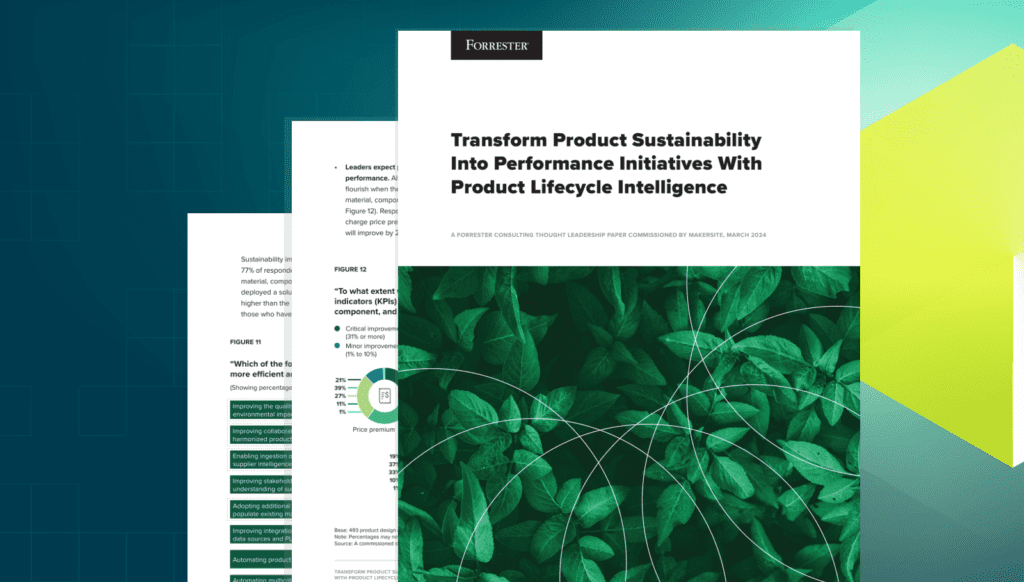
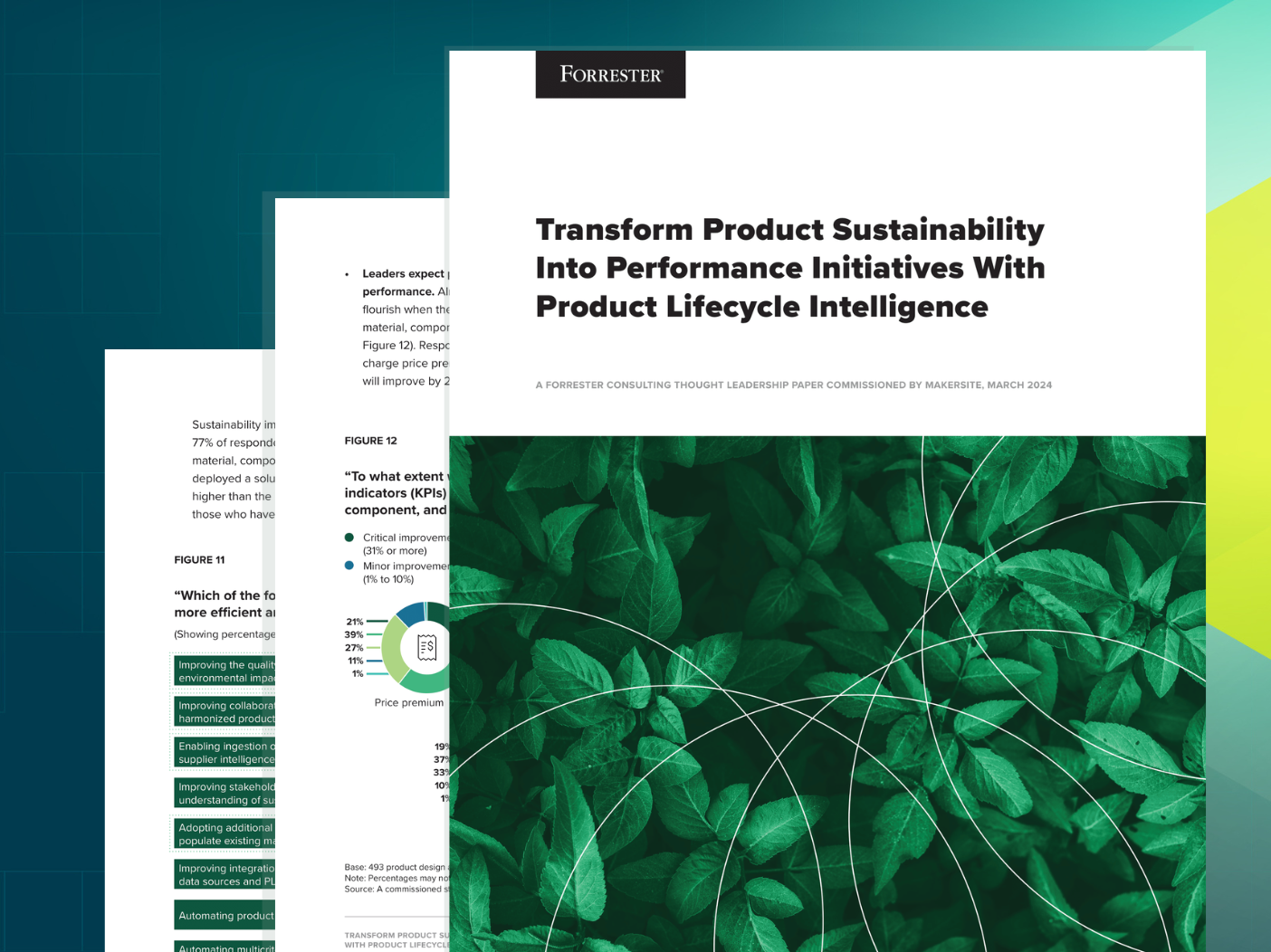
In “Transform Product Sustainability into Performance Initiatives with Product Lifecycle Intelligence”, our collaborative white paper with Forrester, we took insights from 493 product design and sourcing decision-makers in manufacturing. Our aim in commissioning the study? To redefine how businesses approach sustainability, and to map a path forward for those who are beginning to take on the challenge.
We’re diving into a series of key takeaways from the report across a number of blogs. You can already read parts 1, 2, 3 and 4, and below we’ll take a deep dive into our next takeaway: why it’s imperative that a business creates a dedicated sustainability function within the organization.
The gains that stand to be made from a more sustainable approach to product design – whether financially, reputationally or from a regulatory perspective – are already clear to more ‘Advanced’ manufacturing businesses. Whether driven by changing customer expectations, an increased emphasis on supporting a circular economy, a need for greater transparency in supply chains or a variety of other factors, the reasons for implementing a more sustainable approach to product design are numerous.
But there is a world of difference between ideas and action. Sustainability must move beyond being a mere concept or being seen as a reporting burden in order for its benefits to be fully realized. In order to do this, there is a strong need for advocates within a business. An organization with a fully functioning and proactive sustainability function is likely to reap many benefits, not least from a cost efficiency perspective.
Managing bottom lines in a tightening business environment is critical when it comes to ensuring continued growth. A dedicated sustainability function, accordingly, encourages not only collaboration but a sharing of resources – both of which save money. Businesses hampered by a more siloed approach to sustainable practices are likely to incur more costs not only through lost time and productivity, but also through a continued reliance on outdated manual processes and expensive, unnecessary equipment and resources.
Ultimately, cross-functional collaboration – combined with a single source of truth – is critical in enhancing product design, sourcing, and gaining a competitive edge. The adoption of product lifecycle intelligence drives sustainability improvements, faster time-to-market, higher profits, and operational enhancements for manufacturers.
Data quality and accessibility forms the foundation of efficient product design and sourcing and product and operations improve with the adoption of a material, component, and supplier intelligence solution.
What are organizations doing – and how can they do it better?
Our study makes this point abundantly clear. The need for such a dedicated sustainability function is obvious and well understood. As the study shows, 27% of respondents placed ‘create a dedicated sustainability function within the organization’ as their top initiative to prioritize over the next 12 months.
From design, production, to maintenance, and end of life, sustainability across the product lifecycle is becoming business-critical and time-critical for manufacturers seeking to maintain a competitive cadence of successful new product launches. Stakeholders across functions must have access to granular, product-level data to rapidly and accurately make trade-offs as they design products and source materials and components from suppliers
With a dedicated sustainability function within an organization, procurement and supply chain leaders can utilize environmental sustainability procurement technology to address the challenge of measuring the environmental impact of the supply chain. Organizations deploying procurement technology are making significant organizational changes to enable them to understand their supply chains to measure, reduce, and report their Scope 3 emissions and to honor their sustainability commitments.
However, obstacles remain. 18% of respondents to the study saw breaking down data siloes to enable cross-functional collaboration as among their biggest headaches. There is work still be done. These data siloes are the hallmark of organizations not yet ‘mature’ enough to fully realize the benefits of embracing such an approach.
The study indicates that immature enterprise manufacturers have a steep hill to climb. A typical Novice manufacturer (those with the lowest maturity on the PLM maturity model that Forrester created) find themselves hamstrung by manual processes, data and decision-making silos, a lack of collaboration, and they struggle to track and verify the sustainability credentials of their suppliers.
Regulatory compliance and sustainability are secondary considerations for Novices, with cost reductions and product improvements being of primary importance for them. Whilst understandable in the short term, this lack of forward-thinking could come back to sting them – and prevent them from growing as a business.
In contrast, Mature companies are collaborative, take sustainability seriously, and understand the importance of systematic and automated processes. Novices remain inhibited by silos and manual processes and are yet to fully grasp the strategic and competitive importance of integrating sustainability across the product lifecycle.
Stakeholders across product development, procurement, compliance, and sustainability need to collaborate closely to shorten product development cycles, reduce cost and risks in production, and lower environmental impact throughout the supply chain.
Ultimately, maturity drives agility.
How can Makersite help?
The benefits of giving sustainability a platform within an organization are particularly clear when it comes to two of our customers – Barco and Microsoft. By embracing a collaborative, ecodesign-led approach to manufacturing, both have reaped significant rewards.
At Microsoft, the team were able to efficiently scale up their LCAs so their engineers could focus on designing the best and most sustainable products instead of only focusing on disclosures. While their LCA experts are still involved in the process, they can now focus on completing the model with suppliers’ primary data, performing the quality analysis, and ensuring the model is representative.
With Makersite’s help, the benefits of their new methodology were huge. They included improved quality and representativeness of the modeling of the product’s composition, better identification of environmental impact hotspots in the supply chain, and increased accuracy by reducing the inconsistencies associated with the LCA practitioners’ decisions.
Empowered by Makersite’s AI-powered Product Lifecyle Intelligence software, lca software Microsoft were able improve the efficiency of collecting and modelling both product and supplier data, ultimately saving time and money and eliminating data siloes in a more collaborative, sustainability-led environment.
Similarly, Barco faced challenges in efficiently reporting SKU-level environmental data due to data being siloed and scattered across the supply chain, resulting in slow and costly manual efforts.
Makersite provided Barco with automated Life Cycle Analysis (LCA) and Product Environmental Footprints (PEFs) at the SKU level, allowing them to accurately offset their emissions, comply with EU taxonomy reporting requirements, and implement more targeted eco-design principles across their product portfolio.
They were able to consolidate and enrich their data, perform comprehensive environmental reporting, and make data-driven decisions to minimize their environmental impact. Automating their LCAs allows Barco to accurately offset their emissions and further promote their climate-neutral ambitions, as well as strengthen communication on sustainability with external stakeholders – all based on data.
By leveraging Makersite’s automated Life Cycle Assessments (LCAs), Barco gained insights into the environmental impact of different design choices, enabling them to perform scenario analysis and evaluate the impact of various design changes on their products. The implementation of Makersite’s software allowed Barco to bring together the various elements of their product data in one place, enabling them to identify opportunities for sustainable design changes across their product line and make data-driven decisions to minimize their environmental impact.
Makersite’s one model, multi-output approach enables users to integrate multiple data sources and easily deliver reporting and analytics to multiple teams including compliance reports, EPDs, PCFs, Scope 1,2 & 3, forecasts and should costs.
With our digital twin technology, we’re able to put the burden of data siloes to rest. We connect best-in-class data for costs, markets, risks, materials, regulations, environment, health, suppliers and more to create a “digital twin” of a product design or formulation. Tools are built-in to create reports, apps, and maps to clearly visualize the data that matter, making it easier – and significantly quicker – for all involved.
Similarly, with Makersite’s ecodesign dashboard, customers can use product data models to make smarter design, material and sourcing decisions throughout their product development process, allowing them to make better decisions based on multiple criteria whilst supporting decision-making with clear and actionable insights considering multiple criteria like carbon and cost simultaneously.
Less than 1% of new products consider sustainability in their design, but there’s no longer any need for it to be an afterthought. That’s why we make it easy for you to make better decision choices with the data you need, fostering collarboration and enabling the building of a dedicated sustainability function in your organization with ease.
“The trend of AI has been unavoidable, and seeing the proliferation of AI being used so effectively to help solve really hard problems for the good of society and the planet has been pretty eye opening.”
Recently, Makersite sat down for a wide-ranging conversation with James Norman and Dave Duncan from PTC. James is Director at their Global PLM Center of Excellence, and Dave is Vice President of Sustainability.
Makersite and PTC have a well-established relationship, but they’re also one of the most advanced and proactive organizations in the world when it comes to following through on sustainability best practices. Indeed, as their website states, “We don’t just imagine a more sustainable world—we help create it.”
Both Dave and James have fascinating backgrounds, and both took a slightly circuitous path into their sustainability careers. However, the learnings they were able to take from other positions in other industries – and in different cultures entirely – shaped the way they approach sustainability today.
Among many other topics, we discuss:
The proliferation of AI and its impact on how businesses can approach sustainable practices
Why accurate measurements – and accurate reporting – are so important
The through line between PLM and sutainability
Where the world should be by 2050
Makersite: What does sustainability mean to you?
James Norman: Most often I come back to what it means to me on a personal level – having a strong desire to do what I can to leave a world for my kids that is at least as good – if not better – ecologically, socially, and economically than the world I get to live.
Dave Duncan: Mine’s similar. It’s also pretty textbook, which is to make sure that we’re able to meet our needs without sacrificing the needs of future generations. That’s the aspiration. And it’s not just for humans, but it’s for anything that lives on the planet as well.
When it comes to ESG, the ‘S’ and the ‘G’ is just as important as the ‘E’ because even if we can have the best technology ever, if the world is angry and has strife, one, it won’t be implemented fast enough, and two, it’ll be continuously destroyed.
Makersite: When we’re talking about ESG, do you feel that from the ‘S’ and the ‘G’ perspective businesses and executives are catching up, or do you still think there’s a long way to go there before there’s kind of an equal playing all elements of ESG?
Dave: I think the ‘S’ and the ‘G’ can have more regional differences. It’s more complex from a regional perspective. And it needs to have regional flavors to deal with different cultures and priorities and politics, because, particularly ‘S’, if it’s taken too far or too fast in a given culture, then it can have a damaging backlash. It has to be balanced so that it has the effect of being seen as good progress and fair for the citizens, which can have different definitions in each area.
Makersite: In terms of the skills that you’ve acquired of your careers, what do you think helps you most in your roles?
James: For me, the one that comes to mind first is the ability to apply a systems thinking approach to problem solving and innovation. That is without a doubt one of the most useful things I got out of my academic training as an ecologist.
As everything is this space is constantly evolving, the ability to deal with ambiguity and be adaptable has been really beneficial as well. And because “sustainability” can mean different things depending on who you ask, having some interpersonal and political savvy helps a lot when trying to align stakeholders with disparate points of view around a common set of goals and actions around sustainability.
Dave: For me, my role at PTC focuses on industrial sustainability. I think what’s helped me – and I never realized this would be such a big help – but it’s all the dirty jobs I had growing up. I drove a loader up in Alaska on an oil field. I was in the military where like many junior officers, they make you the battalion maintenance officer for one of your first platoon assignments. At the time, it was like the last job that you want. You’re stuck in motor pools fixing things. But it’s an important job, and gave me a lot of hands-on intuition for my current role.
I worked on a factory assembly line for a few summers, ran a service outfit – both call center and field service – when I got out of the military. A lot of the hands on work is where the footprint’s emitted.
James and I, now we’re in industry-supporting positions where we’re suppliers of software to manufacturers who sell things to customers, and those customers have people that work for them and actually use these tools and operate them, service them and throw them away.
We might be several steps removed right now, but having some of that frontline experience in my prior roles helps with intuition about what can be effective, what sort of risks might arise and so on.
It’s important for us to still do ride alongs and do things and just have curiosity in our normal lives where we might say ‘let’s go try to repair something’ or whatever it might be. We have to continuously get down on that ground level if we’re going to design things that will make a difference.
Makersite: What motivates you to work for in your chosen field? I feel like we’ve covered most of that already, but is there anything else you’d like to add?
Dave: Just the amount of footprint that’s created from discrete manufacturing is probably low double digits contribution overall. And it’s a fairly consolidated market of vendors that drive the design of those products.
The effect that we can have as one of those consolidated providers on the vast amount of footprint causing machinery in the world is motivating.
James: We’ll talk about PLM a little bit later. But really a big focus for PTC is the concept of the Digital Thread, which at its core is really a systems thinking approach to product lifecycle management. A lot of product lifecycle management historically through today is silo by function starting in the factory and stopping at the gate.
The ability to evolve perspectives on product lifecycle management toward accounting for the entire lifecycle of a product to affect meaningful change across design, manufacturing, consumption/use, service, reuse/remanufacturing, and ultimately end-of-life is enabled by the tools PTC develops. I don’t necessarily touch the topic of sustainability directly each day, but it’s always connected to the work we do in one form or another and that’s pretty motivating.
Dave: An example of that is from the Ellen MacArthur foundation where, for circularity, you want to have modules in your products where you can take off bigger components of an end-of-life part or product, and repair it, refurbish it, reuse it, remanufacture it, and only then, if you can’t do any of those four or five things, would you shred it or melt it down to recycle. The only way you can do that is with modular design.
And there’s other reasons to do modular design as well, because you want to have product variation for your customers needs. But with modularity, you make factory and service workers jobs much more complex. Rarely do they see the same configuration twice, even on an assembly line.
And with the digital thread and the systems thinking and capabilities that we have, when you design a modular product, you have that logic so that you don’t have to burden those frontline workers with the complexity of the module design. A factory worker can receive instructions that are specific to the product that they’re looking at. So can a service technician. And with that holistic systems approach that makes circularity possible, we have a unique span across engineering, manufacturing and service.
Makersite: Talk me through your career paths. How did you come to work in a sustainability role? Is it something you’ve always pursued?
James: I’m an ecosystem ecologist by training, and I spent my early career applying that training in various scientific advisory and policy making roles, both in academia and the nonprofit world, and then as a legislative fellow for a brief stint in the United States Congress.
I’d always envisioned staying on that applied science/policy path for my professional career. But a series of serendipitous events, in particular the Great Recession, pushed me off that path. I ended up landing in an early-stage start-up called Planet Metrics, the first product carbon accounting software founded in 2007 during Cleantech 1.0. I was the second employee there and we had similar aspirations to what Makersite is doing now. It’s funny that Neil was across the pond working on a competing product that was quite similar around the same time, long before Makersite.
I knew nothing about software, but I had studied some industrial ecology as part of my academic training which, along with my ecosystem ecology background, formed the scientific underpinnings of Planet Metrics.
Helping build Planet Metrics put me on the path to working at PTC, as we were acquired by PTC in 2010 and I’ve been here ever since. While I couldn’t have predicted I have a career in software starting out as an ecologist, I’m happy I landed where I did.
Makersite: How about you, Dave?
Dave: Mine is from a while ago. I was a kid growing up between Boston and New York. The 70’s cars were kinda cool, but I hated the pollution. There were very few emission standards and the cities I was in just smelled really bad. And there were some early electric cars and solar panels, and even when I was a youngster, I thought to myself: ‘wow, why aren’t we doing more of this?’
Then it really hit home when I was in the military, based in Germany and Bosnia. A lot of the units that I was based with in Germany had to cycle into the Middle East, largely for oil security. This was before some of the larger conflicts there. But our unit across the street, where I have a lot of friends, were across from the Khobar barracks that got blown up in Saudi Arabia in the mid-nineties. It just really hit home. I thought: ‘they really are putting our lives at risk for oil and we use a lot more oil than we need to.’
I left the US in 1995. I came back in 1998. In that period of time, a few good things happened, like microbreweries, but a few bad things happened, like gas prices went down and SUVs got bigger. It upset me to the core, just watching people fill up monstrous SUVs who I don’t think really understood the blood that was shed to have oil security and just how much of a waste that was.
So that was how I got into it long before I knew about global warming. And that just added emphasis to it as far as how I got in the role at PTC. When they started the sustainability program, they were initially looking for a sustainability lead outside of PTC. And the hiring group came to the realization that it would be a lot easier to teach sustainability to someone that knows our PLM and SLM manufacturing digital markets.
Essentially, I just got lucky and I got to pursue a passion and get deeper into the field.
Makersite: How do you make your own lives more sustainable?
James: As a family, we really orient towards baking sustainability into every aspect of our lives as much as we can. I chose to pursue ecosystem ecology out of a personal desire to have a positive effect on the environment that I enjoyed in my youth, and that desire is something my whole family shares now. It informs all the choices we make about our daily actions – the cleaning products we buy or make (vinegar and lemon go a long way), how we conserve water and energy, the food we eat and grow in our garden, being scrupulous about the kinds of material goods we consume, minimizing household waste by repairing and reusing what we can and trying to recycle / donate / compost what we can’t, the car we drive or abstain from driving in favor of walking and biking.
With young kids, seeing how they are such sponges for life really keeps us motivated at every corner try to find other ways that we can be more conscious about making our lives and theirs more sustainable.
Dave: I would say as far as things that I’ve done – just coming from my initial passion of not liking oil and gas from my army experience – is electrifying everything I can. And renewing that electricity in my personal life. I Insulated the house as soon as we got our house. Since then, anytime I have an opportunity to not throw something away and to give it to somebody else so that we can all get the most out of it.
Being an early adopter of electronic tech is a big one for me. We got solar panels probably ten years ago when they were still a lot more expensive and less productive than they are now. I got one of the first Tesla Model 3’s off the line, which has still been a fantastic car, but it’s nowhere near as nice as the newer ones.
Even before that, I was the guy who would clear snow my driveway with a shovel. I raked my lawn with a rake I was the first with an electric lawn mower. I think the one internal combustion engine I had to buy in the last five years was snowblower. And that was just because I had some open chest surgery and I couldn’t shovel.
Always, top of mind for me is how do I get rid of a gas engine and how do I use renewable electrons as one of the priorities. I eat very little red meat now. I’m not full vegetarian. I still do chicken and fish, so I’d be a moderate in that respect. My children are into it as well. My son’s 21, my daughter is 14. And I’ve seen that generally with the youth, they’re very appreciative and proud of any green things that they do.
Makersite: What about something new you’ve learned in the last year?
James: The trend of AI has been unavoidable, and seeing the proliferation of AI being used so effectively to help solve really hard problems for the good of society and the planet has been pretty eye opening. It’s a topic in an area that I just hadn’t really paid a lot of attention to until about a year or two ago, particularly when Makersite first came across my radar. Seeing the ways that AI has been used for good – a lot of the research into protein folding, for example – has been inspiring and has me excited for what the future of AI holds for the field of sustainability.
Dave: I think the most promising thing that I’ve seen is the proliferation of Scope 3, Category 1 measurement. At PTC we’re always talking with companies, asking them ‘what are your priorities?’
Starting about two years ago, it went from zero to 100 miles an hour where sustainability was top one, top two or top three for everybody at the same time. And I couldn’t figure it out when I learned greenhouse gas accounting and I learned more about the different levels of emissions with each category. Scope 3, Category 1, for PTC, is over 50% of our emissions.
We’re a software company. We don’t even have physical goods or a manufacturer. For most manufacturers, over 90% from what we’ve seen, they have the downstream too, but that’s number two in their reduction commitments. Now they’re all calling their suppliers and asking them about their emissions: ‘are they bringing them down? Because we’re going to be a lot less friendly of a customer if you don’t. Everybody is getting those calls from all of their customers now.
And I think that is a good thing because now every manufacturer considers this a top line revenue priority, not just a nice thing to do. It’s because of the accounting and the disclosures and reduction commitments that need to be made on it.
Makersite: Where do you think companies are lacking still in relation to that? In their approaches to sustainability?
Dave: It’s been a top discussion in our executive rooms with customers for 24 months. It has not proliferated down to the levels of our software users fast enough. Generally the attitude is: ‘we’ve heard of sustainability, but we don’t really have marching orders on it yet.’ I think CSRD going to do a lot to drive that faster from a global perspective.
James: Ultimately you can’t impact or manage what you don’t measure. And there is nowhere near enough measurement today. It’s great that we’re starting to see more of the greenhouse gas protocol measurements starting to happen. And while carbon is a relatively good proxy for other environmental impacts, and it’s not wholly sufficient to drive the sustainable change the present moment and our future requires.
To improve their approaches to sustainability, I think companies should orient around how they will provide value to their customers in an increasingly constrained world. Companies need to be asking themselves ‘if we want to be the same company or a better company than we are now in 20 years, what do we need to do now to get things in order to drive true sustainability?’ I think that’s where I feel like it’s still lacking, and it rings a little hollow in some of the conversations I’ve been having the last couple years that focus primarily on regulations and narrowly defined shifts in consumer preferences. Not taking that more holistic and strategic view misses the opportunity for business and society to realize what sustainability can and should mean.
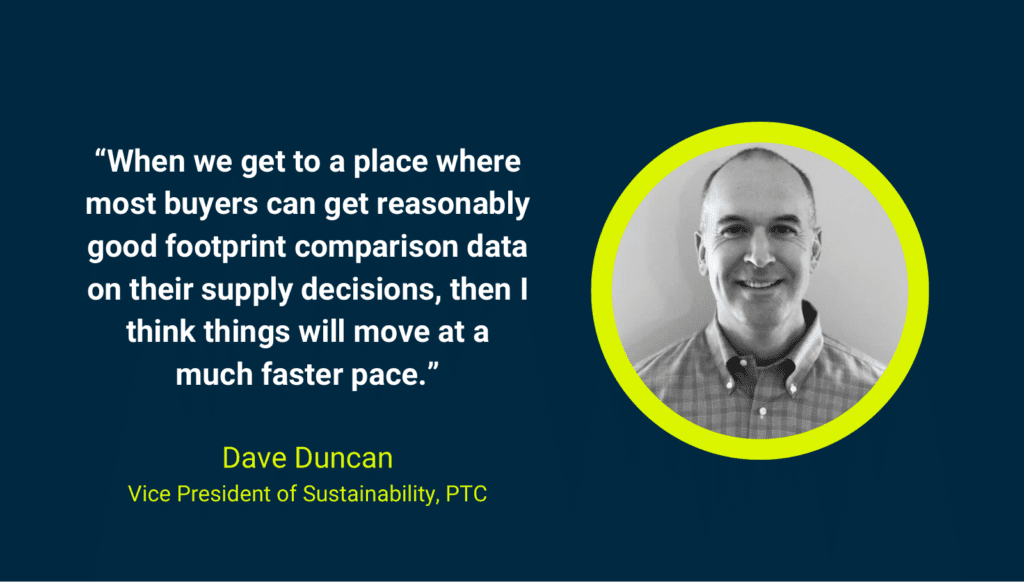
Dave: I think a lot of the work that Makersite is doing – like automating some of the calculations that LCAs were never able to do at scale manually and making that data available to buyers in a way where they can compare suppliers – that’s going to move things forward a lot.
Because today when people make decisions based off global average data or qualitative data, then there isn’t as much of an urgent top-line incentive for corporations to do things. But when we get to a place where most buyers can get reasonably good footprint comparison data on their supply decisions, then I think things will move at a much faster pace.
All businesses know where they are in cost leadership today. They have the competitive intelligence to understand what all their competitors are doing on price and cost and when they get there with footprint, that’ll be a wonderful time. I don’t think it’s that far away with a lot of things that Makersite is doing.
Makersite: In terms of legislation and regulation, is there anything we don’t have yet that you would wish to see?
James: Yes, I think I’d like to see more incentives. More carrots and perhaps less sticks. And I know that sometimes sticks are the path of least resistance and generally perceived to move the needle faster. But an interesting counter to that can be seen in the Inflation Reduction Act that passed in the US Congress almost two years ago.
When you look at what that’s done for creating a fully-fledged EV supply chain in places in the United States that had been resistant in less than 18 months, it’s incredible and it was all done through incentives, not penalties. If the legislation had been driven by penalties alone, this and many other notable projects that have broken ground since probably never would have happened.
There are still inefficiencies and it’s not a perfect piece of legislation (if such a thing exists), but it is a good example that shows if you design incentives in the right way, they can be very motivating and effective in driving change.
Dave: I think incentive based is a great way to get out of first gear into say, because then you get a critical mass of support and infrastructure moving. And once you have scaling at 1% to 2% or a superior approach, it’s going to move. But incentive-based does cost money. It’s less efficient and that won’t be lost on people and politicians will scream from the rooftops about it at some point.
Really the only efficient way to do it is with a carbon tax. But unfortunately, it’s called ‘carbon tax’.
Maybe it could be called carbon price, or somehow communicated in a way where it’s not about tax but about redistribution or properly priced pollution. That’s the only way to really generate the capital allocations that would be most efficient as well as the motivations, and would finally harmonize greenhouse gas accounting with financial accounting.
Makersite: Where do you think we’ll be in 2050, when it comes to sustainability and how we approach it? And where do you hope it will be?
Dave: My best guess and my hope is that we’ll be at Net Zero because we had some technology breakthroughs that helped us get there, in particular things like mechanical carbon capture or hydrogen.
I think the reality is we’ll be close, but unfortunately it will get close because there’ll be some really bad things that will happen and it will happen to rich people that finally move the ball. Like how much wealthy real estate is located in environmentally sensitive areas where insurers no longer provide coverage. Like Manhattan doesn’t have to have a very high sea level rise for there to be an impact.
I think the trajectory of greenhouse gas emissions and other pollutants will be largely solved. My concern is how much damage would have done before that and how quickly would we be able to unwind that damage when everything is more expensive to do?
James: I oscillate between optimism and pessimism on this topic. I do worry that a myriad of factors will prevent society from being as far as along as we need to be in 2050 to avoid the some of the worst outcomes, and that the resulting tumult will be the primary driver for the global cooperation and investment needed to advance the technology and policy breakthroughs required for a more sustainable future.
Then there are countless regional and local examples of incredible sustainability innovations in the public and private spheres that give me great hope we’re building momentum towards a more bottoms-up, proactive, and collaborative approach to sustainability that will pave the path to much more sustainable society in 2050.
In either scenario, I’m more convinced than ever that technological innovations will be at the core of the most impactful approaches to sustainability we’ll see between now and 2050. Technologies that drive sustainability are progressing so much faster than policy, and I think we’ll see that trend continue to accelerate.
Makersite: How do PLM and sustainability align, or how should they align?
James: Going back to the point about how you can’t manage what you don’t measure, you can’t measure what isn’t well defined. As the backbone of the Digital Thread, PLM is intended to deliver the right product definition at the right time in the right context to the right person. At PTC, we think about PLM as more than a singular tool or platform, but rather a suite of enterprise cross-functional tools that enable true closed loop product lifecycle management.
Managing product sustainability requires a robust understanding of the inputs and outputs at each stage of a product’s lifecycle and in the context of how that product is designed, manufactured, used, serviced, and handled at end of life. PLM provides the digital infrastructure and framework to connect all that product data in context so that cross-functional teams can drive meaningful and impactful decision about a product’s sustainability impacts. To put it simply, PLM enables sustainability to be integrated as core strand of the Digital Thread.
Dave: PLM is the ‘home system’ for design engineers. Accountants use ERP. Systems and finance folks use Bloomberg terminals. Our design engineers are in Windchill or Arena all day, every day, and they use it to aggregate data for multi criteria analysis on design decisions. And design decisions could be ‘what material should I use?’, ‘What supplier should I use? ‘How should I shape this part? ‘How should I manufacture it?’, ‘What sort of product service system would I put on this product?’, ‘Am I meeting my sustainability design requirements and how are they validating?’
It’s really the central decision making tool. And it can call out to a wealth of different data sources outside of PTC or supply chain data, material data, other data. And then it can also run subroutines of simulations, whether that’s for a streamlined LCA or for performance validation or other things.
But the promise that PLM has is it’s done multi criteria analysis on design decisions ever since it was incepted. More and more, it’s extending across the full product lifecycle, and the data that they’re able to gather in it and the simulations that they’re able to run for decision support are increasing.
Makersite: What are your frustrations with what PLM best practice is currently seen as, and how do we frame it to make it be more successful in the future? To be more adaptive to what we’re facing?
Dave: Some of the academic papers on design for sustainability say that you really don’t have to overhaul the PLM process, you just need to include sustainability as an additional criteria with performance, cost and time to market, and then everything else kind of takes care of itself.
So I don’t think that PLM needs to be radically overhauled. Rather, I think it’s a case that some of the foundations of PLM most of the market has not yet progressed to. A lot of customers just use PLM to vault their CAD designs and Word documents that inform designs. They need to get towards bill of material management, modular design, derivative bills of materials for manufacturing and service, and then the information and instructions that link to that.
Those are all foundations that have value, that had value even before sustainability was a big thing. But that sets the plate nicely to add on another dimension of criteria for footprint.
Makersite: What about you, James?
James: As Dave said, I’d like to see the expansion from engineering-centric PDM or product data management to a more comprehensive and cross-functional vision of PLM supporting the connected model-based enterprise.
Having an openness that allows collaboration and connectivity with PLM being the foundation for the Digital Thread and product digital twin is also crucial, as it allows you to go wild with microservices and APIs to different systems of engagement as well as niche tools that help you solve very targeted and specific problems. You can then bring all that data and analysis back into a centralized view where you can manage it in the right context with the right product information delivered to the right person at the right time.
We need to get to more of a federated approach with PLM as the foundation for product definition and fanning out from there. It’s about more collaboration, more connected data, a faster exchange of information, and ultimately more precise and actionable data. This is critical to making enterprise PLM and sustainability initiatives efficient and effective. It must involve more than just R&D and engineering. It necessitates more of that systems thinking and collaborative, multidisciplinary approach to developing a product referenced many times in our discussion, which in and of itself should drive us to a much better place.
All that said, technology alone will only get you so far. These evolved business and product lifecycle management strategies require disciplined and robust organizational change management to make them successful. This is something I think a lot of companies take for granted, and we’ll need a lot more focus there to drive alignment and best practices if we hope to realize the benefits at scale.
In “Transform Product Sustainability into Performance Initiatives with Product Lifecycle Intelligence”, our collaborative white paper with Forrester, we took insights from 493 product design and sourcing decision-makers in manufacturing. Our aim in commissioning the study? To redefine how businesses approach sustainability, and to map a path forward for those who are beginning to take on the challenge.
We’re diving into a series of key takeaways from the report across a number of blogs. You can already read parts 1, 2 and 3, and below we’ll take a deep dive into our next takeaway: why organizations must seek to initiate – or expand – their supplier engagement programs to meet sustainability goals.
Sustainability improvements already sit top of mind for the vast majority of manufacturing businesses. Whether driven by changing customer expectations, an increased emphasis on supporting a circular economy, a need for greater transparency in supply chains or a variety of other factors, the reasons for implementing a more sustainable approach to product design are numerous.
But ‘being sustainable’ is not simply a case of ticking regulatory boxes and filing annual reports. Taking the next logical step when it comes to your supply chain can make a world of difference. A better functioning supplier engagement program will not only help with cost efficiency – enabling you to better manage bottom lines in a tightening and ever more competitive business environment – but it will also assist with business continuity, helping you to ensure the smooth running of day-to-day operations and minimizing disruptions that would otherwise result in lost production.
Manufacturers who are quicker, smarter, and more sustainable will thrive. Those who are able to leverage better supplier intelligence will benefit from improved data visibility, which in turn will guide better design and sourcing decisions. They will enjoy time to market advantage over less mature competitors and have the opportunity to scale their scarce design and supply chain expertise over a wider range of product variants.
More advanced organizations are defined, at least in part, by the structure of their supplier engagement programs. Hallmarks of a refined system include an ability to track the ESG status of approved-for-purchase suppliers automatically using software, a fully documented, centralized onboarding process that all suppliers must follow and a defined process where the sustainability credentials data provided by suppliers is verified by a risk management or supply chain certification platform.
Without such processes in place, delays in the material supplies by the suppliers often lead to a change in plans which can have a serious knock-on effect on other areas of the operation. This is a scenario every manufacturer would like to avoid.
What are organizations doing – and what challenges are they facing?
The study results clearly highlighted an ongoing move towards the establishment and development of better supplier engagement programs, although there is still work to be done. 27% of respondents are prioritizing supplier engagement programs as a response to external impacts to their product development process, a sure sign that decision-makers in organizations realize how critical a step this is when it comes to taking action to balance sustainability, resilience, and top and bottom-line improvements.
However, there are still challenges which remain more difficult to overcome. A full 50% of survey respondents face significant obstacles when it comes to obtaining funding and budget to obtain material, component, and supplier intelligence solutions. Governance issues are a prosaic but all-too-real issue for those seeking to implement better PLM practices within their organization.
Stakeholders responsible for PLM are the strongest proponents of sustainability within their organizations, but the battle with resistance internally and an ongoing wrangle with people, process, and technology complexities can take its toll.
53% of respondents struggled with securing executive support for incorporating sustainability in product lifecycle management processes, alongside the 50% we identified above who find it hard to obtain budget to gather material, component, and supplier intelligence which is integral to optimizing their product’s quality, cost, and sustainability.
Furthermore, over half experience difficulties measuring and quantifying the environmental impact of their products which can be a factor for the lack of leadership alignment. These governance challenges are a manifestation of poor maintenance of availability, cost, sustainability, and performance data in manufacturer’s material and component libraries – an issue for 49% of decision-makers.
Respondents find themselves in a scenario that underscores a critical juncture for decision-makers in product design and sourcing, one that urges a radical shift towards integrated, sustainable practices that meet the demands of a dynamic global market. The battle against overzealous governance practices is one well worth fighting.
How can Makersite help?
The differences between Advanced and Novice organizations when it comes to supplier engagement programs are stark. Where Novices struggle to track and verify the sustainability credentials of their suppliers, Advanced firms embrace more sustainable supply chains as a differentiator. We have seen that in practice with our own customers.
Let’s take Schaeffler as an example. They want to achieve a carbon-neutral supply chain by 2040, but in order to do that, they need to reduce the carbon footprint of their raw materials by 25% by 2030. However, 90% of the raw materials used to make their electric motors are sourced from China with little-to-no deep-tier insight into emissions.
Makersite optimized Schaeffler’s supply chain by detailing alternative sourcing options to China, from Australia to Canada to Norway. In a very short timeframe, we were able to implement new supply chains for neodymium, disposium and electricity. In doing so, we were able to significantly lower Schaeffler’s carbon footprint, particularly due to a better electricity carbon footprint in Norway.
Consequently, they were able to test whether their new, optimized supply chain was greener and more sustainable than their existing model, and with Makersite’s help they were able to confirm their hypothesis, giving them confidence that the changes they were implementing would result in a demonstrable improvement. In the simplest of terms, we helped them to move from theory to practice.
Their supply chain was greener, more secure, less prone to disruption and ensured – as well as enhanced – business continuity going forward.
Additionally, in our work with Microsoft, we helped them to use LCA to identify where primary data is needed to drive and understand improvements, which in turn influenced how they work with technology and their suppliers – even at tier 3 or 4 – to collect that data and implement changes.
As Microsoft’s Ecodesign Program Manager Xavier Vital has said: “Makersite includes an AI that was trained to read the bill of material and composition of our products and associate manufacturing processes. By not spending all this time on modelling, we were able to spend the time on getting data from suppliers.”
“Makersite’s AI helped us improve the efficiency of the process and save a lot of time, meaning that we could use this data not only for ecodesign improvement, but for supply chain improvement. Without AI we would clearly not be able to do it with this level of detail today.”
With our AI capable of the enrichment and intelligent mapping of both internal and external data sources and a data foundation that comprises the largest product and supply chain database with 36,000+ industrial processes, 600,000+ environmental impacts, and 100,000+ materials, and their physical properties, all in one system, Makersite is primed to not only solve but to evolve the nature of supplier engagement programs.
So how can change be enacted? By empowering and enabling the right people. Product engineers want to create great, well-functioning products that have a low environmental impact. But they have historically lacked the required tools and support from the organisations they work for.
To achieve the sustainability goals businesses, consumers and regulators have put before us, the focus should be on making it better rather than making it faster. But to do that, the negative environmental impacts from the design and production process have to be removed.
The solution? New machinery. A tool that enables engineers to see the impact of material choices during the design phase of a product – a phase where, currently, some 80 per cent of the ecological impact of a product happens. A tool that enables speed, experience, performance and costs to be optimised and environmental impact to be removed. A tool that enables faster, smarter, greener decisions powered by the deepest understanding of your supply chain. A tool 50 times faster than traditional methods. That tool is a new piece of software – Product Lifecycle Intelligence, or PLI for short.
Product design led by an informed consideration of materials and the environmental footprint of our choices is a logical progression. This places the engineer in the spotlight. They not only understand the intricacies of design and manufacturing but also the broader ecological and socio-economic context in which they operate. However, there are challenges to overcome.
With projections indicating that the sustainability market could be worth $2 billion by 2030, there’s an evident rush among companies to gather necessary ESG and sustainability data and to meet regulatory benchmarks. But this often leads to a short-sightedness, with a disproportionate focus on reporting and little tangible improvement in actual practices.
We find ourselves at a moment where sustainability has crossed the chasm from afterthought to imperative. But in five years’ time, reporting will mean very little if no actual action is taken. Product development teams will be measured and held accountable for the changes they are able to systematically implement to drive the transition to a sustainable economy. To succeed, there needs to be a way to power this transformation at scale.
As it stands, the current machinery for product design is inherently rigid and not fit for purpose. Siloed data systems, an array of disconnected experts, a reliance on legacy systems, slow information exchange and a lack of proper strategy or understanding at board and executive level all result in poor product choices where the negative cost and supply chain impacts are not understood until it’s too late.
Far from facilitating rapid innovation, this situation inhibits inter-departmental collaboration and access to critical, real-time data – ultimately hindering informed decision-making.
However, we are standing on the edge of something new. Companies that embrace this new approach to product development will have a significant advantage over others. Adaptability is essential. The future belongs to an ecosystem of integrated systems that allow a seamless flow of data and an outcome where all relevant information is gathered in one place, informing decisions and enabling rapid course corrections.
If we present engineers with the data they need, they will use it – and use it well. No one wants to make a “bad” product, but “good” products can only be made with the right decisions informed by the right data. That is what will make the difference.
By placing engineers and product developers at the core of a data-centric approach, organisations can ensure that the products they design not only meet market demands but are also firmly anchored in sustainability. Combined with AI, a harmonised approach to data will provide full visibility into the manufacturing process, materials and supply chain during the design phase, enabling speed, experience, performance and costs to be optimised and negative environmental impacts to be limited.
But the product engineer cannot operate in isolation. Their perspective must be comprehensive, encompassing environmental, socio-economic and commercial considerations. To succeed in this mission, teams – from procurement and sustainability to supply chain management – must align.
Emerging platforms will play a pivotal role here. New solutions like PLI act as bridges that span knowledge gaps, fostering a culture of collaborative innovation and allowing easy access for all. PLI is a tool that not only helps the business to adhere to its core principles, but ensures visibility and transparency at every step, leading to better design choices and the creation of products that will stand the test of time.
Organisations need to rally their diverse teams – be they procurement, sustainability, engineering, or IT – under a shared, compelling vision, bringing about a dynamic ecosystem that is agile, adaptable and geared toward ethical, criteria-driven innovation.
The market is ready and waiting for a better approach. Some may argue that this is wishful thinking or is not worth the effort. However, a Bain & Company study found that, while only 40 per cent of businesses are on track to meet their sustainability goals, companies have an increasingly conscious and proactive base of consumers willing to pay 11 per cent more for sustainable products and employees that will help.
It’s not just blue-sky thinking for a greener future either. The most significant driver for companies to do anything has always been growing revenue. A 2022 report, the Sustainable Market Share Index by NYU Stern’s Center for Sustainable Business, examined what actually happened in the past decade. It found that the share of CPG products marketed as sustainable grew twice as fast as conventional products and accounted for one-third of the total revenue growth in the industry. Customers paid 27 per cent more for those products.
With a massive demographic shift bringing more environmentally conscious buyers into the market already well underway, the time never has been better to build better products.
Makersite is proud to announce the launch of our co-authored study with Forrester, titled “Transform Product Sustainability into Performance Initiatives with Product Lifecycle Intelligence”. Not only is it a pivotal moment in Makersite’s journey and growth as a company, but it is also a confirmation of our vision and a validation of the underlying goals and objectives that serve as the foundation on which our software has been built.
Make it better, not make it faster
As a society, we have reached a critical turning point. More and more companies are producing high-profile, single-use products which, in turn, has created a new normal – a continuing acceptance that increased consumption and rapid wastage is fine. And that doesn’t even consider the fact that some 80% of the ecological impact of a product happens in the design phase alone.
We exist in a place and a time where “take, make and waste” has become the norm. But there is a different future, one based around “make it better” rather than “make it faster.”
In order to make that vision a reality, however, we have to give those leading the charge the right platform to succeed. That is the purpose of Makersite. I see a future where those people who make and manufacture products – our product engineers and product designers – drive strategic transformation underpinned by a shared, compelling vision, financial support based on more than just commercial imperatives, and a dynamic ecosystem that is agile, efficient and geared toward ethical, criteria-driven innovation.
The power of data
Empowered with the right tools and best practices to make better products faster, engineers can provide the solutions needed to collaborate and take the actions that will make a difference. Products can be more sustainable, more efficient and more cost-effective while still making money and ensuring a profitable, healthy business. However, we must give them a foundation to work from first.
If we present engineers with the data they need, they will use it – and use it well. No one wants to make a ‘bad’ product, but ‘good’ products can only be made with the right decisions informed by the right data.
Some may argue that this is wishful thinking or is not worth the effort. However, a Bain & Company study found that while only 40% of businesses are on track to meet their sustainability goals, companies have an increasingly conscious and proactive base of consumers willing to pay 11% more for sustainable products and employees that will help.
A recent IBM report also noted that organizations that embed sustainability in their product design processes experience a 16% higher rate of revenue growth. They’re 52% more likely to outperform their peers on profitability. And they’re two times more likely to attribute great improvement in operating costs to sustainability efforts.
It’s not just blue-sky thinking for a greener future either. The most significant driver for companies to do anything has always been growing revenue. A 2022 report – the Sustainable Market Share Index – by NYU Stern’s Center for Sustainable Business examined what actually happened in the last decade and found that the share of CPG products marketed as being sustainable grew twice as fast as conventional products and accounted for one-third of the total revenue growth in the industry. Customers paid 27% more for those products.
Now is the time
With a massive demographic shift bringing more environmentally conscious buyers into the market already well underway, the time never has been better to build better products. This is what our study with Forrester reiterates. We have seen it and we have talked about it and we have translated ideas into actions with some of our biggest customers – Microsoft, Barco, Cummins, Schaeffler. It is fantastic to see that validated here.
We are amidst an unprecedented revolution that is changing not just the products we make, but how we make them. Companies that are set up for rapid change are becoming the new leaders of tomorrow and we’re already witnessing this evolution. Unfortunately, companies have only a piece of the data needed to make decisions quickly – the internal view. Most of the data needed comes from the world outside – supply chains, costs, regulations, impacts and others. This is the external view. The ability to combine the two instantaneously to drive better decisions and tradeoffs will avoid costly mistakes, shorten time-to-market and create more sustainable and successful products.
Study findings
The study, which includes insights from 493 respondents with product design and sourcing decision-makers in manufacturing, found that the surge in customer expectations alongside stringent regulations is pushing leaders to revolutionize their approaches to product lifecycle management and supply chain operations.
These leaders are increasingly championing sustainability within their organizations. However, they face significant hurdles; they’re often without the backing of upper management to enact meaningful strategic transformation, and they lack the necessary tools to provide access to precise, detailed data on materials, components and suppliers. This scenario underscores a critical juncture for decision-makers in product design and sourcing, urging a radical shift towards integrated, sustainable practices that meet the demands of a dynamic global market.
Ultimately, the study offers compelling evidence for the hypothesis that we have long been promoting as a company: that harmonized access to a breadth of reliable data forms the foundation of efficient product design and sourcing, and that organizations that are able to leverage granular product lifecycle intelligence in product development will enjoy competitive advantage against their peers with a faster time to market and more successful and profitable products.
There is plenty more to uncover in the study itself – from a wealth of new data to in-depth insight on the importance of data quality to a selection of actionable key takeaways that organizations can apply to their own business operations. Take your time to read our findings in full here.
Every hero needs a villain. It’s a narrative as old as time. And our story is no different.
In my previous article, I outlined our “take, make, waste” culture and the figureheads—our villains—who fuel it. I also spoke about how our future will be defined by collaboration, not individualism, where it’s still possible to be profitable, but success is not just measured by money or the value of shares.
We have irrevocably damaged our planet; however, there’s still time to reclaim our world and retool it for a better future. History has repeatedly shown us that by working together, we can achieve more than we ever could by working alone.
Lessons from the moon landing
July 1969 was a big month—as in “one giant leap” big. It was the month we went to the moon. Walter Cronkite described it as the “greatest adventure in which man has ever embarked.” It might have been more than half a century ago, but there’s still a lot we can learn from the Apollo 11 lunar landing.
While it exhibits the miracles of science and engineering and the drive and commitment of NASA, it also teaches us about teamwork, leadership and the importance of new ideas. About the importance of working together for a greater goal, of giving our engineers and innovators the support to succeed in their aims.
It takes a village. We’ve all heard that before. But in the case of the Apollo 11 landings, it was a very big village. Spanning government, private industry, astronauts and the American public—estimates have put the entire Apollo team at around 300,000 people. From planning to building to launch, millions of components were involved. Success was only possible because there was a collective realization and understanding that everyone involved had a duty to solve the problems and challenges they faced—and they knew they could only do that by working together.
Today—when it comes to fixing our planet and ending our culture of waste—the same thinking must apply.
Grand achievements aren’t built on the shoulders of a single person or by an unrelenting drive for profit. They’re built on encouragement of ingenuity and creativity, outstanding levels of commitment and an understanding that mistakes aren’t problems but lessons to learn from. After all, the great success of Apollo 11 was made possible in large part by the tragic failure of Apollo 1.
What engineers need today
So, how do we prevent our own “tragic failure” from happening? This is where our hero comes into the story. Research shows that approximately 80% of a product’s environmental impact is determined during the design phase. Empowered with the right tools and best practices to make better products faster, engineers can provide the solutions needed to collaborate and take the actions that will make a difference. Products can be more sustainable, more efficient and more cost-effective while still making money and ensuring a profitable, healthy business. However, we must give engineers a foundation to work from first.
“Build it and they will come.” Shoeless Joe Jackson might have been talking about a baseball field rather than product engineers, but the message resonates here. If we present engineers with the data they need, they will use it – and use it well. No one wants to make a ‘bad’ product, but ‘good’ products can only be made with the the right decisions informed by the right data. That is what will make the difference. Not so much “build it and they will come”, but rather “give them what they need and let them build it.”
With data and a goal, the engineer can fly. But the benefits don’t stop there. The market is ready and waiting for a better approach. Some may argue that this is wishful thinking or is not worth the effort. However, a Bain & Company study found that while only 40% of businesses are on track to meet their sustainability goals, companies have an increasingly conscious and proactive base of consumers willing to pay 11% more for sustainable products and employees that will help.
A recent IBM report also noted that organizations that embed sustainability in their product design processes experience a 16% higher rate of revenue growth. They’re 52% more likely to outperform their peers on profitability. And they’re two times more likely to attribute great improvement in operating costs to sustainability efforts.
It’s not just blue-sky thinking for a greener future either. The most significant driver for companies to do anything has always been growing revenue. A 2022 report – the Sustainable Market Share Index – by NYU Stern’s Center for Sustainable Business examined what actually happened in the last decade and found that the share of CPG products marketed as being sustainable grew twice as fast as conventional products and accounted for one-third of the total revenue growth in the industry. Customers paid 27% more for those products.
With a massive demographic shift bringing more environmentally conscious buyers into the market already well underway, the time never has been better to build better products.
Accordingly, there must be a stronger push for change. We are not there yet, but there are green shoots rising from the soil. Early adopters and innovators striving to make a difference. Schneider. Siemens. Estée Lauder. IKEA. Companies like these understand what’s at stake. They might remain the early majority, but they show us we are not hopeless.
The old tools and processes were defined by siloed data systems and slow information exchange. Now, we find ourselves in a new era defined by real-time data that facilitates inter-departmental visibility and collaboration, in turn leading to more informed—and more sustainable—decision-making.
We are shifting from “make it faster” to “make it better”, where product design is led by an informed consideration of materials and the environmental footprint of our choices. Now, more than ever, the spotlight turns to the engineer who not only understands the intricacies of design and manufacturing but also the broader ecological and socioeconomic context.
As the American engineer and educator James Kip Finch is credited with saying: “The engineer has been, and is, a maker of history.” With the right support and technology, and in a world where the balance between money and purpose is equal, the future is theirs to define.
A version of this article appeared on Forbes.com. You can also read the first part in the series here.
You are currently viewing a placeholder content from Hubspot Embedded Content. To access the actual content, click the button below. Please note that doing so will share data with third-party providers.
You are currently viewing a placeholder content from Hubspot Meetings. To access the actual content, click the button below. Please note that doing so will share data with third-party providers.
You are currently viewing a placeholder content from Intercom. To access the actual content, click the button below. Please note that doing so will share data with third-party providers.
You are currently viewing a placeholder content from Wistia. To access the actual content, click the button below. Please note that doing so will share data with third-party providers.